Soil health is the capacity of your soil to function as a living system: cycling nutrients, absorbing water, resisting erosion and supporting crops, pasture and livestock year after year. Every other regenerative practice, from grazing to agroforestry, rests on it. This guide covers what soil health is, how to measure it, the practices that build it, and a first-year plan you can start this season.
Quick answer: Soil health means soil that works as a living ecosystem. You build it by keeping the ground covered, disturbing it less, growing living roots as much of the year as possible, increasing plant and animal diversity, and returning organic matter. Measure it with a baseline set of tests (soil test, slake test, infiltration, earthworm counts) and retest on the same schedule. Expect visible changes in structure and water infiltration in 1 to 3 years, and slower gains in organic matter over a decade or more.
What soil health actually means
Soil is not just a medium that holds up plants and delivers fertilizer. It is a community of billions of organisms per teaspoon, a mineral and organic structure full of pores, and a chemical bank account all at once. Healthy soil does its jobs well: it infiltrates and stores water, cycles nutrients, suppresses some diseases, buffers against drought and flood, and grows productive crops with fewer purchased inputs.
USDA NRCS frames soil health around four management principles: keep soil covered, minimize disturbance, maximize biodiversity, and maintain living roots. We will return to those throughout. If you want a shorter primer on the concept itself, our upcoming explainer what is soil health will go deeper on definitions and indicators.
The three dimensions: physical, chemical and biological
It helps to think of soil health in three overlapping parts. A problem in one usually shows up in the others.
Physical health
Physical health is about structure: how particles clump into aggregates, how much pore space exists, and how easily air, water and roots move through. Signs of good physical health include a crumbly texture, rapid infiltration, little crusting, and roots that grow deep rather than turning sideways at a hard layer. Compaction, tillage-induced crusting and erosion are the main enemies. If you suspect a hardpan, see our guide to fixing compacted soil without heavy tillage.
Chemical health
Chemical health covers pH, nutrient levels, cation exchange capacity (CEC), salinity and the absence of problem contaminants. Chemistry still matters in a regenerative system. A soil at pH 5.0 will limit even the best biology for most crops, and a severe phosphorus deficiency will not be solved by cover crops alone. The goal is not to ignore the numbers but to read them alongside biology and structure.
Biological health
Biological health is the living component: bacteria, fungi, protozoa, nematodes, arthropods and earthworms, plus the roots they work with. This is where most of the nutrient cycling happens, and where practices like cover cropping and reduced tillage pay off first. Biological activity is harder to measure than chemistry, but it is increasingly testable, as we cover below.
The soil food web in plain terms
The soil food web is the network of organisms that feed on plant residues, each other and root exudates. Plants fix carbon through photosynthesis and release a portion of it through their roots as sugars and other compounds. Microbes feed on those exudates and, in return, release nutrients in forms plants can take up.
- Bacteria decompose easy residues, build some aggregates with sticky secretions and cycle nitrogen.
- Fungi break down tougher residues and weave soil particles together with fine threads. Mycorrhizal fungi extend root reach, especially for phosphorus. See our guide to mycorrhizal fungi.
- Protozoa and nematodes graze on bacteria and fungi, releasing nitrogen right where roots can use it.
- Arthropods and earthworms shred residues, mix soil and create channels and stable casts.
You do not manage each group individually. You manage the habitat: food (residues and root exudates), shelter (cover and minimal disturbance) and a stable environment (moisture and temperature moderated by living cover). For a deeper look at the microbial layer, see our planned guide to the soil microbiome.
Organic matter, aggregates and infiltration
These three connect in a chain that explains most of what farmers notice in the field.
Organic matter is the carbon-rich material from decomposing plants, animals and microbes. Most mineral agricultural soils sit somewhere in a broad range of roughly 1 to 6 percent, with the humid South and arid West often at the low end and prairie-derived soils higher. Organic matter feeds the food web, holds nutrients and improves water holding.
Aggregates are the crumbs formed when mineral particles, organic matter, fungal threads and microbial glues bind together. Stable aggregates resist falling apart in rain. They create the pore network that lets water and air move.
Infiltration is how fast water enters the soil surface. When aggregates are stable and the surface is covered, rain soaks in instead of running off. Better infiltration means less erosion, more stored water for dry spells, and fewer ponded patches that delay field work.
Building organic matter is a slow process, and honest expectations matter. Changes of a tenth of a percent per year are often considered good progress, and results vary with climate, soil texture and management. For realistic timelines and methods, read how to increase soil organic matter and how long it takes. Structure and infiltration usually improve faster than total organic matter does.
How to measure soil health
You cannot manage what you do not measure, and soil changes slowly enough that memory is unreliable. Set a baseline in the first season, then repeat each year at the same time and, where possible, the same spots. Combine lab tests with simple field tests.
| Test | What it tells you | Typical cost / effort | When |
|---|---|---|---|
| Standard soil test | pH, nutrients, CEC, organic matter | Low lab fee; widely available through extension and private labs | Every 1 to 3 years |
| Biological tests (Haney, PLFA, respiration) | Microbial activity, active carbon, nutrient release potential | Moderate lab fee; interpretation varies by lab | Annually, same season |
| Slake test | Aggregate stability | Nearly free; 10 minutes | Several times a year |
| Infiltration ring test | Water entry rate | Free to low; a ring and a stopwatch | Annually, similar moisture |
| Earthworm count | Biological activity and habitat quality | Free; a shovel and 15 minutes | Spring or fall when soil is moist |
| Visual assessment (shovel test) | Structure, roots, color, smell, compaction | Free | Anytime; document with photos |
Lab tests
A standard test gives you the chemistry baseline. Biological add-ons such as the Haney test, phospholipid fatty acid (PLFA) analysis or CO2 respiration give clues about microbial activity, though results are best used for tracking change over time rather than as absolute grades. Different labs use different methods, so stick with one lab for comparisons. Our guide to soil testing for regenerative farmers compares standard, Haney and biological approaches and how to read the results.
Field tests you can do this afternoon
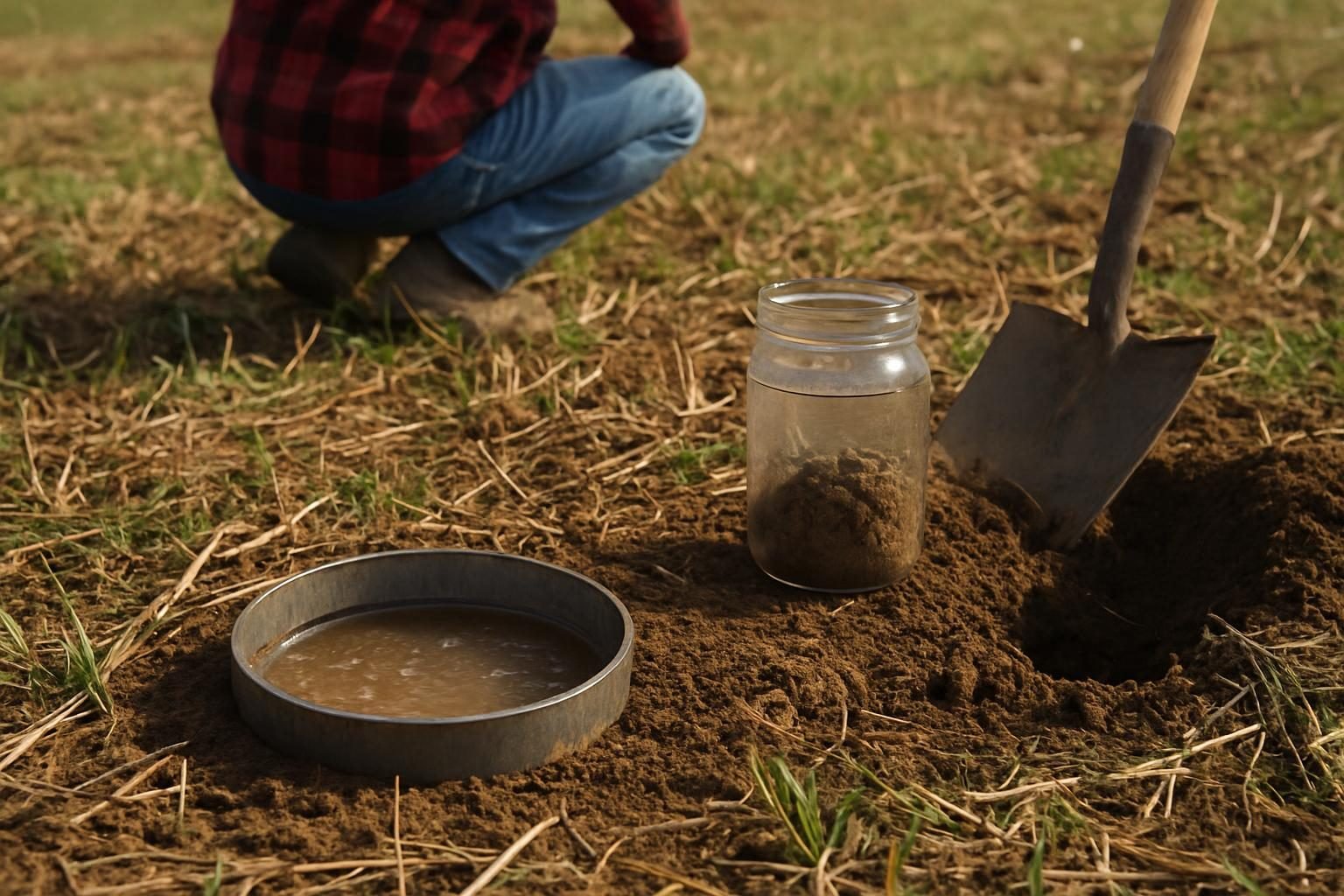
- Slake test: Drop a dry, pea-to-marble-sized clod into a clear jar of water and watch it for several minutes. Aggregates that hold together are stable; ones that collapse into mud or cloud the water are not. Compare soil from a cropped field, a pasture and an undisturbed fencerow.
- Infiltration test: Push a ring (a section of 6-inch pipe or a cut-open can works) a couple of inches into the ground, fill it with a measured amount of water and time how long it drains. Do a second fill, since the first wets the soil and the second is more representative. Compare results across fields and years.
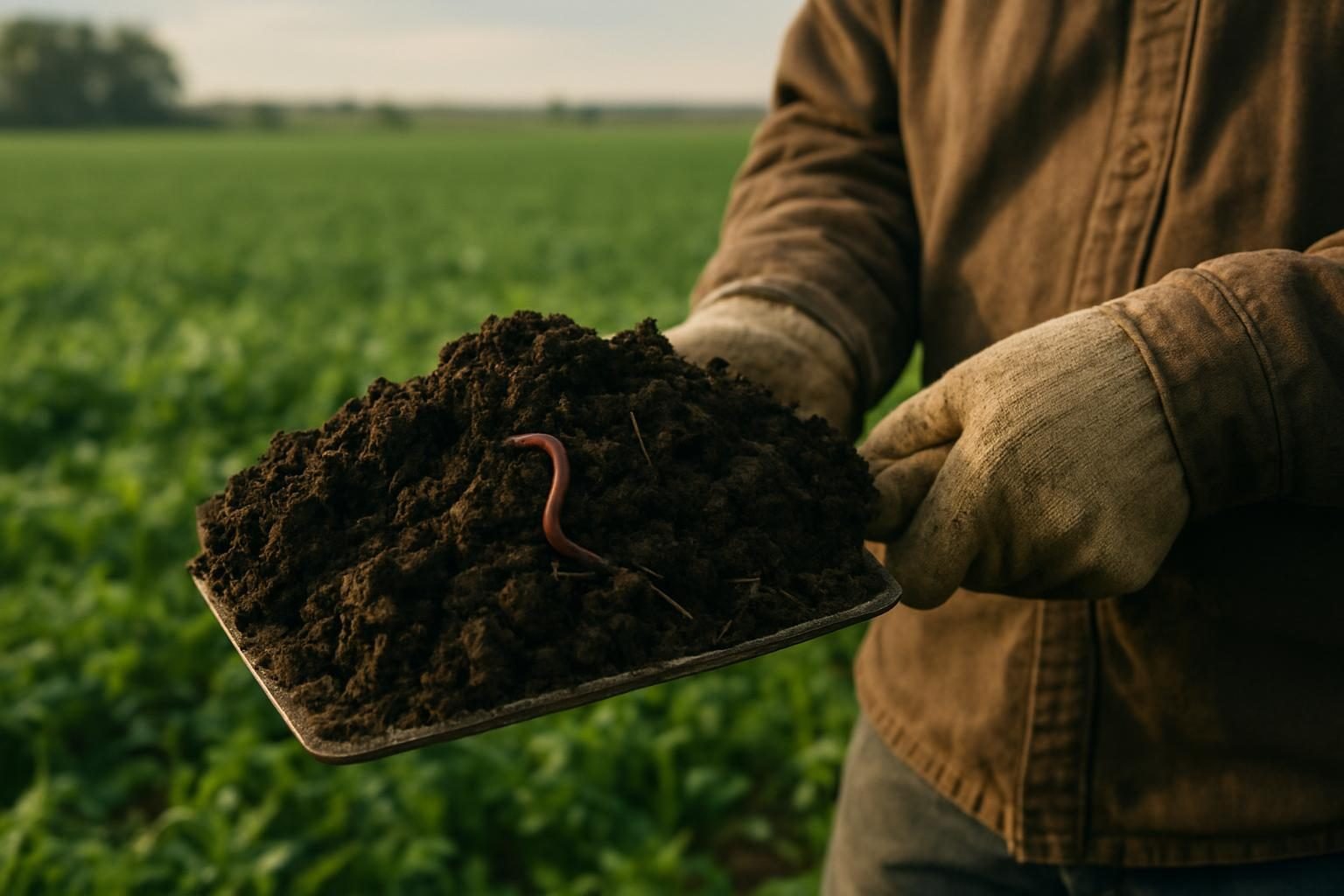
- Earthworm count: Dig a cubic-foot hole in moist soil, sort through the soil on a tarp and count the worms. Counts vary widely by region and season, but a handful of worms per cubic foot is commonly cited as a sign of activity, and many more in well-managed soils. Track your own trend rather than chasing a universal number.
- Shovel test: Pull a clean spadeful and look at roots, structure, color, smell and any layers where roots bend sideways.
Keep a simple log with dates, locations, weather and photos. The pattern across years is more valuable than any single number.
The five core practices that build soil health
Nearly every regenerative soil program is some mix of five practices. You do not have to adopt all of them at once, and the right order depends on your operation and region.
1. Cover crops
Cover crops keep the soil armored and feed the food web with living roots during times when the field would otherwise be bare. They suppress weeds, scavenge nutrients, protect against erosion and, with legumes, supply some nitrogen. Species choice depends on your goal: grasses and brassicas for biomass and compaction relief, legumes for nitrogen, mixes for general function. Start small and simple. Our cover crops for beginners guide walks through choosing, planting and terminating, and best cover crop mixes compares blends for soil health, grazing and weed control. For row-crop growers short on windows, interseeding into standing corn and soybeans extends the growing season of cover. If you are on heavy ground, our planned guide to best cover crops for clay soil will help.
2. Reduced tillage or no-till
Tillage breaks up aggregates, exposes organic matter to rapid oxidation, damages fungal networks and leaves the surface open to erosion. Reducing tillage, from full inversion to strip-till or true no-till, protects structure and moisture. The trade-offs are real: no-till can mean colder, wetter springs in northern fields, a learning curve with planting equipment, and a different weed management strategy. Read our no-till farming guide to pros, cons and how to make the switch. If you want to terminate cover crops without herbicide, a roller crimper is one option worth understanding.
3. Compost and organic amendments
Finished compost adds stable organic matter, a diverse set of microbes and nutrients. It is especially valuable on small acreages, market gardens and degraded ground where cover crops alone are slow. Quality matters: a well-made, mature compost behaves very differently from fresh manure or immature material. Applications vary widely, from a quarter inch to a few tons per acre depending on scale and goals, so follow local extension guidance and your soil test. For liquid products, see our evidence review, compost tea and biological amendments: do they work? Biochar is another amendment with specific uses and limits, covered in our planned guide to biochar.
4. Diverse rotations
Rotating crop families breaks pest and disease cycles, spreads root depths and residue types, and feeds a broader range of microbes. Adding a small grain, a forage or a perennial phase can change the whole system. In vegetable systems, rotating among families (brassicas, alliums, nightshades, legumes, grasses) accomplishes much the same. Where a full rotation is impractical, mixed cover crops between cash crops add diversity cheaply. Sometimes a short-season cover is treated as green manure and turned in to feed the next crop.
5. Livestock integration
Well-managed grazing animals stimulate plant growth, cycle nutrients through dung and urine, and can graze cover crops and crop residues that would otherwise sit unused. The key phrase is well-managed: continuous overgrazing degrades soil faster than almost anything else. Short grazing periods with long recovery are the foundation of rotational grazing, and stacking species can improve utilization, as in multi-species grazing. Winter feed costs often drop when you stockpile forage. Even small operations can capture the benefit; backyard chickens and pastured pigs can work as compost makers and soil renovators when stocking and movement are managed well.
Regional differences that change the plan
- Humid East and Southeast: Fast decomposition and warm, wet conditions burn organic matter quickly, so continuous cover and high residue matter most. Erosion from heavy rain is a major concern. Cover crop windows are long, but so is weed pressure.
- Corn Belt: Soils often start higher in organic matter. The short window after corn and soybean harvest makes establishment the main challenge, which is why interseeding and early-maturing crops are popular. Cold, wet springs can slow no-till warm-up.
- Great Plains and arid West: Water is the limiting factor. Residue cover that reduces evaporation is valuable, but cover crops can use water the cash crop needs, so termination timing and species choice require care. Irrigation and salinity management matter in many western systems.
- South: High heat accelerates breakdown and favors warm-season covers such as cowpeas and sorghum-sudan. Sandy coastal soils respond strongly to organic inputs but also leach quickly.
Your local NRCS office, Cooperative Extension and conservation district can tell you which species and dates have worked locally.
Water, drainage and landscape
Soil health and water management are tied together. Better infiltration reduces runoff, but some sites also need landscape-scale help. Poorly drained ground may need attention to structure and rooting depth first; see our planned guide to how to improve soil drainage. On sloping ground, earthworks can slow and spread water, though they are not right everywhere; read when swales work and when they do not before digging. Perennial plantings like hedgerows and trees, covered in our upcoming agroforestry guide, add deep roots, habitat and wind protection, and can anchor edges of fields.
A practical first-year plan
Do not try to change everything at once. Pick one or two fields or beds as your learning ground and expand from what works.
- Season 0 (now): Observe and baseline. Dig holes in each field. Do slake, infiltration and earthworm tests. Send samples for a standard test and, if budget allows, a biological test. Photograph everything. Note compaction layers, bare patches, erosion channels and where water pools.
- Set one or two goals. Examples: raise infiltration, cut erosion on a slope, reduce purchased fertilizer by a set amount, extend grazing days. Goals shape practice choices and help you decide what to measure.
- Fix the obvious limits first. Correct severe pH or nutrient deficiencies based on your soil test and local recommendations. Address compaction or drainage problems that would otherwise undermine everything else.
- Add a cover crop to one field. Choose a simple mix suited to your region and cash crop timing. Plant early enough to establish, and plan termination before you seed.
- Reduce disturbance where you can. That might mean one fewer tillage pass, strip-till in place of full tillage, or trying no-till on a small trial strip. Keep an untreated comparison strip.
- Return organic matter. Apply compost where it makes economic sense, keep residues on the surface and, if you have livestock, plan grazing on covers or residues with adequate rest.
- Retest at the same time next year. Repeat field tests in the same spots and under similar moisture. Compare photos and notes. Adjust one thing at a time so you can tell what worked.
Expect that some trials will underperform. Seed costs, equipment access, weather and labor all shape results, and the first year is as much about learning your farm as improving it. Soil health investments are most sustainable when they pay in lower input costs, better yields or lower risk, so keep records. If you are exploring cost-share, programs from USDA NRCS and state agencies have supported cover crops and conservation practices; confirm current availability, payment rates and eligibility with your local office, and see our regenerative farming business guide for funding and market context. Smaller growers can follow along with our planned small scale regenerative farming guide.
Common mistakes to avoid
- Skipping a baseline, then having no way to show progress.
- Expecting rapid organic matter gains and abandoning the system too soon.
- Planting covers too late or without a plan to terminate them.
- Going fully no-till on compacted ground without addressing the cause of compaction.
- Buying biological products before fixing basics like pH, drainage and cover.
- Changing too many variables at once and learning nothing.
Where soil health fits in the bigger picture
Soil health is the foundation of regenerative agriculture, not the whole structure. If you are new to the broader framework, start with what regenerative agriculture is and how to start, and see how it relates to other approaches in permaculture vs regenerative agriculture. Soil carbon and farm contributions to climate goals are covered, with appropriate caution about what is and is not well established, in regenerative agriculture and climate change. You can browse everything in this topic through the Soil Health category.
Key takeaways
- Soil health is physical, chemical and biological function working together, not a single number.
- Four principles guide most decisions: keep soil covered, disturb it less, keep living roots in the ground, and increase diversity.
- Set a baseline with a lab test plus slake, infiltration and earthworm tests, then repeat annually.
- Structure and infiltration often improve within a few years; organic matter takes much longer.
- Start with one or two fields, change one thing at a time, and keep an untreated comparison.
- Local conditions decide the details, so lean on NRCS, Extension and neighbors who farm similar soil.
Frequently asked questions
How long does it take to improve soil health?
It depends on the indicator. Surface cover, earthworm activity and aggregate stability can show improvement within one to three growing seasons. Infiltration often follows. Total soil organic matter changes slowly, often a tenth of a percent or less per year under good management, and can take a decade or more to move meaningfully. Climate, soil texture and starting condition all matter.
What is the single best practice for building soil health?
There is no single best practice, but if you must start somewhere, keeping the soil covered with living plants or residue for as much of the year as possible delivers broad benefits. For most farms that means cover crops, reduced tillage or both. The best first step is the one that fits your equipment, labor and cash flow and that you can actually carry out well.
Do I need expensive biological tests to know if my soil is healthy?
No. A standard soil test plus free field tests (slake, infiltration, earthworm counts and a shovel inspection) give you a useful picture. Biological lab tests can add information, but interpretation varies between labs and methods. Use them to track your own trend over time rather than to chase a universal score.
Can I build soil health without going no-till?
Yes. Reducing tillage helps, but cover crops, compost, diverse rotations and good grazing management all build soil health in tilled systems too. Many market gardens use limited tillage along with heavy residue and compost inputs. Moving toward less disturbance over time is a reasonable goal even if you never go fully no-till.
Is soil health worth it economically?
It can be, but the payoff varies by operation. Possible gains include lower fertilizer and herbicide costs, better water use, more stable yields in stress years and extended grazing, while costs include seed, equipment changes, labor and a learning curve. Start small, track costs and results, and check with NRCS or your state about cost-share programs, confirming current details directly with the agency.