Soil organic matter (SOM) is the closest thing farming has to a bank account: slow to build, quick to spend, and worth far more than its small share of the soil would suggest. If you want to know how to increase soil organic matter, the honest answer is that the practices are simple but the timeline is long. This guide covers what SOM is, what moves the needle, and what progress really looks like.
Quick answer: To increase soil organic matter, add more carbon than you lose: keep living roots in the ground as long as possible, return residue and compost, cut tillage, and graze or rest pastures well. Typical gains are about 0.1 to 0.3 percentage points per year at best, so expect visible change in 5 to 10 years, not one season.
What soil organic matter is (and isn’t)
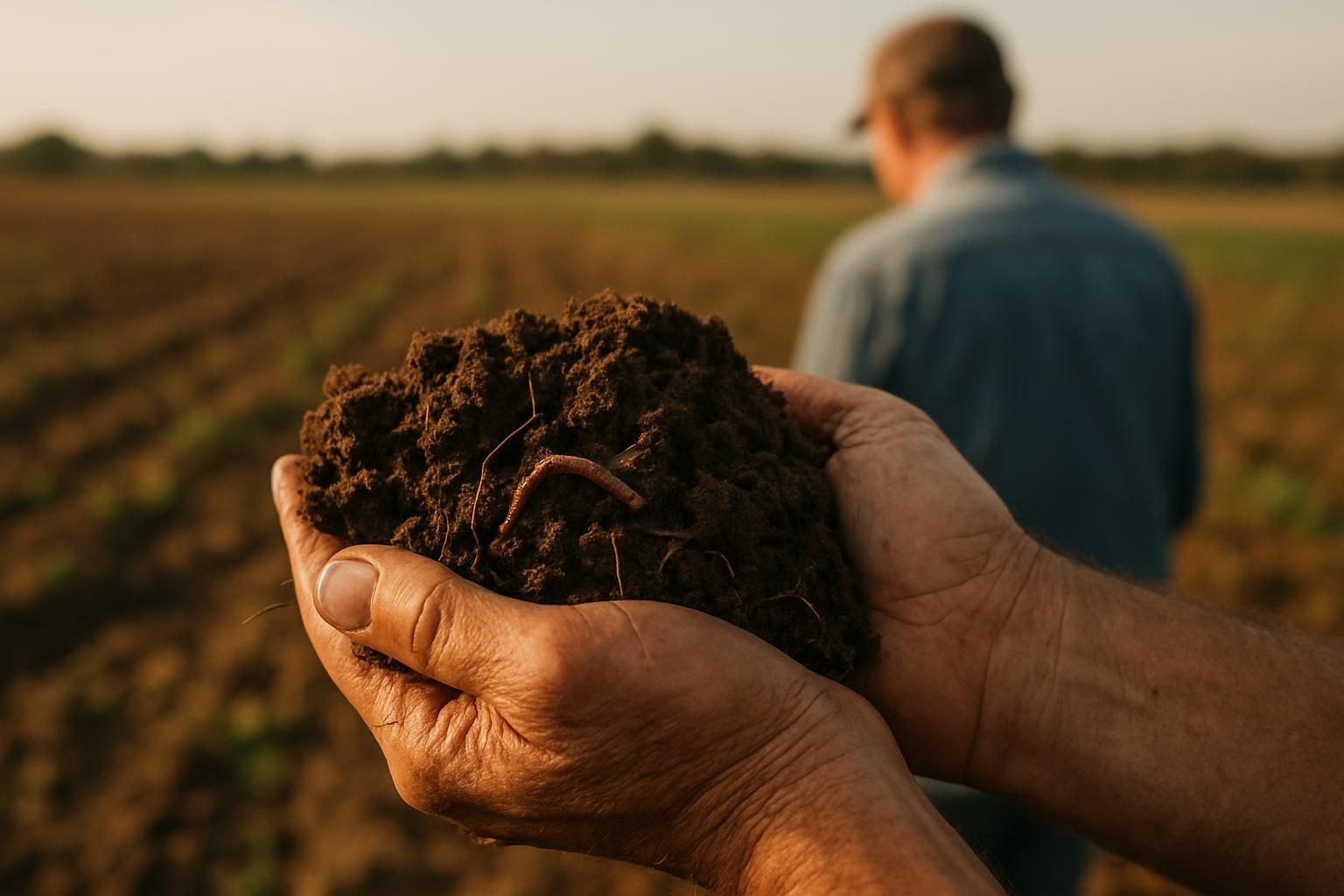
SOM is everything in the soil that was once alive: fresh residue, decomposing plant and animal material, microbes, and the dark, stable humus that remains after decomposition. Most mineral soils in the U.S. fall somewhere between 1% and 6% SOM. Sandy soils and arid rangeland often sit at 1% to 2%, while prairie-derived soils in the Corn Belt and cool, wet soils can be well above 4%.
You will often see soil organic carbon (SOC) mentioned alongside SOM. Carbon makes up roughly half of SOM by weight; a common conversion factor is about 1.72 (SOM is roughly SOC times 1.72), though labs vary. Check which one your report gives you.
Why soil organic matter matters
Water holding
SOM improves aggregation, which opens pore space so rain soaks in instead of running off. A widely cited rule of thumb is that each 1% increase in SOM can add on the order of 20,000 gallons of available water per acre, but the real figure depends heavily on soil texture and measurement method. Treat it as a ballpark, not a promise. The practical effect is real: better infiltration and more buffer in dry spells, especially in sandy soils.
Nutrients and biology
SOM holds nutrients and releases them slowly as microbes break it down. A typical rule of thumb is that each 1% SOM mineralizes roughly 15 to 25 pounds of nitrogen per acre per year, again varying with temperature, moisture, and soil type. It also feeds the biology behind aggregation and disease suppression, including mycorrhizal fungi that extend root reach for water and phosphorus.
For the wider picture of what the evidence says about these benefits, see benefits of regenerative agriculture.
Realistic rates of change
This is where most hype falls apart. SOM is controlled by the balance between carbon inputs and losses, and it takes a large mass of carbon to move the percentage. Rough arithmetic: raising SOM by 1 percentage point in the top 6 inches of soil means adding on the order of 10 to 12 tons of organic matter per acre that actually stays in the soil, after decomposition losses.
- Typical sustained gain: about 0.1 to 0.3 percentage points per year under good management, often less.
- Time to notice on a lab test: usually 3 to 5 years for a hint, 5 to 10 years for a clear trend.
- Ceiling: every soil has a practical upper limit set by climate, texture, and drainage. Warm, humid regions burn through organic matter faster than cool, dry ones, and sandy soils hold less than clays.
- Fragility: a single season of aggressive tillage can undo years of gain.
Gains also tend to be fastest at first when starting from a depleted baseline, then slow as the soil approaches its capacity. Plan on the long game, and measure function (infiltration, tilth, yield stability) along the way, not just the lab number.
Practices ranked by impact
No ranking is universal, but across most U.S. systems these practices tend to deliver the most, roughly in this order of reliability.
| Practice | Typical impact on SOM | Best fit | Main trade-off |
|---|---|---|---|
| Perennial cover (pasture, hay, agroforestry) | High | Grazing lands, marginal cropland, edges | Lower annual crop income |
| Well-managed adaptive grazing | Moderate to high | Pasture and rangeland | Needs fencing, water, and management time |
| Cover crops (diverse, high biomass) | Moderate | Row crops, market gardens | Seed cost, termination, water use in dry regions |
| Reduced tillage or no-till | Moderate (mostly slows loss) | Most cropping systems | Weed and residue management learning curve |
| Compost and manure | Moderate, fast on small areas | Gardens, small farms, nearby sources | Cost, hauling, nutrient loading |
| Diverse rotations with residue return | Low to moderate | All cropland | Market and equipment constraints |
1. Keep living roots in the ground
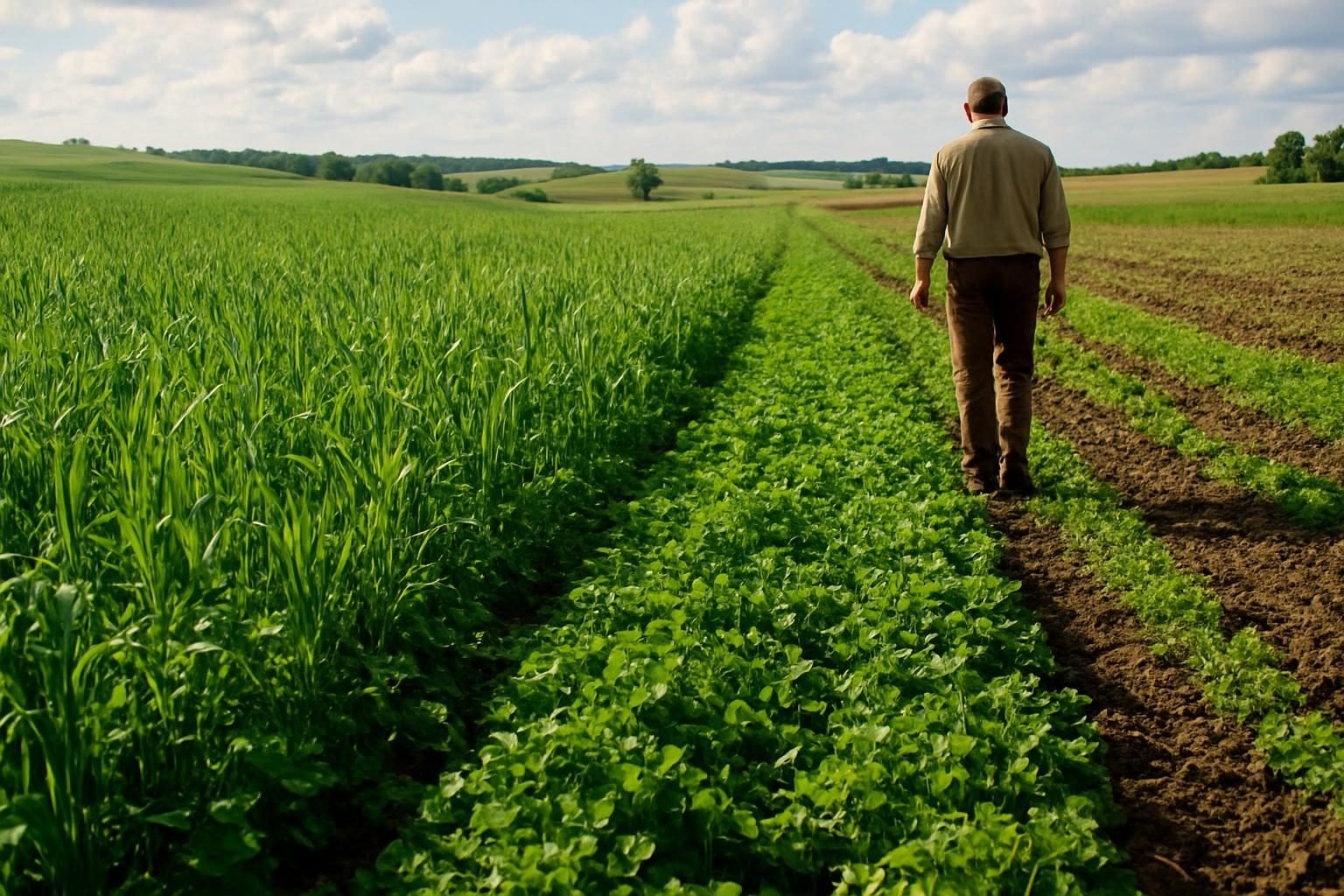
Living roots are the main route carbon takes into stable soil organic matter, because root-derived carbon tends to persist longer than surface residue. The goal is to cover as many days of the year as you can with something photosynthesizing. Start with our guide to cover crops for beginners, then look at cover crop mixes built for biomass and diversity. In corn and soybean country, interseeding cover crops can extend the green window when there is no gap after harvest.
2. Stop destroying what you build
Tillage speeds oxidation of organic matter and breaks up aggregates. Cutting it back is often the highest-value change for cropland, even if the gain shows up as lost less rather than gained more. See no-till farming: pros, cons and how to make the switch. Gardeners can get the same effect with no-dig gardening. If you plan to terminate covers without herbicide, a roller crimper is one option worth learning.
3. Graze for recovery, not just utilization
On pasture, rest periods and moderate residual height drive deeper roots and more carbon input. Overgrazing does the opposite. Learn the fundamentals in our complete guide to rotational grazing and match animal numbers to forage using stocking rate basics. Be aware that research on grazing and soil carbon is mixed and site-specific, so manage for forage recovery and measure your own results.
4. Add organic inputs where they pay
Compost, manure, and mulch work well on small acreage, high-value beds, and degraded spots. They are rarely practical across hundreds of acres. Watch phosphorus and salt buildup with heavy repeated applications, and confirm manure and compost rules with your certifier or state agency if you sell organic.
5. Add trees and perennials
Woody and deep-rooted perennials add carbon above and below ground for decades. Options include silvopasture and planting a food forest.
How to measure soil organic matter
Measurement is where many farmers get frustrated, because SOM changes slowly and testing noise can be as large as the change. Follow these steps to get a trustworthy trend.
- Pick fixed sampling locations and mark them with GPS or stakes so you return to the same spots.
- Sample the same depth every time, commonly 0 to 6 inches (or 0 to 8), and note it.
- Sample the same time of year and under similar moisture conditions.
- Take multiple cores per composite sample and mix them well.
- Use the same lab and method each year. Loss on ignition and combustion methods give different numbers.
- Test every 2 to 3 years, not every season.
Standard lab tests report SOM percentage; other tests estimate active carbon or microbial activity. For a breakdown of what each test tells you, see soil testing for farmers. Also track simple field indicators: how fast water infiltrates, aggregate stability when a clod hits water, earthworm counts, and root depth.
Common myths about building SOM
- Myth: You can raise SOM by several points in a few years. Rarely. Sustained gains are slow, and big claims usually reflect sampling differences, not real change.
- Myth: Higher SOM always means higher yield. Benefits are strongest in low-SOM, droughty, or degraded soils and flatten out at higher levels.
- Myth: Compost tea or a biological product will fix it. Inputs that add little carbon cannot meaningfully move SOM. See our look at compost tea and what it can and cannot do.
- Myth: Every region can reach the same SOM. Climate and texture set the ceiling. A hot, sandy Southern field will not match a cool, clay prairie soil.
- Myth: Compaction is a separate problem. It limits roots and carbon input, so sort it out early; see how to fix compacted soil.
Regional notes
In the humid East and South, warm temperatures and rain drive fast decomposition, so you need steady, high-volume inputs and year-round cover just to hold ground. In the Corn Belt, diversified rotations and covers after short-season crops are the main levers. In the arid West, water limits biomass, so grazing management, residue retention, and irrigated perennial cover matter most, and cover crops must be weighed against soil moisture use.
Getting started and getting paid
Pick one or two practices you can sustain, put them on a few fields, and baseline-test before you change anything. A phased approach is laid out in our 3-year transition plan. Cost-share may help with cover crops, grazing infrastructure, and reduced tillage; check current options and eligibility with your local NRCS office and read EQIP for regenerative farmers for the basics. For the market side, including funding and premiums, start with the regenerative farming business guide. Explore more in our Soil Health section.
Key takeaways
- SOM rises only when carbon inputs exceed losses, and it moves slowly: think 0.1 to 0.3 points per year at best.
- Living roots, perennials, and reduced disturbance are the most reliable levers.
- Compost and manure help, but are practical mainly on small acreage.
- Measure the same spots, depth, season, and lab every 2 to 3 years, and track infiltration and aggregate stability too.
- Climate and soil texture set your ceiling, so set goals for your region, not someone else’s farm.
Frequently asked questions
How long does it take to increase soil organic matter by 1%?
Commonly 5 to 10 years or more with consistent good management, and longer in hot, sandy, or humid-region soils where decomposition is fast. Gains are often quicker in the first few years from a depleted baseline and then slow down.
What is a good soil organic matter percentage?
It depends on soil type and climate. Many productive mineral soils fall between 3% and 5%, but sandy soils may do well at 1% to 2% and prairie soils may exceed 5%. Compare yourself to your own baseline and similar local soils.
What is the fastest way to build soil organic matter in a garden?
Mulch heavily, add finished compost, keep beds planted or covered year-round, and avoid tilling. Small areas can improve noticeably in a few seasons because you can apply large amounts per square foot, though lasting gains still require ongoing inputs.
Do cover crops really increase soil organic matter?
They can, mainly through added root and shoot biomass and reduced erosion, but the effect varies. Results depend on biomass produced, species, climate, and tillage. Expect modest gains over several years, not dramatic jumps.
Does no-till increase soil organic matter?
No-till mostly reduces losses and improves aggregation and surface SOM, rather than adding large amounts on its own. Deeper in the profile, gains are less consistent, so it works best combined with covers and diverse rotations.