Ask five ranchers how many acres per cow and you’ll get five answers, and every one of them can be right. The honest answer depends on rainfall, soil, forage, season length, and how you manage the grass. This guide gives you the vocabulary, the typical ranges, and a simple way to work out the number for your own land.
Quick answer: A mature 1,000-pound cow (one animal unit) typically needs anywhere from about 1 to 2 acres per year on productive, well-watered pasture in the humid East, to 10, 30, or even 100+ acres on arid Western rangeland. The only reliable way to know your number is to calculate it from how much forage your land actually grows and how much your animals eat.
Start with the animal unit
Stocking math runs on a standard unit so that cows, calves, sheep, and bulls can be compared. The animal unit (AU) is usually defined as one mature 1,000-pound cow with or without a nursing calf. One animal unit month (AUM) is the forage one AU eats in a month, commonly estimated at around 780 to 800 pounds of dry matter (roughly 26 pounds per day).
Not every animal is one AU. These are typical conversion figures; check your state extension service for the factors they recommend:
| Animal | Approx. animal units |
|---|---|
| Mature cow (1,000 lb) with calf | 1.0 |
| Mature cow (1,400 lb) | 1.2 to 1.4 |
| Bull | 1.2 to 1.5 |
| Yearling steer or heifer | 0.6 to 0.8 |
| Mature ewe with lambs | 0.15 to 0.2 |
| Mature goat | 0.1 to 0.15 |
| Horse | 1.0 to 1.25 |
The practical lesson: if your cows are bigger than the reference animal, your carrying capacity is lower than a generic chart suggests. A herd of 1,500-pound cows eats considerably more than the same number of 1,000-pound cows.
Stocking rate vs stock density: two different numbers
These terms get mixed up constantly, and the difference matters.
- Stocking rate is how many animals a piece of land supports over a long period, like a grazing season or a year. It’s expressed as acres per AU or AU per acre. It’s about how much total forage the farm produces and uses.
- Stock density is how many animals are on a given area at one moment. It’s expressed as pounds of livestock per acre, or AU per acre, for a short period. It’s about how concentrated the animals are right now.
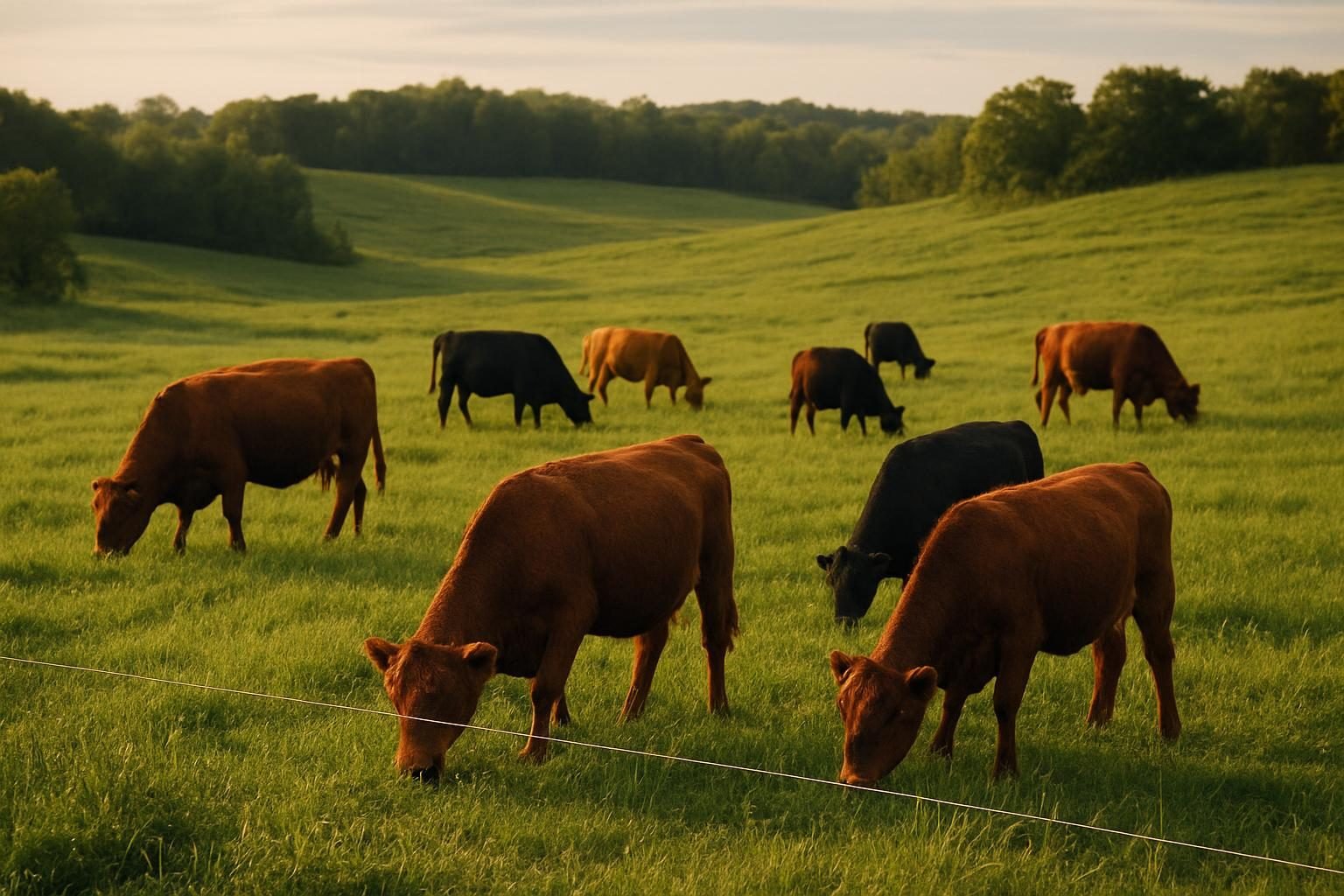
You can have a low stocking rate and a very high stock density at the same time. Picture 20 cows on a 200-acre ranch (a modest stocking rate) that you move through small paddocks, giving them a fresh slice of grass each day (a high density, briefly). Conversely, you could run the same 20 cows loose on all 200 acres all year: same stocking rate, very different density and grazing behavior. The same rotational principles apply to pastured poultry and other livestock.
Higher density, with enough rest afterward, is what drives more even grazing and trampling. We cover the high-density end of the spectrum in mob grazing, and the broader system in our complete guide to rotational grazing.
Typical acres per cow by region
Treat these as rough, general estimates for a cow-calf pair on a yearly basis, not guarantees. Local soils, rainfall in a given year, and forage species move the numbers a lot. Your county NRCS office and extension agent can give you site-specific figures, including NRCS soil survey forage production data.
| Region | Typical range (acres per cow-calf pair, year-round) | What drives it |
|---|---|---|
| Humid East and Southeast (well-managed improved pasture) | About 1 to 4 | Long growing season, ample rain; limited by summer slump or winter feed needs |
| Upper Midwest and Corn Belt pasture | About 2 to 5 | Good rainfall, shorter season, winter feeding period |
| Southern Plains and Texas | About 8 to 30 or more | Rainfall gradient from east to west, drought risk |
| Northern Great Plains rangeland | About 8 to 20 | Cool-season and warm-season mix, moderate rainfall |
| Intermountain and desert Southwest | About 30 to 100+ | Low and erratic precipitation, sparse forage |
The variation within each region is as important as the variation between them. A bottomland pasture and a rocky hillside on the same farm can differ by a factor of three or more.

How to calculate carrying capacity from forage
Guessing from regional charts gets you in the neighborhood. Calculating from your own forage gets you to the right door. The logic is simple: forage available divided by forage needed.
Step by step
- Estimate annual forage production per acre. Use NRCS soil survey data for your soil type, clip-and-weigh samples (cut forage in a measured square, dry it, weigh it), or a grazing stick or rising plate meter. Express it in pounds of dry matter per acre.
- Decide how much to leave behind. Grass needs leaf area to regrow and roots need to stay healthy. A common rule of thumb is to graze or trample about half and leave about half, so a “take half, leave half” harvest efficiency of roughly 25 to 50 percent is typical, depending on management. Continuous grazing sits at the low end; well-managed rotational grazing can reach the higher end.
- Work out usable forage per acre. Multiply production by your harvest efficiency.
- Calculate animal demand. One AU eats roughly 26 pounds of dry matter per day (about 3 percent of body weight for a 1,000-pound cow, sometimes figured at 2.5 to 3 percent). Multiply by the number of days you need to feed from pasture.
- Divide usable forage by demand to get AU per acre, then flip it to get acres per AU.
Worked example
Say you have 40 acres of cool-season pasture in a humid region, and you want to graze for about 200 days.
- Estimated production: 4,000 lb of dry matter per acre per year (an example figure; yours will differ).
- Harvest efficiency: 35 percent, which is realistic for decent rotational management.
- Usable forage: 4,000 x 0.35 = 1,400 lb per acre.
- Demand per AU for 200 days: 26 lb x 200 = 5,200 lb.
- AU per acre: 1,400 / 5,200 = about 0.27, which means roughly 3.7 acres per AU for that grazing period.
- For the whole 40 acres: 40 x 0.27 = about 10 to 11 animal units.
So this farm would carry roughly 10 mature cows on pasture for 200 days, with hay or stockpiled forage covering the rest of the year. If you run 1,400-pound cows (about 1.3 AU each), that drops to about 8 cows. Run the numbers twice, once with an average year and once with a dry year, and stock for something closer to the dry-year figure.
How rotational grazing changes the math
Moving animals through paddocks and resting each one lets plants recover fully before being bitten again. Compared with set-stocking, well-run rotation often improves forage utilization (less trampled and wasted), extends the green season, and can raise the carrying capacity of the same acreage. Many producers report meaningful gains, but the size varies widely by climate, starting condition, and management skill, and it often takes a few seasons to show up as plants and soils respond.
Some key points to keep honest expectations:
- It’s not magic in drought. Rotation helps you manage scarce grass better, but it can’t create forage without rain. Build a drought plan and be ready to destock.
- Rest periods matter more than paddock count. In fast-growing spring conditions, plants may need two to three weeks to recover; in slow summer or dry-region growth, rest may stretch to 60 to 90 days or longer.
- Infrastructure is the real work. Fencing, and especially water systems for rotational grazing, determine how finely you can subdivide.
For a deeper look at flexible, observation-driven management, see our explainer on adaptive multi-paddock grazing.
Ways to carry more animals without overgrazing
- Extend the grazing season. Every extra day on pasture is a day you’re not feeding hay. Stockpiling forage for fall and winter is one of the most cost-effective tools in many regions.
- Improve forage quality and diversity. Adding legumes, mixing cool- and warm-season species, and planting cover crops for annual forage can raise total production.
- Add trees thoughtfully. In the right climate, silvopasture can provide shade, shelter, and forage together, though tree canopy will reduce understory growth if too dense.
- Use more than one species. Sheep, goats, and cattle eat different plants, so multi species grazing can make fuller use of the same ground.
- Match animals to the land. Moderate-framed cows that thrive on forage often outperform big-framed cows on pasture-only systems, especially if you’re finishing on grass.
Signs you’re stocked too heavily
Your pasture will tell you before the math does. Watch for plants grazed to the ground repeatedly, increasing bare soil, more weeds and unpalatable species, slow regrowth, animals losing condition, and a growing dependence on purchased feed. If you see these, reduce animal numbers, lengthen rest, or both. Keep records of grazing dates, paddock rest periods, and rainfall; they make your next stocking decision far better than memory.
Key takeaways
- One animal unit is a 1,000-pound cow with calf; convert other animals and adjust for larger cows.
- Stocking rate is the long-term load on your land; stock density is the short-term concentration. They are not the same.
- Typical acres per cow range from roughly 1 to 4 in the humid East to 30 to 100+ in arid country. Treat regional numbers as estimates only.
- Calculate your own carrying capacity from forage production, harvest efficiency, and animal demand, and plan for a dry year.
- Rotational grazing and longer grazing seasons can raise capacity, but results depend on rainfall, soil, and management.
- Let the pasture, not the spreadsheet alone, tell you when you’re pushing too hard.
Stocking decisions are also business decisions: they affect feed costs, equipment, and income. Our overview of the regenerative farming business covers how to fit grazing into a sound farm plan, and the Grazing & Livestock section collects our other grazing guides. If you’re new to the bigger picture, start with what regenerative agriculture is. For fencing, water, or seeding cost-share, ask your local NRCS office about EQIP and confirm current eligibility and payment details directly with the agency.
Frequently asked questions
How many acres do I need for one cow?
It ranges from about 1 to 2 acres on lush, irrigated or high-rainfall pasture to 30 or more acres on dry rangeland. For most humid-region small farms with decent pasture, 2 to 4 acres per cow-calf pair for a grazing season is a common planning range, but calculate from your own forage and have a hay or stockpile plan for the non-growing season.
How many cows can I run on 10 acres?
On productive, well-managed pasture in a humid area, 10 acres might support roughly 3 to 5 cow-calf pairs for a grazing season, and fewer if you want to avoid buying hay in winter. In drier regions, 10 acres may not support even one cow year-round. Use the forage calculation above and start conservatively.
What is the difference between stocking rate and stock density?
Stocking rate is how many animals your land carries over a season or year (acres per AU). Stock density is how many animals are on a given area at one moment. A farm can have a modest stocking rate and still use high density by moving animals frequently through small paddocks.
Does rotational grazing really let you run more cows?
Often yes, because less forage is wasted and plants recover better, but gains vary by climate, starting pasture condition, and management. Expect improvement to build over several seasons rather than overnight, and don’t count on it to overcome drought.
How do I know if I’m overstocked?
Look at the grass and the animals. Persistent short, thin pasture, rising bare ground and weeds, slow regrowth, thin cattle, and heavy reliance on purchased feed are warning signs. Reduce numbers, lengthen rest periods, or both, and consult your local extension office or NRCS for a site-specific assessment.