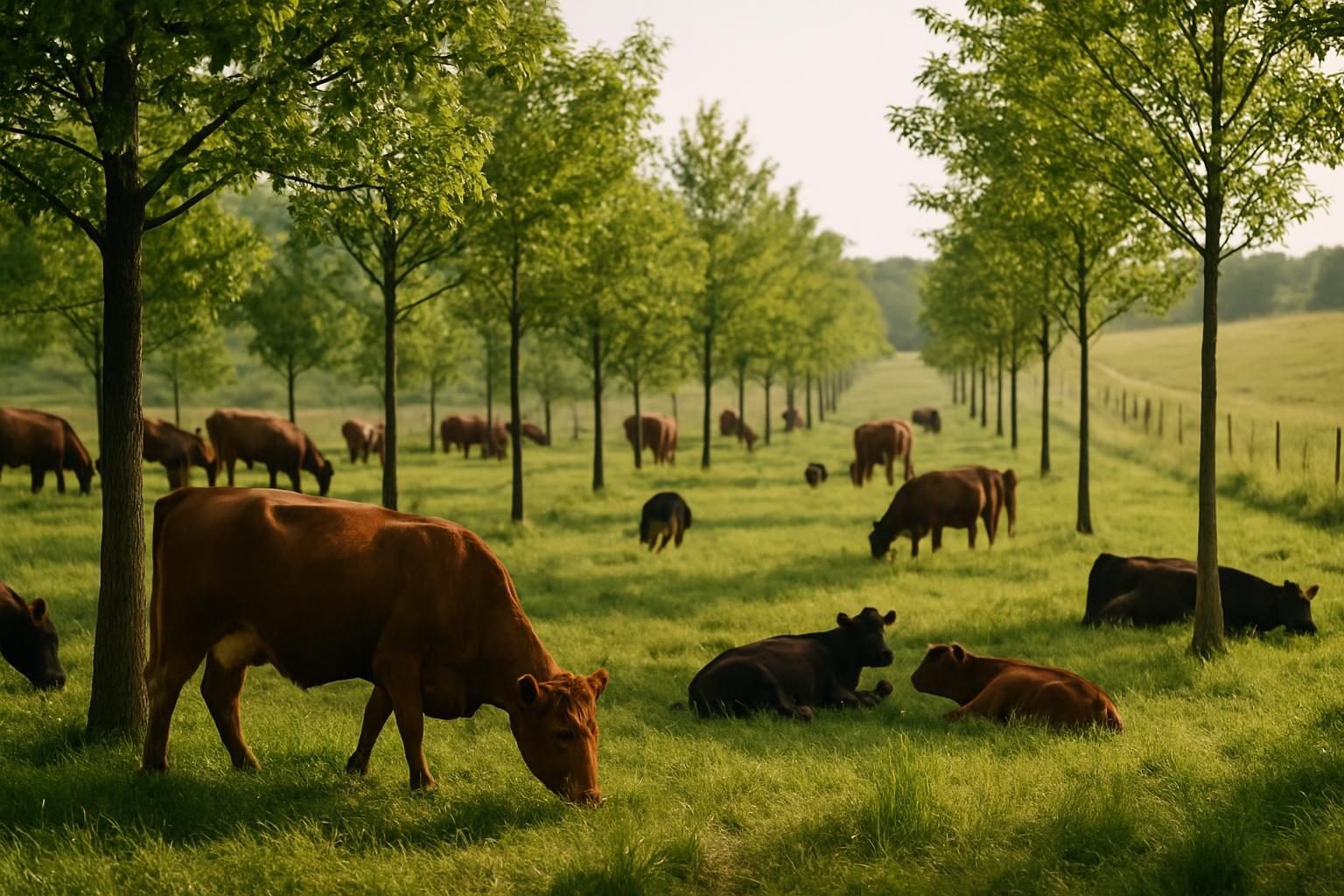
Silvopasture is the deliberate combination of trees, forage and livestock on the same acres, managed as one system instead of three. Done well, it gives animals shade and shelter, gives the land a second product (timber, nuts, fruit or fodder), and keeps the ground covered year-round. Done carelessly, it gives you dead saplings and a muddy woodlot.
Quick answer: Silvopasture is managed grazing under or between trees. You build it either by planting trees into open pasture or by thinning existing woodland so light reaches the forage. Aim for moderate shade (often about 30-50% canopy), protect young trees until they outgrow browsing, and expect cooling benefits in roughly 5-10 years and timber or nut income much later. Ask your local NRCS office about practice standard 381 before you spend money.
What silvopasture is and why it works
Trees and pasture compete for light, water and nutrients, but they also help each other. Deep tree roots reach water and minerals that shallow forage roots miss. Leaf litter and animal manure cycle nutrients back to the soil. Canopy softens wind, summer sun and winter chill. The goal is not a forest with cows in it, or a pasture with a few ornamental trees. It is a planned balance where trees, forage and animals all earn their place.
It fits naturally with the principles in regenerative agriculture: living roots, armored soil, diversity and livestock integration. It also asks for patience. Trees pay on a different clock than grass does.
It is also not a food forest. A food forest is a layered, mostly perennial planting for people. Silvopasture is built around grazing animals and the forage they eat, so the tree spacing and protection plan are different.
Two pathways: plant trees into pasture or thin woodland
Most farms start from one of two places. Your starting point decides your costs, your timeline and your biggest risks.
| Factor | Planting trees into pasture | Thinning existing woodland |
|---|---|---|
| Starting point | Open pasture or hayfield | Wooded acres with dense canopy |
| Shade benefit | Slow; years to decades | Immediate, often too much |
| Main cost | Trees, protection, fencing, weed control | Forester, thinning labor, forage seeding |
| Forage | Already established | Must be established or improved |
| Main risk | Losing trees to browsing, drought, weeds | Soil damage, loss of tree regeneration, overgrazing |
| Early income | None from trees for years | Possible from thinned logs or firewood |
Pathway 1: planting trees into pasture
- Map the site. Note slope, soil depth, drainage, prevailing wind, water points and existing fences. Trees do poorly in compacted, waterlogged or very shallow soils unless you choose species that tolerate them.
- Pick species for your goals. Decide whether you want shade, timber, nuts, fodder or all of them. Choose trees that suit your climate, your soil and your animals.
- Lay out rows. Plant in single or double rows with wide alleys, so you can mow, hay or graze between them. Rows can double as windbreaks when oriented across the prevailing wind.
- Prepare the planting strip. Kill or smother sod in a strip or spot around each tree. Grass competition is a leading cause of seedling failure.
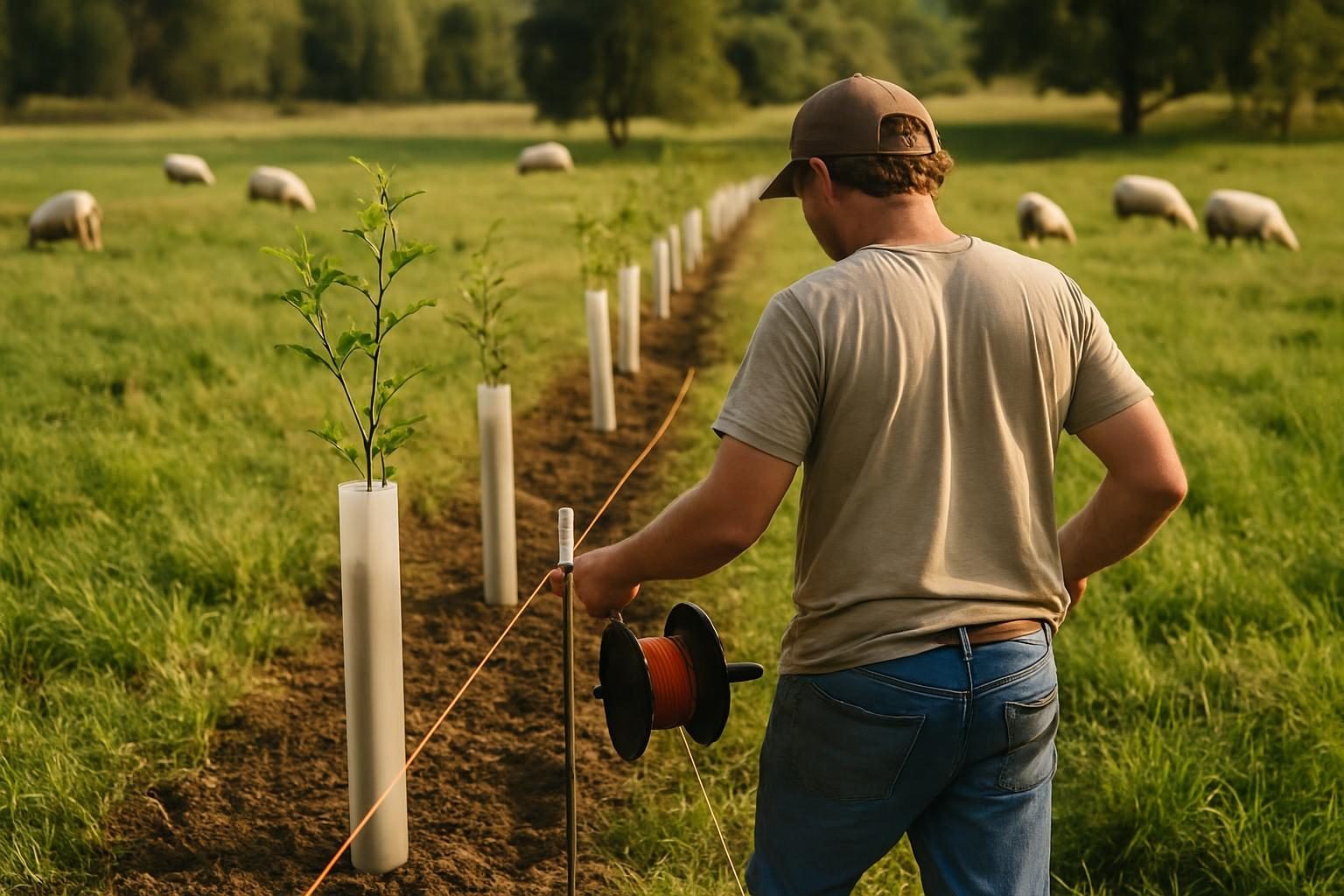
- Plant and protect immediately. Install tubes, cages or an electric fence at planting, not after the first browsing damage.
- Maintain for 3-5 years. Control weeds, replace losses, prune for form and water during dry spells. Graze the alleys only once the tree protection is in place.
Keep the forage between the rows healthy. If you are renovating pasture at the same time, a cover crop or perennial mix can help, and cover crops for beginners covers the basics of choosing and terminating them.
Pathway 2: thinning woodland for grazing
Many farms already have wooded acres that livestock wander into. Turning that into silvopasture is not the same as opening the gate. Unmanaged grazing in dense woods compacts soil, strips understory and stops new trees from regenerating.
- Get a forester involved. A state or consulting forester can inventory the stand, identify your best crop trees and mark what to remove. Many state forestry agencies offer free or low-cost advice.
- Remove the right trees. Typically you take out low-value, diseased, crooked or overcrowded stems and leave healthy, well-spaced trees with good crowns.
- Thin in stages if needed. Opening a stand all at once can cause windthrow in some species. Your forester can advise on a staged approach.
- Work when the ground is firm. Frozen or dry soil reduces rutting from equipment.
- Establish forage. Once light reaches the floor, you may need to seed shade-tolerant grasses and legumes. Remove invasive shrubs first.
- Start grazing lightly. Use temporary fencing, short stays and long recovery periods, as described in our rotational grazing guide.
Tree species by region
There is no universal silvopasture tree. The list below is a starting point, not a recommendation. Always check with your extension office, state forester or NRCS for locally adapted species and any invasive-species concerns.
| Region | Commonly used options | Notes |
|---|---|---|
| Northeast and Upper Midwest | Oaks, white pine, hybrid chestnut, black walnut, apple | Cold hardiness and deer pressure drive choices |
| Corn Belt and Plains | Bur oak, black walnut, honey locust, hackberry, hybrid hazelnut | Wind and drought tolerance matter |
| Southeast | Longleaf and loblolly pine, pecan, persimmon, mulberry, oaks | Pine silvopasture is well established; heat makes shade valuable |
| Arid West and Southwest | Mesquite, ponderosa pine (thinning), pinyon-juniper (thinning), native oaks | Water is the limit; fire risk shapes thinning |
| Pacific Northwest | Douglas-fir, Oregon white oak, hybrid poplar, hazelnut | Wet winters, dry summers; watch soil compaction |
A few cautions apply everywhere. Black walnut shavings are toxic to horses. Wilted wild cherry and red maple leaves can poison livestock. Black locust bark and seeds are toxic to some animals. Large acorn intakes can sicken cattle. For revenue-producing options, see our upcoming guide to nut trees for agroforestry.
Spacing and shade targets
Spacing depends on species, goals and how much shade your animals and forage can use. As typical ranges, not rules:
- Canopy cover: about 30-50% shade at maturity keeps many cool-season forages productive. Denser canopy cuts forage sharply, especially warm-season grasses.
- Between rows: 30-60 feet gives room for equipment and light, though some systems go wider.
- Within rows: 10-20 feet for most timber or nut trees, closer at planting if you plan to thin later.
- Trees per acre: often 40-100 at planting, falling as you thin to the final crop trees.
Row direction matters too. North-south rows spread shade more evenly across the alley through the day. East-west rows leave a persistent shaded strip on one side and more full-sun area on the other. Think about your forage species and your wind direction before choosing.
Protecting young trees from livestock
This is where most silvopasture plantings fail. Cattle rub, sheep and goats browse and horses chew bark. A seedling can be lost in a single afternoon.
- Tree shelters or tubes: good against deer, rabbits and light browsing. They do not stop a cow from trampling or rubbing.
- Welded-wire cages: sturdy and reusable. Use stakes and make them tall and wide enough that animals cannot reach through.
- Electric fence along tree rows: often the most practical for larger plantings. One or two strands of hot wire or polywire keeps animals out of the row while they graze the alleys.
- Delay grazing: keep animals out until the tree crowns are above browsing height, typically several years. Goats and sheep need more time than cattle.
- Use bigger stock: larger trees cost more but often survive animal pressure better.
Fence along the stream edge as well. A riparian buffer keeps animals out of the water and gives you habitat and bank stability.
Shade and heat-stress benefits
Livestock under heat stress eat less, graze at night and may gain more slowly or breed less successfully. Shade is one of the simplest ways to reduce heat load. Research on shaded pastures generally points to better animal comfort and less heat-stress behavior, though outcomes vary by climate, species and tree density.
Trees can also:
- Moderate winter wind and help newborn animals in cold snaps.
- Spread animals out, because they do not all crowd one shade spot.
- Extend the grazing season, since cool-season forage under partial shade may stay green longer in summer.
- Slow runoff and hold soil with deeper root systems.
There are trade-offs. Animals concentrate manure and compact soil where they loaf in shade. Dense shade lowers forage yield. Trees use water, which can matter on dry sites. Consider keyline design to manage water on your property. Plan for movable water and mineral feeders to keep animals from lingering in one place.
Timelines and costs
Expect a slow build. Newly planted trees give little shade for 5-10 years in many regions. Nut trees often need 7-15 years or more to bear meaningfully, and timber typically takes decades. Thinning gives light right away, but forage and animal management take a few seasons to settle.
Costs vary widely by region, species, labor and fencing. The figures below are rough estimates only. Get local quotes before budgeting.
| Item | Rough estimate |
|---|---|
| Tree seedlings | About $1-$5 each; larger stock $10-$40 or more |
| Tubes or cages | About $2-$10 per tree |
| Electric fencing for rows | Roughly $0.50-$2 per foot installed |
| Site prep and weed control | Varies with sod, machinery and labor |
| Forester plan and thinning | Fees vary; thinning may offset costs or add to them depending on local timber markets |
| Total planted system | Often several hundred to $1,500+ per acre |
If you are weighing silvopasture against other investments, see our overview of the business of regenerative farming. A related system, alley cropping, grows crops rather than forage between tree rows and shares many design principles.
NRCS practice standard 381
NRCS Conservation Practice Standard 381 (Silvopasture) covers establishing or managing a combination of trees or shrubs and compatible forage for livestock. It sets criteria for things like species selection, shade levels, forage management and protecting trees from livestock. Requirements and payment rates vary by state.
Practice 381 is often paired with other NRCS standards, such as tree and shrub establishment, prescribed grazing, forest stand improvement and fencing. Cost-share may be available through programs like EQIP, but funding, eligibility and sign-up periods change. Contact your local NRCS service center, and confirm current details before you plant or build anything you hope to have reimbursed. Do not start the work first, since many programs require approval beforehand.
If you graze in a managed system, such as adaptive multi-paddock grazing, your grazing plan fits naturally alongside the 381 requirements. You can find more on trees and water in our Agroforestry & Water section.
Key takeaways
- Silvopasture is trees, forage and livestock managed together, not livestock simply wandering through woods.
- Choose your pathway: plant trees into pasture (slow, lower risk to soil) or thin woodland (fast shade, higher soil risk).
- Target moderate shade, roughly 30-50%, to protect forage production.
- Protect every young tree from the day you plant it, and delay grazing until crowns are out of reach.
- Match species to your region and avoid trees that are toxic to your livestock.
- Budget for slow returns, and check NRCS practice standard 381 and local cost-share before you start.
Frequently asked questions
What is the difference between silvopasture and just grazing in the woods?
Silvopasture is planned. Trees are thinned or planted at set densities, forage is managed for light and animals are moved on a schedule. Simply letting livestock into woods usually degrades soil, understory and tree regeneration, and gives little forage.
How long before silvopasture trees provide shade?
On planted pasture, meaningful shade often takes 5-10 years or more, depending on species and growing conditions. In thinned woodland, shade already exists, so the work is opening enough light for forage.
Can I use silvopasture with sheep and goats?
Yes, but they are harder on young trees than cattle because they browse leaves and bark. Use taller protection, stronger fencing and a longer delay before grazing near trees. Many farmers start with cattle or use goats only once trees are well established.
How much does silvopasture cost per acre?
Planted systems often run from several hundred to more than $1,500 per acre depending on tree density, protection and fencing. Thinning costs depend on forester fees and timber markets. These are estimates only, so get local quotes and ask NRCS about cost-share.
Does silvopasture hurt forage production?
Heavy shade does reduce yield. Moderate shade can keep cool-season forage green longer in summer heat, though total yield per acre may be lower than open pasture. The offset comes from animal comfort, tree products and resilience in hot or dry years.