If you have asked “what is regenerative agriculture?” and gotten a different answer from every person, you are not alone. The term is used by backyard growers, fifth-generation ranchers, and food companies alike. This guide gives you a plain definition, the principles behind it, the practices that put it to work, and an honest look at what it can and cannot do.
Quick answer: Regenerative agriculture is a way of farming and ranching that aims to improve the health of the soil and the ecosystem instead of just sustaining it. It does this by keeping soil covered, disturbing it less, growing diverse plants with living roots as much of the year as possible, and often integrating grazing animals. There is no single legal definition, so the best test is whether your land is measurably improving over time.
What is regenerative agriculture, in plain terms?
Regenerative agriculture treats the farm as a living system, not a factory with inputs and outputs. The soil is full of fungi, bacteria, protozoa, worms, and insects that cycle nutrients, build structure, and move water. Regenerative farmers work to feed and protect that community instead of bypassing it with purchased fertility and frequent tillage.
The goal is improvement. Sustainable farming asks how to keep from making things worse. Regenerative farming asks how to leave the soil, water, and wildlife in better shape each year, while still paying the bills.
Practices versus outcomes
Some people define regenerative agriculture by a list of practices: cover crops, no-till, rotational grazing. Others define it by outcomes: rising soil organic matter, better water infiltration, more biodiversity, healthier animals, and a viable farm income. The most useful definition combines both. Practices are the tools. Outcomes tell you whether the tools are working on your ground.
There is no official standard
The USDA does not define “regenerative” in a way that regulates the word on a label. Several third-party certifications and company programs exist, and they differ in what they require. If you are considering one, confirm the current standards with the certifier. That is also why the word can be stretched into greenwashing. A farm that plants one cover crop on a fraction of its acres is not the same as a farm that redesigned its whole system.
Where it came from
The ideas are not new. Many Indigenous land stewardship systems, the soil conservation movement of the 1930s, organic pioneers, holistic management, and permaculture all contribute. Today the language of soil health from USDA NRCS and land-grant extension services gives the movement a practical, science-based core. If you are curious how it overlaps with a design-based approach, we cover that in our comparison of permaculture and regenerative agriculture.
The 6 soil health principles
NRCS teaches five core soil health principles. Many educators add a sixth, knowing your context, because nothing works the same everywhere. Together they are the backbone of every regenerative system, from a half-acre market garden to a 10,000-acre ranch. We go deeper, with examples for each farm type, in our guide to the six principles of soil health.
- Know your context. Your climate, soil type, markets, goals, equipment, and labor all shape what is realistic. A practice that thrives in Iowa may fail in New Mexico.
- Minimize disturbance. Tillage, heavy compaction, and excess chemical use damage soil structure and the organisms that build it. Disturb less, and when you must disturb, do it purposefully.
- Maximize soil cover. Bare soil is exposed to raindrop impact, wind, and heat. Residue, mulch, and living plants act as armor and hold moisture.
- Maximize biodiversity. Different plants feed different microbes, support different insects, and spread risk. Diversity above ground builds resilience below it.
- Maintain living roots year-round. Roots pump sugars from photosynthesis into the soil, feeding the microbial community. The more months of the year you have something green and growing, the better.
- Integrate livestock. Well-managed grazing animals cycle nutrients, stimulate plant growth, and add biology. This can be cattle, sheep, goats, poultry, or pigs, depending on your place.
Read these as a checklist, not a purity test. Most farms start by improving on two or three, then add others as they learn.
Core regenerative practices
The principles become real through specific practices. Here are the six you will hear about most, along with what each does and what to watch for.
Cover crops
Cover crops are planted between cash crops, or sometimes alongside them, mainly to protect and feed the soil rather than to harvest. Cereal rye, oats, crimson clover, hairy vetch, radishes, and multi-species mixes are common choices. They suppress weeds, reduce erosion, scavenge leftover nitrogen, and keep roots in the ground.
The trade-offs are real. Seed, seeding, and termination cost money and time. In dry regions, cover crops can use water the following crop needs. In short-season northern climates, the window for planting can be tight. Start small, on a field or bed you can watch closely, and match species to your goal and timing. Your county extension office or local NRCS office can help with species selection and cost-share options. Confirm current program details with them directly.
No-till and reduced tillage
No-till plants directly into undisturbed residue instead of plowing or disking. Reduced tillage and strip-till are middle steps. The benefits include less erosion, more stable soil aggregates, better water infiltration, and lower fuel and labor use over time.
The honest part: many large-scale no-till systems rely on herbicides for weed and cover crop termination, and some growers see yield drag or slow spring warming in cold, wet soils. Market gardeners often use tarps, mulch, broadfork, and shallow tillage as part of a low-disturbance approach. Aim to reduce disturbance in ways that fit your crops and scale, not to follow a slogan.
Adaptive and rotational grazing
Instead of letting animals graze one big pasture continuously, adaptive grazing moves them through smaller paddocks. They graze, then leave while plants recover. The idea is to mimic how wild herds moved across the landscape, bunched up, then gone for a long rest.
Recovery periods vary widely, from roughly 30 days in fast-growing humid pastures to 60-90 days or more in arid rangeland, and they change with season and rainfall. The word adaptive matters. You observe grass height, regrowth, and weather, and then decide when to move, not by calendar alone. Our complete guide to rotational grazing and adaptive grazing systems covers fencing, water, and planning in detail.
Diversity: rotations, polycultures, and multi-species pasture
Diversity can mean a longer crop rotation, a multi-species cover crop mix, intercropping, a pasture with grasses, legumes, and forbs, or hedgerows and habitat strips that support pollinators and beneficial insects. A corn-soybean rotation adding small grains and a cover crop is a classic Midwest step. A vegetable farm might rotate plant families and add flower strips. The key is that more kinds of plants support more kinds of life.
Integrating livestock
Animals and crops were once partners on most American farms. Reconnecting them can be as simple as grazing cover crops or crop residue in winter, running chickens behind cattle, or using sheep in an orchard. Manure and trampled plant material feed the soil, and the animals turn a cover crop into a second income stream.
It also adds complexity: fencing, water, handling, labor, and sometimes a processing and marketing question. If you do not want livestock, you can partner with a neighbor who does, or lean harder on the other principles.
Agroforestry
Agroforestry puts trees and shrubs on working land on purpose. Examples include silvopasture (trees with grazing), alley cropping (crops between tree rows), windbreaks, riparian buffers, and food forests. Trees add a deep-rooted, long-lived layer that shades animals, shelters crops, protects streams, and can produce nuts, fruit, timber, or other products. Payback is slower than annual crops, so planning matters. See our practical guide to agroforestry, silvopasture, alley cropping, and food forests for how to get started.
Practices at a glance
| Practice | Main principle served | Common challenge |
|---|---|---|
| Cover crops | Soil cover, living roots | Seed and management cost; water use in dry regions |
| No-till / reduced tillage | Minimize disturbance | Weed control, equipment changes, cold soils |
| Adaptive grazing | Livestock, cover, diversity | Fencing, water, daily management |
| Diverse rotations and mixes | Biodiversity | Marketing new crops, planning complexity |
| Livestock integration | Livestock, nutrient cycling | Labor, infrastructure, animal health |
| Agroforestry | Biodiversity, living roots | Upfront cost, slow payback |
What outcomes should you expect?
Regenerative farming is judged by results. Here are the four outcomes that matter most, and how to think about each one realistically.
Soil organic matter
Soil organic matter (SOM) holds nutrients and water and feeds soil life. It builds slowly. In many farm settings, measurable increases come in tenths of a percentage point over several years, not overnight, and results depend heavily on climate, soil texture, and starting point. Warm, humid Southern soils break down organic matter faster than cool, dry ones. Test the same fields, the same way, at the same time of year, so you can compare apples to apples.
Water infiltration and resilience
Better soil structure lets rain soak in instead of running off. Farmers often notice this first: less ponding, less erosion, and crops that hold up better in dry spells. You can track it with a simple infiltration ring test, which NRCS and extension guides describe, and with photos after heavy rain.
Biodiversity
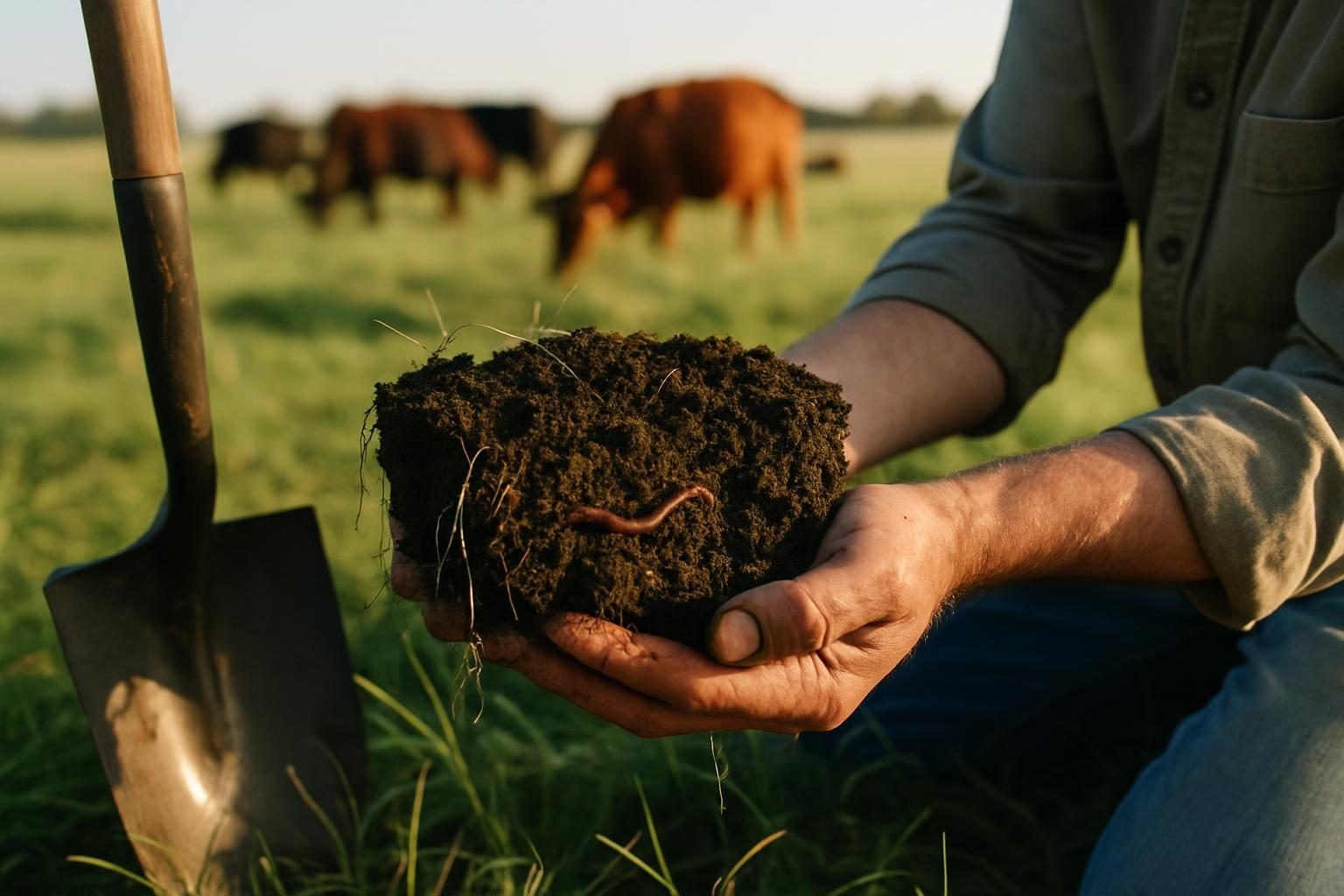
More plant species, more habitat, and fewer broad-spectrum inputs generally mean more pollinators, beneficial insects, birds, and soil organisms. Count earthworms in a shovelful, note bird and pollinator activity, and keep an eye on plant diversity in your pastures.
Profitability
This is where regenerative systems earn their place on working farms. Savings can come from lower fertilizer, fuel, feed, and herbicide spending, and premiums can come from direct sales or value-added products. But yields can dip during the transition, and new infrastructure costs money. Results vary widely by farm, so run your own numbers, ideally with a farm business advisor. We cover this in the business of regenerative farming, including funding, certification, and selling direct.
Honest limits and open debates
Regenerative agriculture has real promise, and real unknowns. A trustworthy guide should say both.
- No single definition. Without a standard, “regenerative” can mean almost anything on a label. Look for specifics, not slogans.
- Carbon is complicated. Soils can store carbon, but the amount varies by region and soil, storage can plateau, and it can be released again if practices stop. Measuring it accurately is hard and expensive. Be wary of big claims. Our article on regenerative agriculture and climate change digs into what farms can and cannot do.
- Yield questions. Some farms match or beat conventional yields over time; others see a lower yield and make up for it with lower costs or higher prices. The evidence differs by crop and region.
- Grazing science is debated. Researchers disagree about how much high-density grazing improves outcomes compared with other well-managed grazing. Many farmers report clear benefits, and controlled studies are mixed. Observe your own land and keep records.
- Scale and access. Land tenure, equipment, and capital shape who can make changes. Renters, in particular, may hesitate to invest in long-term soil building.
- It is not a cure-all. Regenerative practices will not fix poor markets, thin margins, or a damaged climate on their own.
For a fuller treatment of the arguments, see regenerative agriculture criticism: myths, debates, and what the evidence says.
How it looks in different regions
Context is the first principle for a reason. The same goals look different from one region to the next.
| Region | Typical focus | Common constraint |
|---|---|---|
| Humid East | Pasture management, cover crops, orchard and woodlot integration | Small fields, wet springs, high weed pressure |
| Corn Belt | Cover crops, extended rotations, no-till, grazing cover crops | Rented land, commodity economics, short windows after harvest |
| Arid West | Rangeland grazing, water capture, keeping ground covered | Low rainfall, slow recovery, water rights |
| South | Year-round cover, warm-season grasses, multi-species pasture | Heat, fast residue breakdown, parasite pressure in livestock |
Urban growers and homesteaders face a different set of questions, such as compost sourcing, contaminated soil, tiny footprints, and zoning. Our guide to small-scale regenerative farming for market gardens, urban farms, and homesteads addresses them.
How to start on any size farm
You do not need to change everything in a season. A steady, observed progression beats a dramatic overhaul. Here is a beginner roadmap that works for a backyard bed or a thousand acres.
- Write down your goals. Think about money, time, family, land, and what you want your place to look like in ten years. Goals drive every later decision.
- Observe and baseline. Walk your land after a rain. Dig a few holes. Note bare ground, compaction, erosion, plant diversity, and earthworms. Take dated photos. Consider a soil test from a reputable lab, including organic matter, plus a basic infiltration test.
- Pick one or two changes to test. Choose things that address your biggest problem and fit your equipment: a cover crop on one field, a no-till bed, a few paddocks with temporary fence, a hedgerow. Keep the trial small enough that failure is affordable.
- Get local help. Talk to your county extension office, NRCS field office, conservation district, and neighbors who have done it. Ask about current cost-share and technical assistance, and confirm eligibility and amounts directly with the agency, since programs change.
- Keep records. Track costs, labor, yields or animal performance, weather, and what you changed. Records turn opinions into evidence and help you decide what to scale up.
- Retest and adjust. Compare results after one to three seasons. Soil takes time, so look for trends rather than single numbers. Expand what worked, drop what did not, and add the next practice.
- Build your market and your network. Whether you sell direct, to a buyer program, or at a farmers market, tell the truth about what you do. Join a grazing group, a soil health network, or a farmer-to-farmer community.
For a longer timeline, see our 3-year plan on how to transition to regenerative agriculture.
Quick start ideas by farm type
- Backyard or urban garden: mulch every bed, stop digging, add compost, and keep something growing in each bed through the year.
- Market garden: adopt permanent beds, tarp-based weed control, and winter cover crops in beds that would otherwise sit bare.
- Row-crop farm: try a cereal rye cover crop on one field, or add a small grain to your rotation, and compare it to a similar field without it.
- Livestock operation: subdivide your best pasture with temporary electric fence, give plants a longer rest, and measure how the grass responds.
- Orchard or woodland owner: plant a diverse groundcover under trees and consider adding grazing animals or an understory crop.
Key takeaways
- Regenerative agriculture aims to improve soil and ecosystem health while keeping farms viable. It is more than reducing harm.
- The six principles are know your context, minimize disturbance, maximize cover, maximize diversity, keep living roots in the soil, and integrate livestock.
- Core practices include cover crops, no-till, adaptive grazing, diverse rotations, livestock integration, and agroforestry. None is mandatory, and all involve trade-offs.
- Measure what matters: soil organic matter, infiltration, biodiversity, and your farm’s finances. Expect change to be gradual.
- There is no legal definition, and some claims, especially about carbon, are overstated. Ask for specifics.
- Start small, observe closely, get local advice, keep records, and scale what works.
Ready to explore further? Browse every guide in the Regenerative Agriculture 101 category.
Frequently asked questions
What is regenerative agriculture in simple words?
It is farming and ranching that works to rebuild soil health and the surrounding ecosystem. Farmers keep the ground covered, disturb it less, grow diverse plants with living roots, and often use managed grazing. The aim is land that is more productive, more resilient, and more biologically alive each year.
Is regenerative agriculture the same as organic?
No. Organic is a legal certification with specific rules about inputs such as synthetic fertilizers and pesticides. Regenerative agriculture focuses on soil and ecosystem outcomes and has no single legal standard. Some farms are both. Organic systems that rely heavily on tillage may not meet regenerative goals, and some regenerative farms are not organic. Our comparison of regenerative and organic farming will cover the differences in detail.
Can a small farm or backyard garden be regenerative?
Yes. The principles apply at any scale. Backyard and urban growers can mulch, avoid digging, compost, plant diverse crops and flowers, and keep soil covered and rooted all year. Many of the most carefully managed regenerative systems are small market gardens and homesteads.
How long does it take to see results?
Some changes show quickly, such as less erosion, better water infiltration, and more earthworms, often within one to three seasons. Measurable gains in soil organic matter usually take several years and vary by climate and soil. Financial results depend on your costs, yields, and markets, so track them from the beginning.
Does regenerative agriculture cost more?
It can cost more up front for seed, fencing, water systems, or equipment, and yields may dip during the transition. Over time, many farmers report savings on fertilizer, fuel, feed, and chemicals, and some earn premiums through direct sales or buyer programs. Outcomes differ widely, so start small, run the numbers, and ask your extension office or NRCS about current assistance programs.