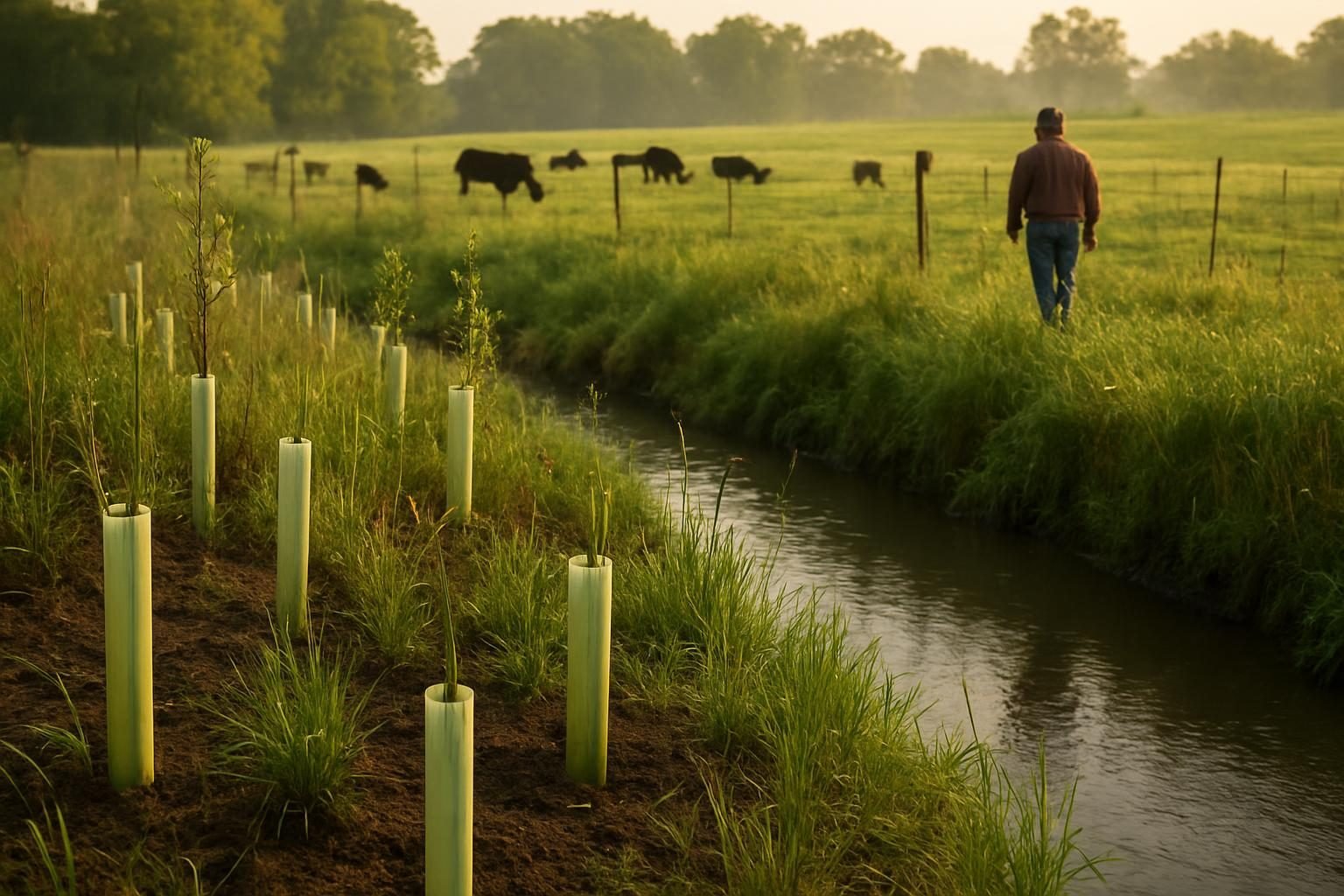
A riparian buffer is a strip of permanent vegetation, ideally trees, shrubs and grasses, along a stream, river, pond or wetland. It is one of the few conservation practices that protects water quality, stabilizes banks and builds wildlife habitat all at once. This guide covers what a riparian buffer does, how wide to make it, what to plant, how to handle livestock, and where to find financial help.
Quick answer: A riparian buffer is a permanent band of trees, shrubs and grass along a waterway that filters runoff, shades the water, holds the bank together and shelters wildlife. A typical design runs 35 to 100 feet wide or more, in zones that move from trees at the water’s edge to shrubs and grass farther out. Keep livestock out or manage access carefully, expect to maintain the planting for the first three to five years, and check with NRCS, your conservation district or your state’s CREP office for cost-share.
What a riparian buffer actually does
Water moving across a field picks up sediment, nutrients, manure and sometimes pesticides. A vegetated buffer slows that flow, so sediment drops out and water soaks in rather than racing to the channel. Roots take up some of the dissolved nitrogen and phosphorus, and soil microbes in the buffer can convert part of the nitrate to harmless nitrogen gas.
The benefits go beyond filtering:
- Bank stability. Deep, woody roots hold soil in place during high flows. Bare or mowed banks tend to slump and cut back year after year.
- Cooler water. Shade lowers summer stream temperatures, which matters for trout, native minnows and the insects they feed on.
- Habitat and corridors. A continuous wooded strip gives birds, pollinators, amphibians and mammals food, cover and a travel route across open farmland.
- Flood resilience. Vegetation slows floodwater and helps it spread and soak in rather than scour.
- Farm income options. Done thoughtfully, buffers can include products such as nuts, fruit, or specialty crops, though harvest rules vary by program.
Results depend on slope, soil, rainfall and how water reaches the stream. A buffer works best against sheet flow. If runoff is concentrated in gullies or drain tile outlets, the water can short-circuit the buffer, and you may need additional practices upslope. Keeping soil covered and healthy across the whole field, as covered in our soil health principles, reduces what the buffer has to catch in the first place.
Zones and widths
The classic design uses three zones, each doing a different job. Exact layouts vary by state and program, so treat these as typical ranges and confirm specs with your local NRCS office.
| Zone | Location | Typical width | Main job |
|---|---|---|---|
| Zone 1 | Closest to the water | 15 to 25 ft | Permanent trees and shrubs for shade, bank stability and root structure. Left undisturbed. |
| Zone 2 | Middle band | 20 to 60 ft | Managed trees, shrubs or mixed woody plantings that take up nutrients and provide habitat. |
| Zone 3 | Outer edge, next to the field | 10 to 20 ft | Grass or grass-forb filter strip that spreads and slows runoff. |
Total width commonly lands between 35 and 100 feet, measured from the top of the bank. Wider is generally better for wildlife and for steeper slopes, while narrower strips still help with bank stability and shade. Many programs set minimum widths and pay more for wider plantings, so ask before you lay out stakes.
Do not let width become an all-or-nothing question. A 30-foot buffer along a whole stream does more than a 100-foot buffer along half of it, because gaps become the pathway for runoff and cattle. Aim for continuity first, then add width where you can.
Choosing species
Plant natives suited to your region, soil moisture and flood frequency. Your NRCS office, conservation district, state forestry agency or extension service can supply regional planting lists and often sell or point you to bare-root stock.
- Humid East: sycamore, river birch, silver maple, bur oak, swamp white oak, buttonbush, elderberry, spicebush, with switchgrass and native sedges.
- Corn Belt and Midwest: cottonwood, willow, silver maple, hackberry, bur oak, dogwoods, chokecherry, with prairie grasses and forbs in the outer zone.
- South: bald cypress, water oak, sweetgum, black willow, wax myrtle, switchcane, with native warm-season grasses.
- Arid West: cottonwood, willow, box elder, Gambel oak, alder, red-osier dogwood, with wetland-edge sedges and rushes. Water availability and flood regimes differ a lot here, so local guidance matters most.
Mix species and growth forms so one pest or disease does not wipe out the planting. Willows and dogwoods can be installed as live stakes, which is a cheap way to armor a bank. If you want a productive layer, nut trees for agroforestry such as pecan or chestnut can fit in zone 2 on suitable sites, but check program rules on harvesting and on non-native or cultivated species before you buy.
Avoid planting invasive species, and watch for aggressive weeds such as multiflora rose, Japanese knotweed and reed canarygrass already on site, since they can overtake young plantings.
Livestock exclusion and alternatives
Unrestricted cattle access is one of the biggest threats to a stream and to a new buffer. Animals trample banks, browse seedlings, and deposit manure directly in the water. Excluding livestock from the buffer is the most reliable fix, and most cost-share programs require it for fenced practices.
Options, from firmest to most flexible
- Full exclusion with permanent fence. Several-strand high-tensile or woven wire set back from the bank, with the buffer outside the paddock. Simple and durable. Set the fence beyond the top of the bank and above likely flood lines where you can.
- Exclusion plus off-stream water. Pipe water to tanks away from the stream so animals have no reason to go near it. See our guide to water systems for rotational grazing for pipe, tank and trough layouts, and consider whether a farm pond fits your water plan.
- Hardened crossings and limited access points. A gravel-stabilized crossing or a narrow, fenced drinking access keeps traffic to one small spot. This is a compromise where animals must cross or where water is scarce.
- Time-controlled grazing of the outer grass zone. In some programs and setups, brief, well-timed grazing of the grass strip is allowed when trees are established and the bank is stable. Rules differ, so confirm before you graze anything enrolled in a program.
If you graze adaptively, the buffer slots in naturally as a protected zone in your paddock layout. Our rotational grazing guide explains how to subdivide and move animals so the riparian area is not the default shade and water spot. Where trees and forage share space away from the stream, silvopasture can give animals the shade they would otherwise seek in the creek.
Cost-share and technical help
You rarely have to fund a buffer alone. Programs worth checking:
- CREP (Conservation Reserve Enhancement Program). A state-federal partnership under the Conservation Reserve Program, offered in participating states. It typically pays annual rental on enrolled land plus cost-share for establishment, with contracts that run for years. Availability, payment rates and rules vary by state and change over time, so contact your local Farm Service Agency office.
- NRCS programs such as EQIP. Provide technical planning and cost-share for practices like riparian forest buffers, fencing and watering facilities. The Conservation Stewardship Program can also reward buffers as part of a broader conservation system.
- State and local sources. Conservation districts, state forestry agencies, watershed groups and some utilities offer plant material, technical help or small grants.
Program details, payment rates and eligibility change, so confirm current terms with the agency before you commit. Apply before you start work, since many programs will not pay for practices already installed. For the wider funding picture, see our overview of regenerative farming business, funding and certification and farm grants for beginning farmers.
One honest trade-off: enrolling cropland in a buffer takes acres out of production, and long contracts reduce flexibility. Run the numbers on rental payments, input savings and the value of marginal, flood-prone ground you were struggling to crop anyway. Often the wettest, lowest-yielding strip is the best candidate.
Planting and maintenance step by step
- Walk the site and call for planning help. Note bank condition, flood lines, drain outlets and existing vegetation. Get a plan from NRCS or your conservation district.
- Control competition. Mow or spray out sod and weeds in planting rows or spots the season before if you can. Grass competition is a leading cause of seedling failure.
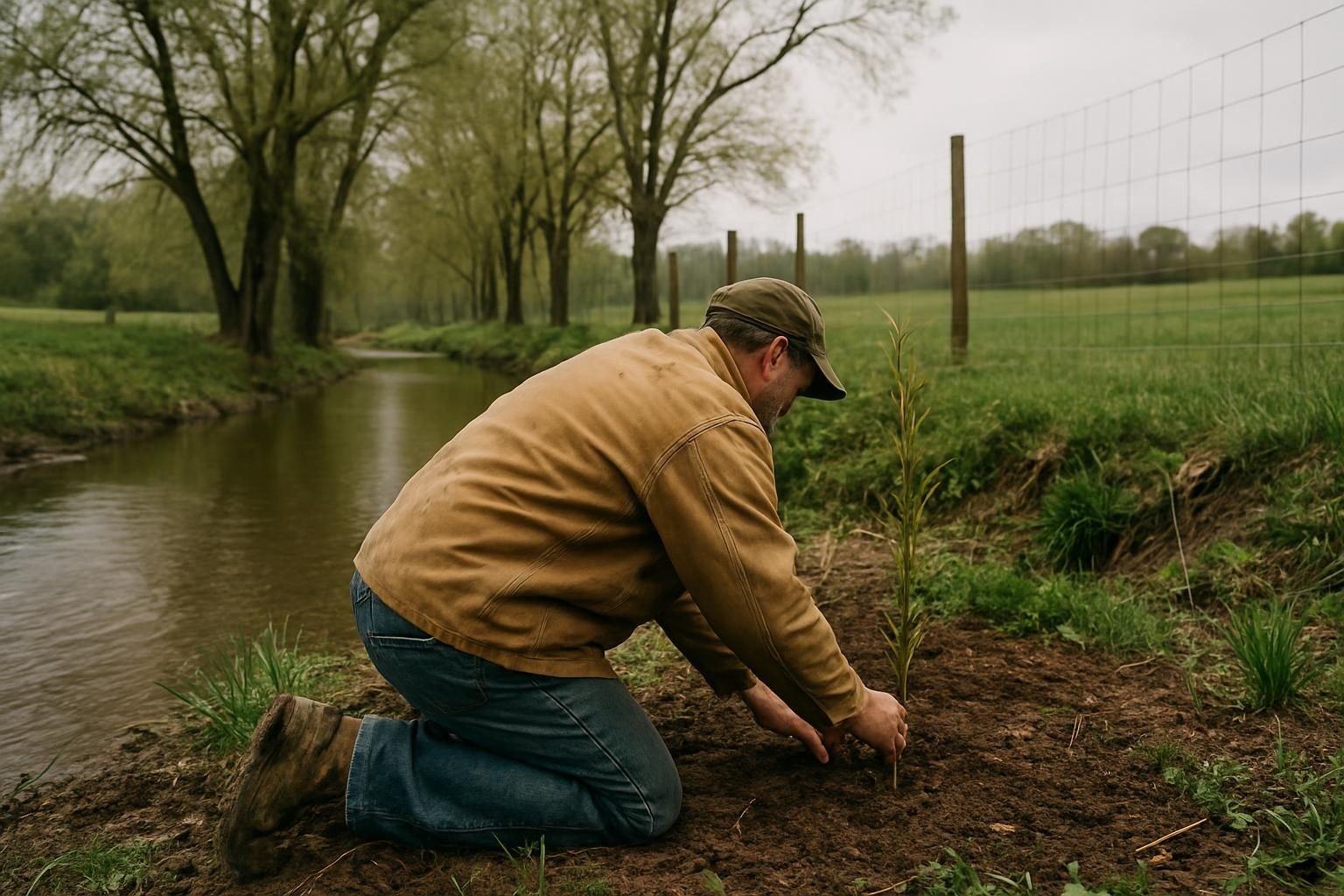
- Plant at the right time. Bare-root seedlings usually go in during dormancy, late winter to early spring in most regions. Use correct spacing for your species and stocking recommendations from your planner.
- Protect the seedlings. Tree tubes or shelters guard against deer and voles and help with herbicide spot treatments. Mulch mats can suppress weeds around each tree.
- Water and replace losses. Expect some mortality. Check after the first summer and replant gaps rather than waiting.
- Manage weeds for three to five years. Keep the area around trees clear until the canopy closes. After that, shade does much of the work.
- Inspect after floods. Clear debris, repair fence and re-stake any washed-out plantings.
Once established, a buffer is low-maintenance, but not no-maintenance. Watch for invasive species, fence damage and bank cuts every season. If you want the buffer to do more, pair it with other practices: keyline design and swales can slow and spread water across the landscape before it reaches the stream, and hedgerows for pollinators extend habitat from the buffer into your fields.
Key takeaways
- A riparian buffer filters runoff, holds banks, cools water and links wildlife habitat.
- Use three zones, trees, shrubs and grass, with total widths commonly 35 to 100 feet.
- Continuity matters more than perfect width. Gaps are where problems get through.
- Plant region-appropriate natives and mix species for resilience.
- Exclude or tightly manage livestock, and provide off-stream water.
- Check CREP, EQIP and CSP with NRCS or FSA before you plant, and confirm current terms.
- Plan on three to five years of weed control and protection while trees establish.
Frequently asked questions
How wide should a riparian buffer be?
Typical designs run 35 to 100 feet from the top of the bank, with trees nearest the water and grass at the field edge. Steeper slopes, erodible soils and wildlife goals favor wider buffers. Program minimums vary, so ask NRCS or your conservation district for the standard that applies to you.
Can I graze cattle in a riparian buffer?
Continuous access is rarely compatible with a healthy buffer. Most programs require exclusion, at least while trees establish. Some allow limited or carefully timed grazing of the outer grass zone later. Confirm program rules, and provide off-stream water to reduce the pull toward the stream.
Will I be paid to plant one?
Often partly. CREP and NRCS programs can provide annual rental payments, cost-share for planting and fencing, or both, depending on your state and the program. Amounts and eligibility change, so confirm current details with your local FSA or NRCS office before starting work.
How long until a buffer works?
Grass strips begin filtering within a season or two. Trees take longer: expect three to five years of establishment care and roughly a decade or more for a closed canopy and full shade and bank benefits. Benefits build gradually, so early weed control pays off.
What if my stream floods or my land is rented?
Choose flood-tolerant native species and expect some replanting after big events. On rented land, talk with the landowner first, since many programs need owner approval and long-term commitments. Put agreements in writing and check program rules on tenant participation.