A well-built farm pond can carry livestock through a dry summer, irrigate a market garden, fight fire, and pull in wildlife. A badly built one leaks, silts in, or turns into a green soup. This guide walks through siting, watershed size, soils, permits, livestock access, costs and maintenance so you build one that holds water for decades.
Quick answer: A farm pond needs a site with clay-rich soil that holds water, a watershed big enough to fill it but not so big it floods the spillway, and a design that follows NRCS pond standards and local permit rules. Plan on a 6 to 12 foot maximum depth in most regions, fence livestock to a limited access point, and expect costs to run from a few thousand dollars for a small excavated pond to well over $20,000 for a larger embankment pond. Confirm permits, water rights and cost-share options with your state, county and local NRCS office before breaking ground.
Why build a farm pond at all?
Water security is the first reason, and it is a regenerative one. A pond buffers you against drought, gives livestock a reliable source, and can feed gravity-fed troughs or irrigation. It also slows and stores runoff that would otherwise leave your land, a goal shared by keyline design and other water-harvesting approaches.
The trade-offs are real. Ponds cost money, take land out of production, can fail if sited poorly, and need ongoing care. They also carry liability, since open water around children and visitors is a risk you should discuss with your insurance provider. A pond is a good investment when you match it to a clear purpose and a good site.
Start with the job the pond must do
Decide what the pond is for before you choose a site, because the purpose drives the size.
- Livestock water: Needs reliable volume through the driest part of your year. Pair it with a pump or gravity line, as covered in water systems for rotational grazing.
- Irrigation: Needs enough stored volume for your peak demand, plus a way to move the water.
- Fire protection: Needs accessible, deep water close to buildings or pasture.
- Wildlife and recreation: Favors varied depths, gentle shorelines and vegetated margins.
Most working ponds serve two or three of these. Be honest about priorities, since a pond optimized for fishing will not be the same as one optimized for stock water.
Siting: where the pond goes
Good siting prevents most pond failures. Walk the land after a heavy rain and note where water collects and moves.
- Natural basins and draws: A narrow valley with a gentle slope lets you build a short dam that stores a lot of water. Steep, rocky sites are hard to seal and costly to build.
- Distance from use: Closer to the point of use saves pipe, but keep the pond away from septic fields, wells and buildings.
- Elevation: If you want gravity-fed water to troughs or gardens, place the pond uphill of where you will use it.
- Access: You need a route for equipment now and for maintenance later.
- Downstream risk: Consider what lies below the dam. A larger embankment pond can cause damage if it fails, which affects design and permitting.
Watershed size: the balancing act
The watershed is the land that drains into your pond. Too small and the pond will not fill or stay full through evaporation and seepage. Too large and storm flows can overwhelm the spillway and fill the pond with sediment.
Rules of thumb vary a great deal by rainfall and soil, so treat any number you read as a starting estimate. In humid regions, a few acres of watershed per surface acre of pond may be adequate, while arid and semi-arid regions may need substantially more, and some places cannot support a pond without a supplemental source. Evaporation is a big loss in the arid West and the South, and pond design there often calls for more depth and less surface area. Your NRCS office or extension service can run the numbers for your site, which is well worth doing before you spend money.
Watershed land use matters as much as size. A pond fed by pasture with good groundcover stays clearer than one fed by bare tilled ground. A regenerative management system that keeps soil covered and rooted upstream protects the pond from silt.
Soil suitability: will it hold water?
Soil is the make-or-break factor. You want enough clay to compact into a tight seal, with minimal sand, gravel and organic matter in the area that will hold the water and in the dam core.
- Dig test pits at the proposed pond and dam locations, down to at least the planned depth plus a few feet.
- Feel and ribbon test the soil. Clay-rich soil forms a long, flexible ribbon when squeezed between thumb and finger.
- Look for problem layers such as sand lenses, gravel, fractured rock or limestone voids, which cause leaks.
- Get lab tests or a professional assessment for a larger pond. NRCS or a qualified engineer can evaluate the soil and tell you whether it needs a clay liner, bentonite or another sealing method.
If your soil drains too freely, you can sometimes still build a pond with a sealing treatment, but costs rise quickly. Basic soil testing habits help you read your ground before you commit.
Permits, regulations and NRCS standards
This is where many landowners get surprised. Rules differ by state, county and the size of the pond, so confirm every requirement locally.
- NRCS Conservation Practice Standard for ponds: NRCS publishes a national standard that guides design, including embankment, spillways, and sizing. The agency’s field office can often provide technical help and may offer cost-share through its programs. Confirm current availability and eligibility with your local office.
- State dam safety rules: Many states regulate dams above certain heights or storage volumes, sometimes requiring engineered plans and approval.
- Water rights: In the arid West especially, capturing runoff can touch on water rights law. Check with your state water agency before building.
- Wetlands and waters of the United States: Work in or near streams, wetlands or floodplains can trigger federal, state or local permits. Ask before you dig.
- Local zoning and erosion control: Counties may require grading or stormwater permits.
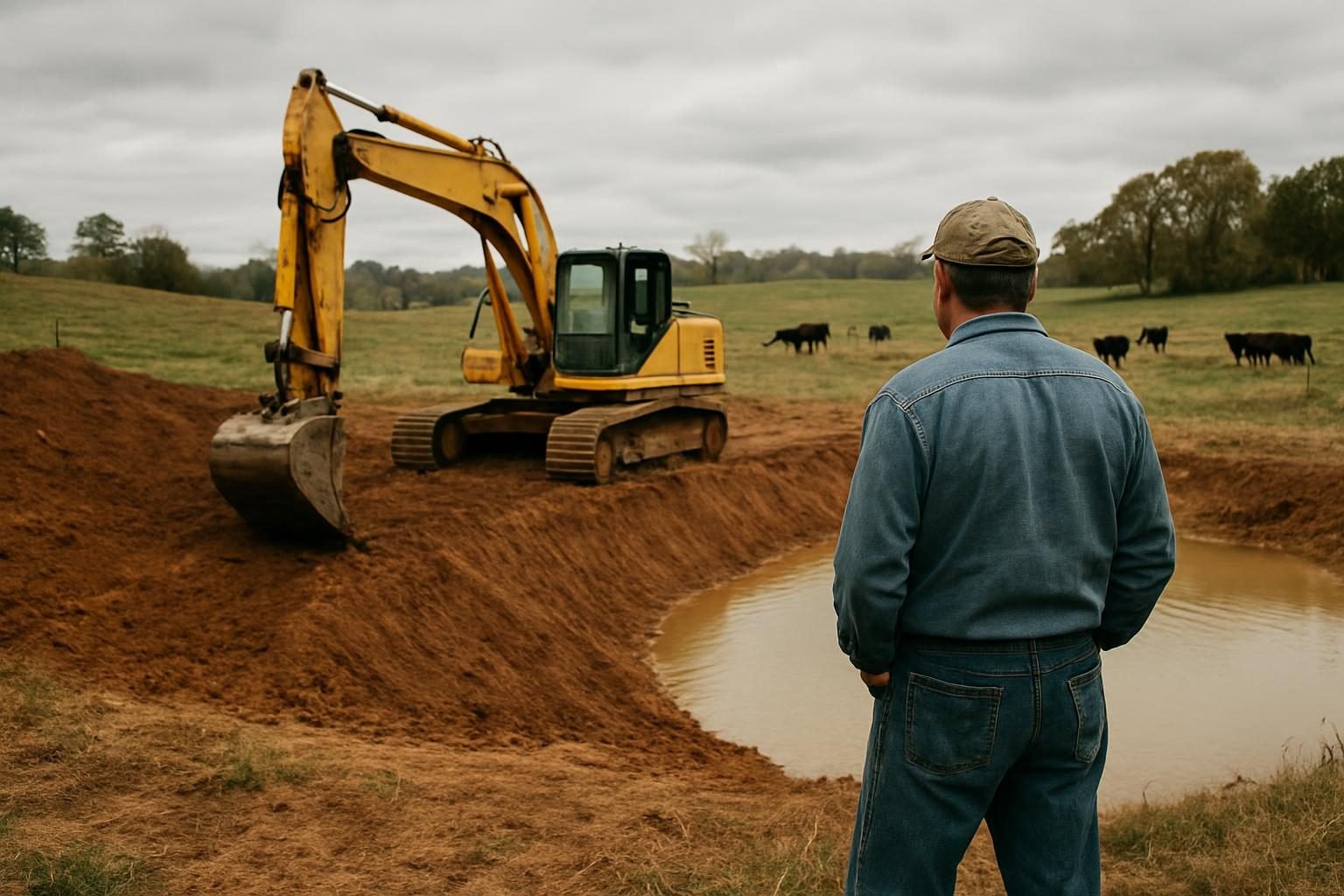
Call your local NRCS or conservation district first. They know the local rules and can point you to the right agencies. For funding support, look into programs such as the Conservation Stewardship Program and other conservation cost-share options, and check current details directly with the agency. For broader funding ideas, see farm grants for beginning farmers.
Design basics: depth, slopes and spillway
A few design features separate durable ponds from problem ponds.
- Depth: Many farm ponds work well with a maximum depth of roughly 6 to 12 feet, with deeper water in hot, dry regions to limit evaporation and summer warming. Shallow ponds heat up, grow weeds and can go dry.
- Side slopes: Gentle slopes are safer and easier to stabilize. Steeper slopes erode and are hazardous.
- Dam core and compaction: A properly keyed and compacted clay core is the heart of an embankment pond.
- Principal and emergency spillways: These control normal overflow and handle extreme storms. An undersized spillway is a leading cause of dam failure.
- Drain or pipe: A drawdown pipe lets you lower the pond for repairs.
Livestock access and water quality
Letting animals stand in the pond causes bank erosion, manure loading, muddy water and algae blooms. A better approach is to limit access.
- Fence the pond and provide a single hardened access ramp, or exclude livestock entirely.
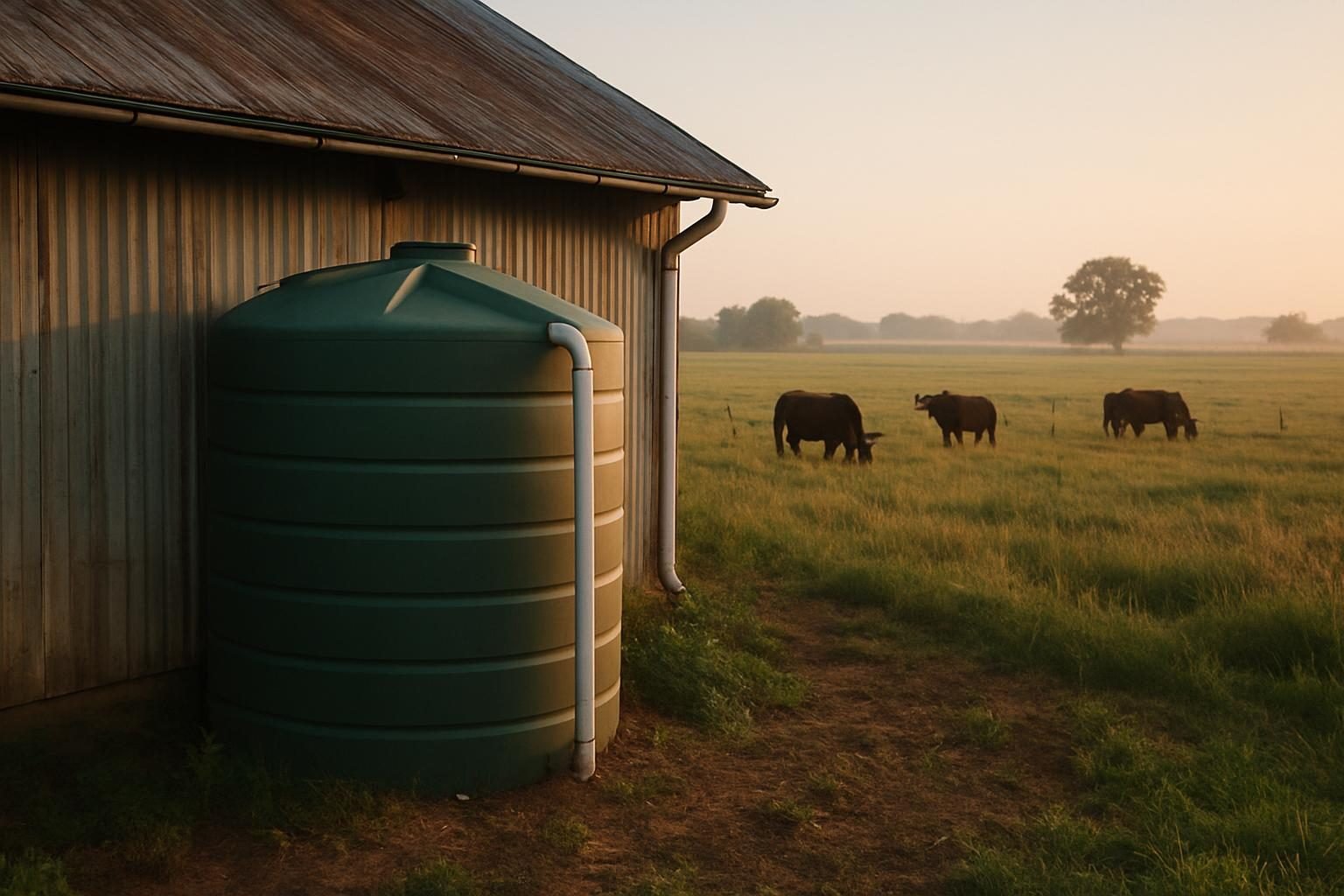
- Pump or gravity-feed water to a trough below the dam or away from the shore. A pasture water system keeps animals out of the water and spreads grazing pressure.
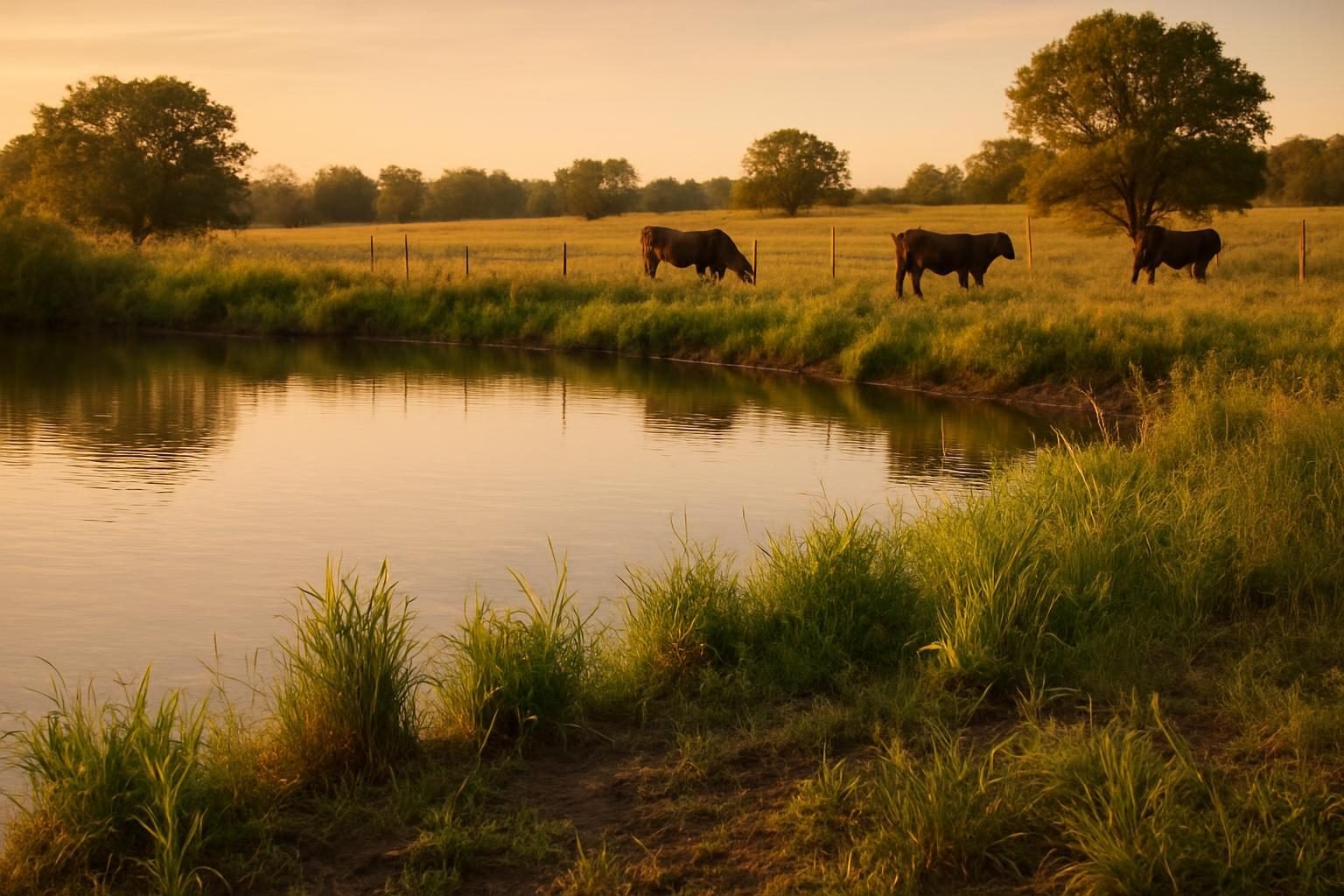
- Use a vegetated buffer around the pond. A riparian buffer of grasses, shrubs and trees filters runoff and shades the edge.
This fits well with rotational grazing, where animals move often and water points can be placed to suit the paddocks rather than the pond.
Wildlife benefits and planting the margins
A pond becomes a hub for life when its edges are planted well. Frogs, dragonflies, birds, bats and pollinators all benefit from water and shoreline cover.
- Plant native grasses, sedges and wildflowers on the upper banks.
- Add shrubs and trees for shade and bird habitat. Edge plantings can include nut trees for agroforestry on higher ground, away from the shoreline.
- Use hedgerows for pollinators along the margins to draw beneficial insects to nearby crops.
- Keep some shoreline shallow and gently sloped so small animals can enter and exit.
If your pond sits near a pasture, think about integrating trees through silvopasture or a food forest on the surrounding slopes. A pond also supplies a handy water source for establishing those plantings.
Cost ranges
Costs vary widely with region, soil, equipment rates, size and permitting. The figures below are rough planning ranges, not quotes. Get written bids from local contractors.
| Pond type | Typical size | Rough cost range | Notes |
|---|---|---|---|
| Small excavated pond | Under about 1/4 acre | A few thousand to roughly $10,000 | Dug into good soil; fewer structural needs |
| Embankment pond | 1/4 to 1 acre | Roughly $10,000 to $30,000 or more | Dam, spillway and engineering drive cost |
| Larger or lined pond | 1 acre and up | Often well above $30,000 | Sealing, permits and safety add expense |
Hidden costs include engineering, permits, fencing, seeding, pipe and pump, and fish stocking. Cost-share programs may offset part of these. Ask NRCS what is available, and check current details with the agency.
Maintenance: keeping it healthy
Ponds are not set-and-forget. A little regular attention prevents expensive repairs.
- Inspect the dam after big storms for seepage, cracks, slumping and animal burrows. Muskrats and burrowing animals can compromise an embankment.
- Keep woody roots off the dam. Roots can create seepage paths, so mow grass and avoid planting trees on the embankment.
- Clear the spillway of debris and keep it vegetated and stable.
- Manage nutrients. Excess manure and fertilizer runoff drives algae. Keep a vegetated buffer and manage grazing upstream.
- Control weeds and algae through depth, shade, aeration and nutrient reduction rather than relying only on chemicals.
- Watch sediment. Over years, silt reduces depth. Good groundcover and cover cropping upstream, as discussed in cover crop mixes, slows this.
Where a pond fits in the bigger picture
A pond works best as one part of a whole-farm water plan. Pair it with contour practices like swales where they suit your landscape, with healthy cover on the watershed, and with grazing that protects banks. You can see how these pieces combine in regenerative agriculture examples. For more in this topic area, browse the Agroforestry & Water section.
Key takeaways
- Define the pond’s job first, then size and site it to match.
- Soil with enough clay and a right-sized watershed decide whether the pond holds water.
- Call your NRCS office, conservation district and state agencies before digging; permits and water rights vary.
- Fence livestock out and pipe water to troughs to protect water quality.
- Plant the margins for wildlife, and inspect the dam and spillway regularly.
- Costs range from a few thousand to tens of thousands of dollars; get local bids and ask about cost-share.
Frequently asked questions
How big a watershed do I need for a farm pond?
It depends on rainfall, soil and evaporation. Humid regions may need only a few acres of watershed per surface acre of pond, while arid regions need much more or may not support a pond at all. Ask NRCS or your extension service to run site-specific numbers.
Do I need a permit to build a farm pond?
Often yes. Requirements depend on pond size, dam height, location near streams or wetlands, and your state and county. Check with your NRCS or conservation district office, state dam safety and water agencies, and local government before you start.
Can I build a pond if my soil is sandy?
Sometimes, but it is harder and costlier. Sandy or gravelly soil leaks, so you may need a clay liner, bentonite treatment or another sealing method. Test the soil first and get professional advice before committing money.
Should livestock drink directly from the pond?
It is better to limit or prevent direct access. Cattle in the water erode banks and add manure that fuels algae. Fence the pond and pump or gravity-feed water to a trough, or provide a single hardened access point.
How much does a farm pond cost?
Small excavated ponds can run a few thousand dollars, while larger embankment ponds often cost $10,000 to $30,000 or more, and lined or very large ponds cost more. Costs vary by region and site, so get local bids and ask about cost-share programs.