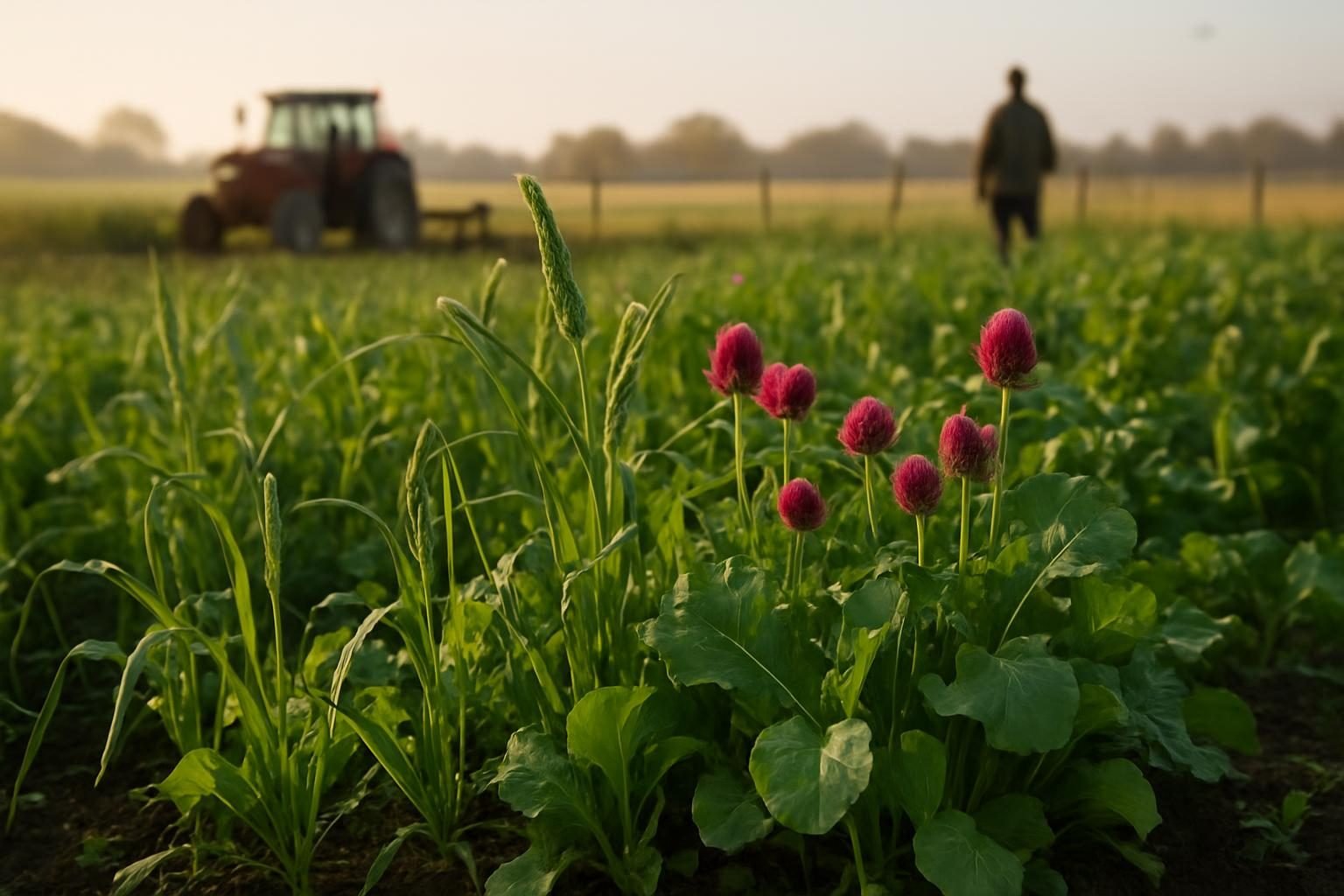
The best cover crop mix is the one built around a single, clear goal on your farm, in your climate, with the equipment you actually own. A good cover crop mix can fix nitrogen, break up a hardpan, hold soil in place, feed livestock or smother weeds, but no single blend does everything well. This guide walks through mixes by goal, gives example species lists by season, and shows you how to design your own cocktail.
Quick answer: Pick one primary goal, then choose 3 to 6 species that cover different functional groups: a grass for biomass and erosion control, a legume for nitrogen, and a brassica or broadleaf for compaction relief or forage. Seed each species at roughly 25 to 50 percent of its single-species rate, adjust for your region and planting window, and confirm rates with your local extension service or NRCS office.
Why Mixes Beat Monocultures (Most of the Time)
A single species gives you a single set of benefits. Cereal rye is a superb scavenger of leftover nitrogen and a strong weed suppressor, but it does nothing to add nitrogen. Crimson clover fixes nitrogen but produces modest biomass. Put them together and you get complementary roots, a mix of carbon-to-nitrogen ratios, more resilience if one species fails in a cold snap or a dry spell, and the benefit of mycorrhizal fungi networks that both species support.
Mixes are not magic, though. More species means more seed cost, more complicated termination, and sometimes one aggressive species crowding out the rest. Research on diverse mixes shows benefits that vary by site and season, and a well-chosen two- or three-species blend can outperform a messy ten-species one. If you are brand new to this, start with our cover crops for beginners guide before moving to cocktails.
Cover Crop Mixes by Goal
Match the mix to the problem you are trying to solve. The ranges below are typical drilled rates for a mix, not per-species single-crop rates, and they shift with region, seed size and planting method. Broadcast rates usually run 25 to 50 percent higher than drilled.
| Goal | Example species | Typical mix seeding rate (drilled) | Notes |
|---|---|---|---|
| Nitrogen | Crimson clover, hairy vetch, Austrian winter pea, with a small grass | 30 to 60 lb/ac total | Keep a grass at low rate to hold the legume up and scavenge extra N |
| Compaction | Tillage radish, forage turnip, rapeseed, cereal rye or oats | 8 to 20 lb/ac brassica plus 30 to 60 lb/ac grass | Deep taproots; best sown late summer for fall growth |
| Erosion | Cereal rye, annual ryegrass, winter wheat, with clover | 50 to 90 lb/ac | Fibrous roots and fast ground cover matter most |
| Grazing | Oats, forage brassicas, annual ryegrass, peas, clover | 40 to 90 lb/ac | Choose palatable, high-quality species; watch for bloat risk |
| Pollinators | Buckwheat, phacelia, crimson clover, sunflower, sweetclover | 20 to 50 lb/ac | Stagger bloom times; avoid spraying during flowering |
| Weed suppression | Cereal rye, buckwheat (summer), sorghum-sudangrass, oats | 60 to 120 lb/ac (rye); 50 to 70 lb/ac (buckwheat) | Dense, fast canopy is the goal; terminate before seed set |
Nitrogen mixes
Legumes capture atmospheric nitrogen through rhizobia in their root nodules. Hairy vetch and crimson clover are workhorses in the humid East and South; Austrian winter pea does well in cool climates. How much nitrogen is released varies widely with species, biomass, termination date and weather, so treat published credits as estimates and verify with local extension guidance. Inoculate seed with the correct rhizobia strain, especially on fields that have not grown that legume recently.
Compaction mixes
Deep-rooted brassicas such as tillage radish can punch through shallow compacted layers, and fibrous grasses then help hold the new pore structure. These are not a cure-all for severe compaction caused by heavy equipment or wet-soil traffic. For a deeper look, see our upcoming guide on how to fix compacted soil without heavy tillage.
Erosion mixes
For erosion, speed and ground cover win. Cereal rye germinates in cold soil and establishes quickly in fall, making it a go-to on slopes and after late harvests. Pair it with a clover or small-seeded legume if you also want nitrogen. On sloping ground, pairing cover with water-shaping practices such as keyline design multiplies the benefit.
Grazing mixes
Cover crops double as forage when you plan for it. Oats, brassicas, peas and annual ryegrass can extend the grazing season into late fall or fill a summer gap. Use temporary fencing and move stock often so you graze, not trample. Our rotational grazing guide covers paddock design, and adaptive multi-paddock grazing explains how to match moves to plant recovery. Watch for bloat on lush legumes and nitrate issues on stressed brassicas or cereals, and ask your vet or extension agent about local risks.
Pollinator mixes
Buckwheat blooms in about 30 days and is a favorite of beneficial insects, while phacelia and crimson clover bloom at different times and extend the food window. Keep expectations honest: a cover crop supports pollinators for the weeks it is in flower, but it is not a substitute for permanent habitat.
Weed suppression mixes
Weeds lose when the canopy closes early and stays dense. Cereal rye in fall and sorghum-sudangrass or buckwheat in summer are classic suppressors, and rye also releases compounds that can inhibit small-seeded weeds. Rye termination timing is critical, and terminating by rolling is one option; see our upcoming guide on the roller crimper for details. Caution: allelopathic residue can also slow small-seeded crops, so wait or transplant instead of direct seeding tiny seeds into heavy rye mulch.

Example Species Lists by Season
These are starting points, not recipes. Planting windows depend on your frost dates, so back-calculate from your first and last average frost and check local extension recommendations.
Fall-sown, winter-hardy (most regions)
- Erosion and weeds: cereal rye 40 to 60 lb/ac, crimson clover 8 to 12 lb/ac
- Nitrogen: hairy vetch 10 to 20 lb/ac, winter wheat or rye 30 to 50 lb/ac
- Compaction: tillage radish 4 to 8 lb/ac, oats 30 to 50 lb/ac, rye 30 lb/ac
Spring-sown
- Quick biomass and weed control: oats 50 to 80 lb/ac, field peas 40 to 60 lb/ac
- Pollinator and green manure: phacelia 6 to 10 lb/ac, crimson clover 10 lb/ac, oats as a nurse crop
Summer-sown (warm-season)
- Weed smothering: buckwheat 50 to 70 lb/ac or sorghum-sudangrass 30 to 50 lb/ac
- Soil building and N: cowpea 30 to 60 lb/ac, sunn hemp 20 to 40 lb/ac, millet 15 to 25 lb/ac
Late-summer sown for fall grazing
- Oats 30 to 50 lb/ac, forage turnip or rape 2 to 5 lb/ac, annual ryegrass 10 to 15 lb/ac
Regional notes: in the humid East and South, winter annuals like vetch and crimson clover thrive; in the Corn Belt, short windows after harvest favor rye and oats; in the arid West, water limits species choice and termination timing, and irrigated systems have more options than dryland ones.
How to Design a Cocktail Mix
- Name one primary goal. If you try to solve everything, you will optimize nothing.
- Know your planting window. Species must establish before your first killing frost or main-crop deadline.
- Pick from functional groups. Choose one or two from each: cool-season grass, legume, brassica, broadleaf (buckwheat, phacelia, sunflower).
- Limit the list. Three to six species is manageable for most farms; more adds cost and complexity without guaranteed benefit.
- Set rates as a fraction. A common starting point is 25 to 50 percent of each species’ full single-species rate, then adjust so the total is not over-seeded.
- Balance carbon to nitrogen. Grasses give high-carbon residue that breaks down slowly; legumes give low-carbon residue that releases nitrogen quickly. Mixing balances both.
- Plan termination first. Decide whether you will graze, roll, mow, till or winter-kill, because that dictates species. Match mixes to your system, especially if you are moving toward no-till farming.
- Test small first. Trial a few acres or a few beds before committing the whole farm.
Seed size and depth matter. Large seeds like peas and oats go about 1 to 2 inches deep; tiny seeds like clover and brassicas go no deeper than about a quarter to half an inch. If you drill a mix, you may need two seed boxes or a broadcast-then-roll approach. Good seed-to-soil contact beats a perfect recipe.
Cost, Cost-Share and Getting Started
Seed cost varies widely by species, supplier and year, so get quotes locally and compare per-acre mix costs rather than per-pound prices. Cost-share may be available; see our guide to EQIP for regenerative farmers and confirm current practice standards and payment details with your local NRCS office. For the bigger picture of where cover crops fit, read our overview of what regenerative agriculture is, and explore more in our Soil Health category. A soil test before you choose a mix can reveal pH or fertility issues that no cover crop will fix on its own, and results build over years; see how to increase soil organic matter for realistic timelines.
Key Takeaways
- Choose the mix by goal: nitrogen, compaction, erosion, grazing, pollinators or weeds.
- Combine a grass, a legume and a brassica or broadleaf for resilience; keep it to 3 to 6 species.
- Seed each species at a fraction of its solo rate and adjust for drilling versus broadcasting.
- Plan termination before you plant, and match species to your planting window and region.
- Trial small, record results, and confirm rates and cost-share with local extension and NRCS.
Frequently asked questions
What is the best cover crop mix for beginners?
A simple fall mix of cereal rye with crimson clover or hairy vetch is forgiving, cheap and effective across much of the country. It covers soil, suppresses weeds and adds some nitrogen. Adjust the species for your frost dates and confirm rates with local extension.
How many species should a cover crop mix have?
Three to six is a practical range for most farms. Enough to cover different functions (grass, legume, brassica or broadleaf) without driving up cost or creating one species that crowds out the rest. More is not automatically better.
Can I graze a cover crop mix?
Yes, and it is a common way to pay for cover cropping. Oats, brassicas, peas and annual ryegrass make good forage. Introduce animals gradually, use temporary fencing, leave residual cover, and talk to your vet about bloat and nitrate risks.
When should I plant cover crops?
It depends on species and region. Cool-season mixes are typically sown late summer through fall, warm-season mixes in late spring through summer. Count back from your average first frost, and give cool-season species enough time to establish before winter.
Do cover crop mixes fix compacted soil?
They can help with shallow compaction by building roots and biological activity, but they will not fix severe or deep compaction alone. Reduce traffic on wet soil, keep living roots in the ground as much as possible, and consider other measures where needed.