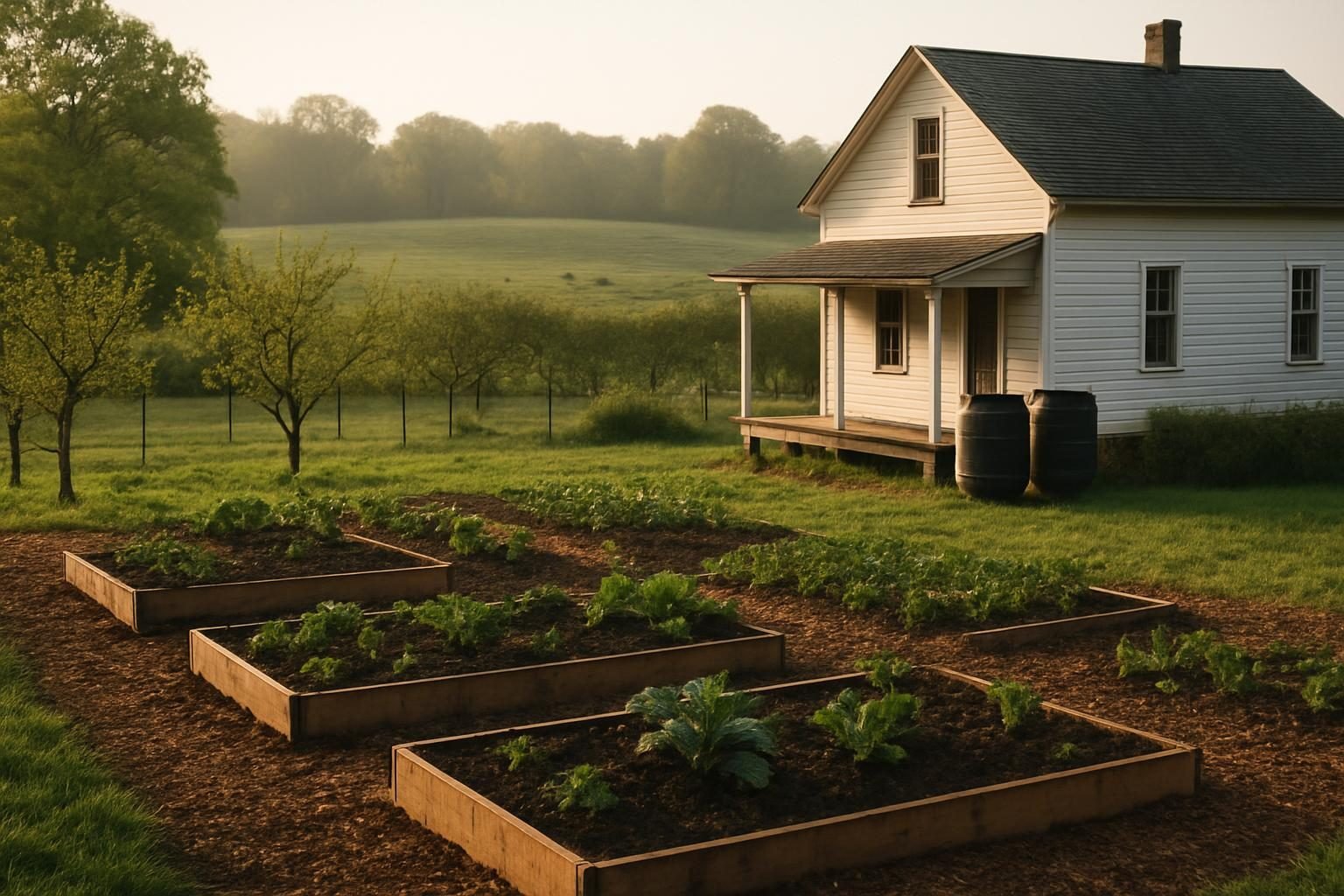
Rainwater harvesting is one of the cheapest ways to add water security to a farm or homestead, and one of the easiest to get wrong by sizing it on hope instead of arithmetic. Done well, it turns the roofs and ground you already have into a reliable supply for livestock, gardens and orchards.
This guide walks through the roof catchment math, storage options, earthworks and ponds, the legal patchwork across states, and how to match the water you catch to the jobs on your place.
Quick answer: Rainwater harvesting means capturing runoff from roofs or land and storing it in tanks, barrels, ponds or the soil itself. A rough rule: one inch of rain on one square foot of roof yields about 0.62 gallons, so a 1,000 sq ft roof in a 30-inch-rain area can shed up to roughly 18,000 gallons a year before losses. Size storage to your driest stretch, filter what you use, and check your state’s rules before you build.
Why harvest rain at all?
Rain arrives in pulses. A farm that can slow, spread and store those pulses has water when the weather turns dry, and it loses less soil and nutrient to runoff when the weather turns wet. Harvesting also takes pressure off wells, municipal supplies and streams, and it can cut pumping costs where you would otherwise haul or lift water.
It is not a cure-all. In arid regions, evaporation and low totals limit what you can catch. In the humid East, you may have plenty of rain but uneven timing. Either way, the principle is the same: capture close to where the water falls, store it as high on the land as practical, and use gravity where you can.
Roof catchment math
Start with the numbers, because they keep you from buying a tank that never fills or one that is far too small.
The basic formula
Gallons collected = roof footprint (sq ft) x rainfall (inches) x 0.623 x efficiency.
Use the footprint of the roof (the area it covers on the ground), not the sloped surface. Efficiency accounts for splash, gutter overflow, first-flush losses and evaporation. A typical working range is 75 to 90 percent, and metal roofs with clean gutters sit at the higher end.
A worked example
A barn with a 40 x 50 ft roof has a 2,000 sq ft footprint. In a place that gets 40 inches of rain a year, the theoretical yield is 2,000 x 40 x 0.623, or about 49,800 gallons. At 80 percent efficiency, plan on roughly 40,000 gallons. That is a sizeable resource sitting on a single building.
Match supply to demand
Demand is where many systems fall short. Typical planning ranges, which vary with climate, breed and management:
| Use | Typical daily need (planning range) |
|---|---|
| Beef cow or horse | 10 to 20+ gallons per head, more in heat |
| Sheep or goat | 1 to 4 gallons per head |
| Laying hen | About a quarter to half a gallon per bird |
| Vegetable garden | About 1 inch of water per week, roughly 0.6 gallons per sq ft |
| Young fruit tree | 5 to 15 gallons per week in dry weather |
Multiply daily demand by the longest dry period you expect, and that is your storage target. Your county extension office can tell you the typical dry-spell length and annual rainfall for your area.
Tanks, barrels and cisterns
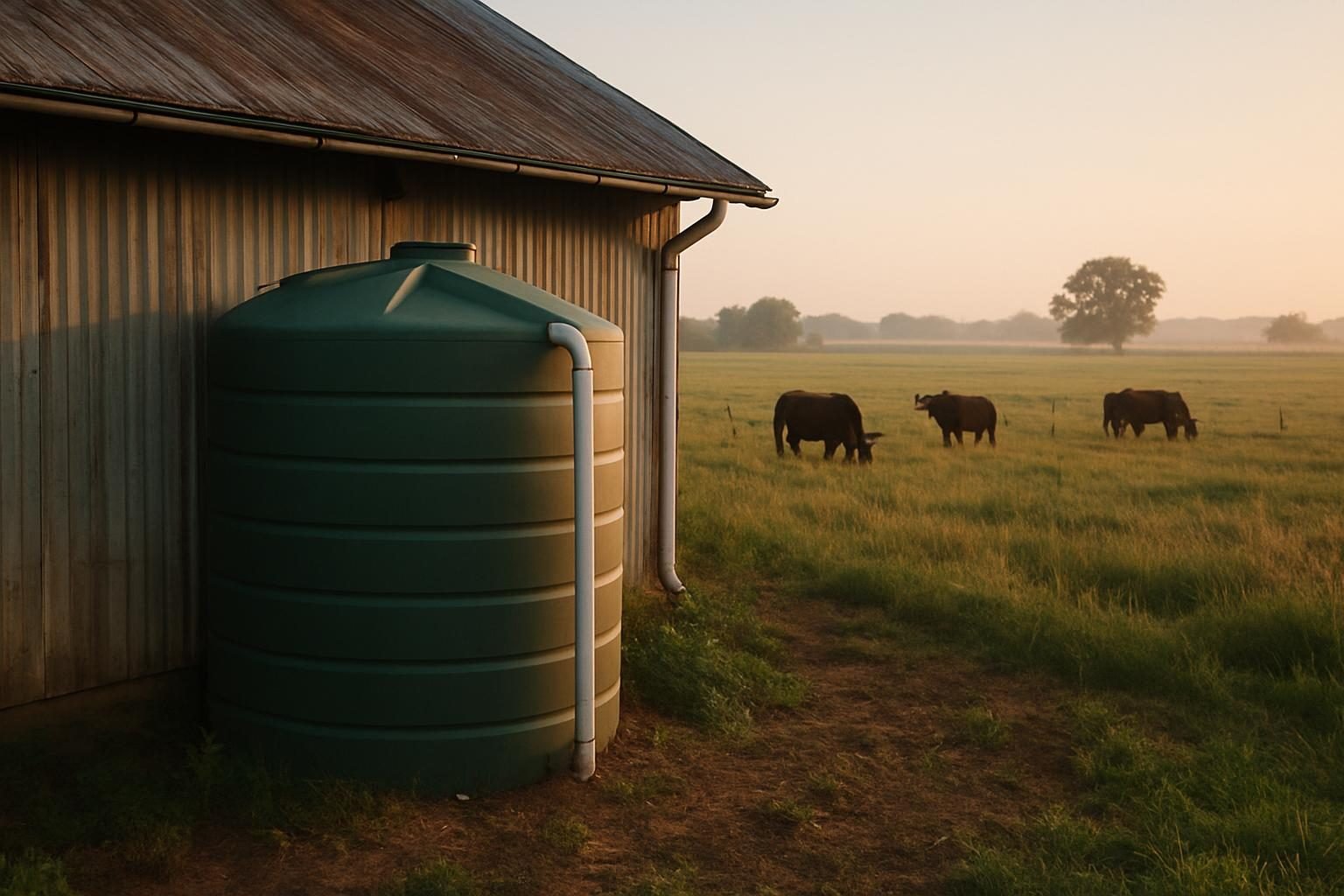
Storage is the heart of the system. Small setups can start with barrels, while larger needs call for tanks or cisterns.
- Rain barrels (about 55 gallons): Cheap and simple, good for a garden or a few hens. Linking several multiplies capacity; see our guide to setting up and linking a rain barrel system.
- Poly tanks (several hundred to several thousand gallons): The workhorse for most farms. Light, durable and available in food-grade versions.
- Steel, concrete and ferrocement cisterns: Long-lived and suited to large volumes, but costlier and heavier to install.
- Underground cisterns: Keep water cool and dark, which limits algae, and save surface space, at higher excavation cost.
Place storage uphill of where the water will be used so gravity does the work. Set tanks on a level, compacted, well-drained base, and plan for overflow to run somewhere useful, such as a garden bed, swale or pond, instead of eroding a bank. For sizing, materials and placement in depth, see our upcoming guide to rainwater collection tanks.
Keep it clean
Roof water carries dust, pollen, bird droppings and leaf litter. A leaf screen on the gutters, a first flush diverter to discard the dirtiest initial runoff, and a sealed, dark tank with screened vents all help. Water for livestock and irrigation usually needs less treatment than water for people, but it still benefits from sediment filtration. See rainwater filtration for the farm for options. If you ever plan to drink harvested water, check with your state health agency about testing and treatment requirements first.
In cold climates, drain or protect barrels, hoses and lines before hard freezes. Our guide to winterizing rain barrels and farm water lines covers it.
Ponds and earthworks: harvesting water from the land
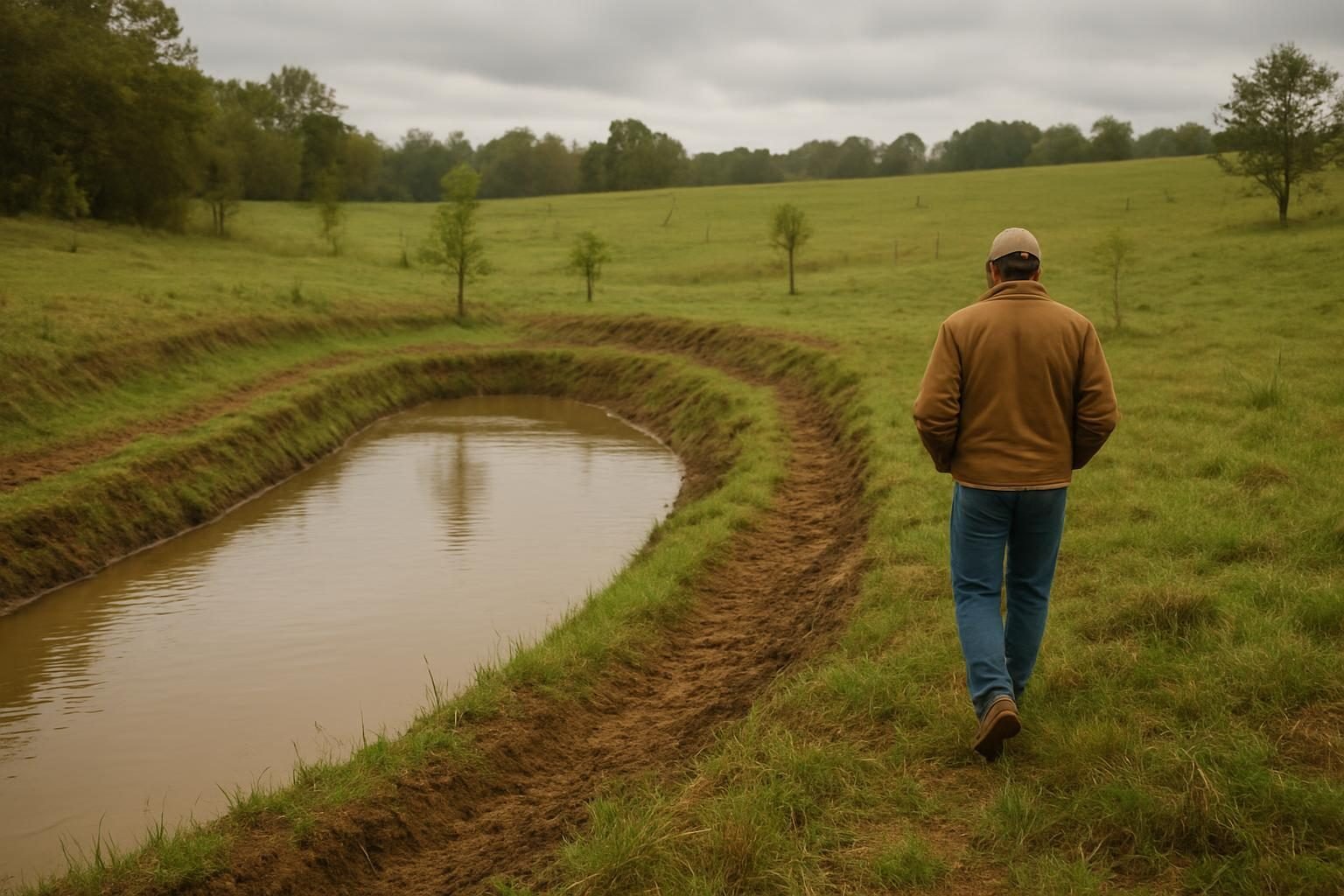
Roofs are small compared with the ground itself. Catching and slowing runoff across fields and pastures can store far more water, mostly in the soil, and it does so without tanks.
Farm ponds
A well-sited pond can supply livestock, fire protection and irrigation while adding habitat. Success depends on soil that holds water (clay content matters), a sufficient contributing watershed, a properly built dam and spillway, and often a permit. Evaporation and seepage can be significant, especially in the arid West. Read building a farm pond for water security and habitat before you break ground, and talk to your local NRCS office about design standards and cost-share possibilities.
Swales, keyline and contour work
Swales are level ditches and berms that intercept runoff and let it soak in. They work best on moderate slopes with soils that infiltrate, and they can fail or cause problems on heavy clay or steep ground. Our piece on when swales work and when they do not lays out the trade-offs. Keyline design takes a related approach, shaping the land to move water from wet areas toward drier ridges.
Soil as your biggest tank
Every 1 percent increase in organic matter can help soil hold additional water, though the amount varies widely by soil type. Cover crops, reduced disturbance and good grazing management all improve infiltration. This is why water harvesting and soil health belong together.
Tying water to trees and the whole-farm plan
Harvested water goes furthest when it feeds perennial systems that then protect and build the water cycle. Trees and shrubs in silvopasture, alley cropping and food forests benefit from slow, deep watering while they establish. A fruit tree guild placed at the end of a swale or downspout overflow is a classic pairing. Establishment is the thirstiest stage; once roots are deep, many systems need little added water.
Thinking about where water enters, travels and exits your property is design work. If you have not mapped it yet, the zones-and-sectors approach in permaculture design basics is a useful starting framework, and the broader agroforestry guide shows how trees and water planning fit together.
Using harvested water: livestock and irrigation
Livestock
Gravity-fed troughs fed from a hilltop tank are one of the best returns on a harvesting system, because they let you place water wherever the herd needs to graze. That flexibility supports rotational grazing by letting you move animals without being tied to a single water source. Keep troughs shaded and cleaned, and check them in summer heat.
Irrigation
Drip lines stretch stored water much further than overhead sprinklers by delivering it to the root zone with little evaporation. See our upcoming guide to drip irrigation for small farms. Low-pressure gravity systems can work fine if the tank is elevated enough, but pressure drops with height, so test before committing to a layout. Mulch and cover crops reduce how much you need to apply in the first place.
Is rainwater harvesting legal where you live?
Rules vary a great deal by state, and sometimes by county or water district. Many states encourage harvesting for small-scale uses. Some historically restricted collection because of water-rights doctrines, particularly in the arid West, though most have loosened limits for rooftop collection. Ponds and larger impoundments are more commonly regulated than barrels or tanks, and may need permits, dam-safety review or water-right filings. Using harvested water indoors or for drinking brings in health and plumbing codes.
This is general information, not legal advice. Before you build, confirm current rules with your state water or natural resources agency, your county, and your local NRCS or extension office, and ask about any permits for earthworks.
A simple planning sequence
- List what you want to water and estimate daily demand.
- Find your annual rainfall and longest typical dry spell.
- Measure roof footprints and run the catchment formula.
- Choose storage sized to the gap between supply and dry-season demand.
- Site tanks uphill, with overflow routed to productive use.
- Add screening, first-flush diversion and filtration.
- Check state and local rules, then build in stages and adjust.
If you are building this as part of a small property, our small-scale regenerative farming guide shows how water fits into the whole system. More water and tree topics live in the Agroforestry & Water category.
Key takeaways
- One inch of rain on 1 sq ft of roof gives about 0.62 gallons; plan on 75 to 90 percent efficiency.
- Size storage to your longest dry spell, not your average rainfall.
- Locate tanks uphill so gravity delivers water to troughs and beds.
- Ponds, swales and healthy soil store far more water than roofs alone, but they carry site and permit considerations.
- Filter and screen harvested water, and treat it before any human use.
- Laws differ by state; confirm with your water agency and local NRCS or extension office.
Frequently asked questions
How much water can I collect from my roof?
Multiply roof footprint in square feet by annual rainfall in inches and by 0.623 to get gallons, then reduce by 10 to 25 percent for losses. A 1,000 sq ft roof in a 30-inch area can yield roughly 14,000 to 16,000 usable gallons a year.
Is rainwater harvesting legal in every state?
No single rule applies. Many states allow or encourage rooftop collection, while some regulate volumes, uses or larger impoundments. Ponds more often need permits than barrels do. Check with your state water agency and county before building.
Can I use harvested rainwater for vegetables and livestock?
Generally yes, with filtration and sensible practices. Apply water at the soil level instead of overhead on leafy crops, and keep tanks covered and clean. Avoid collecting from roofs with treated or leaching materials, and ask your extension office about local guidance.
What size tank do I need?
Work backward from demand. Multiply daily use by the number of dry days you need to cover, then compare it with what your roof can supply. Many farms use several linked tanks so they can add capacity over time.
Do ponds or tanks work better for farm water storage?
They do different jobs. Tanks are compact, clean and easy to site above the use area. Ponds hold far more water at lower cost per gallon but lose water to evaporation and seepage, need suitable soil, and often require permits.