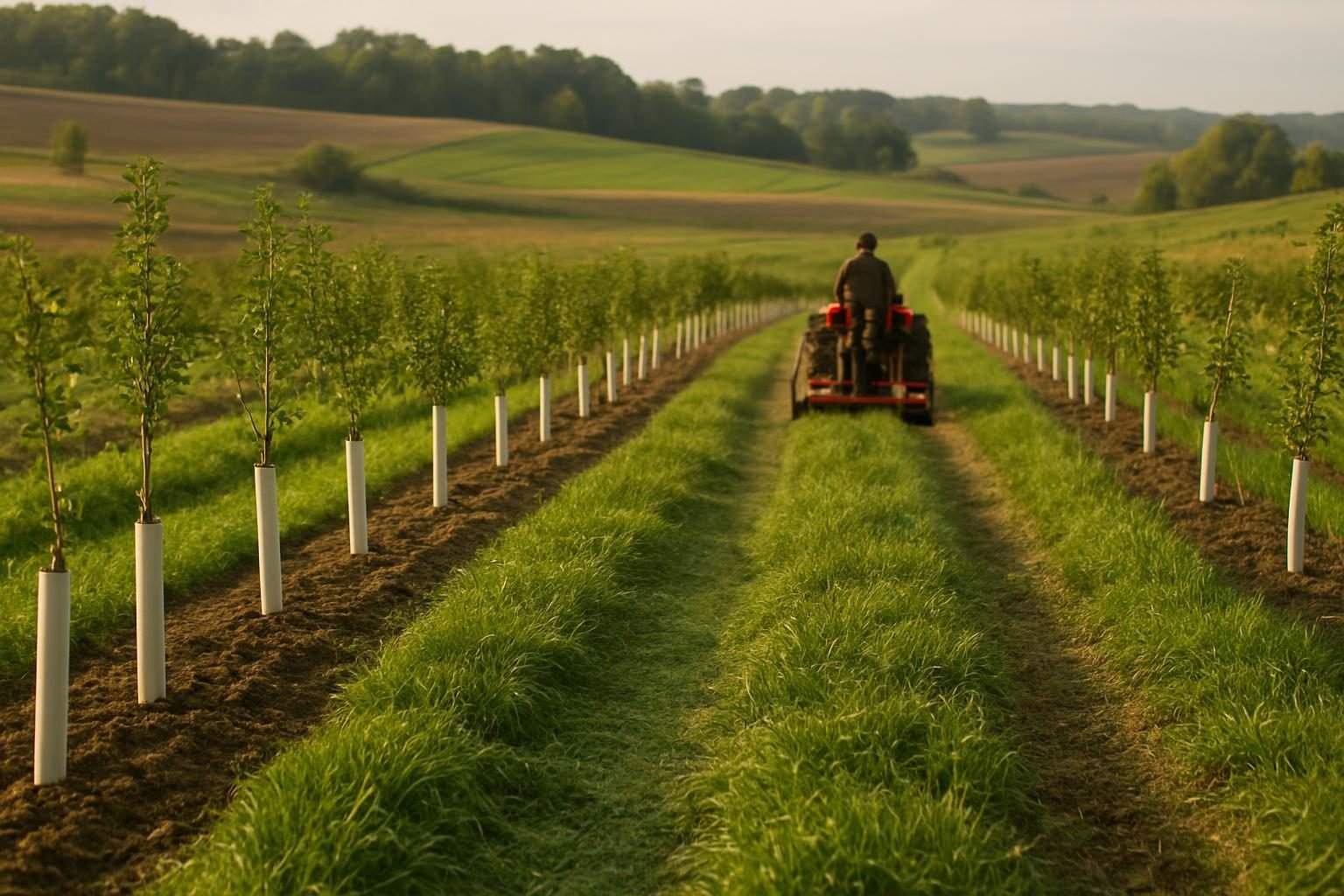
Alley cropping means planting rows of trees or shrubs and growing annual crops, hay or forage in the wide lanes between them. Done well, it lets one piece of ground produce two or more harvests, while the trees shelter soil, hold water and build a long-term asset. This guide covers design, pairings, spacing, income timing and the trade-offs, so you can decide if alley cropping fits your farm.
Quick answer: Alley cropping is a form of agroforestry in which tree rows (often nut, timber or fruit species) are planted 40 to 100 feet apart, with crops or hay grown in the alleys between them. Plan alleys as a multiple of your equipment width, choose trees suited to your climate, and expect crop income from year one but meaningful tree income only after 5 to 15 or more years, depending on species.
What alley cropping is and why farmers use it
Alley cropping sits alongside silvopasture and windbreaks in the agroforestry family. The difference is the focus: here the alleys are cropped, usually with machinery, rather than grazed continuously.
Farmers adopt it for several reasons:
- Diversified income. Annual crops pay while the trees mature, then nuts, fruit or timber add a second stream.
- Soil protection. Tree rows slow wind and water, and perennial roots and leaf litter build organic matter along the strip. See our guide on how to increase soil organic matter for realistic timelines.
- Microclimate. Trees can reduce wind desiccation and moderate temperature extremes for the crop.
- Water management. Rows planted on contour help slow runoff, a natural partner to keyline design.
Basic design: orientation, spacing and equipment
Design is where alley cropping succeeds or fails. Start with the machines you own, not with the trees you like.
Match alley width to your equipment
Measure your widest implement (sprayer boom, combine header, hay baler or planter). Make the alley a clean multiple of that width, plus a few feet of clearance each side for turning and for tree canopy growth. Typical alley widths run from about 40 to 100 feet; narrower alleys suit small tractors and market gardens, wider ones suit grain and hay equipment.
Choose a row direction
- East-west rows cast shade on the crop to the north of each tree row. Often a poor choice for sun-hungry crops.
- North-south rows distribute shade more evenly across the day and are commonly preferred for light-demanding annuals.
- Contour rows follow the slope to manage water and erosion, which can outweigh sun considerations on rolling ground.
Tree row layout
Tree rows can be a single line or a multi-species strip. In-row spacing depends on the tree: nut and timber trees are often planted 10 to 30 feet apart in the row, sometimes closer at first and thinned later. Leave a managed strip, commonly 6 to 12 feet wide, beneath the trees that is mulched or kept in grass or perennial cover rather than cropped.
Tree and crop pairings
Good pairings consider light, water, root depth and timing. Deep-rooted trees complement shallow-rooted crops better than trees that compete for the same top layer of soil.
| Tree or shrub | Typical crop in alleys | Notes |
|---|---|---|
| Pecan, black walnut, hickory | Hay, small grains, forage | Walnut produces juglone, which can stress sensitive crops such as tomatoes; choose tolerant crops |
| Chestnut, hazelnut | Hay, pasture, small grains, vegetables in early years | Hazelnut shrubs fit tighter spacing; chestnut needs room as it matures |
| Apple, pear, other fruit | Cover crops, hay, vegetables | Pest and disease management is more intensive than for nut trees |
| Hardwood timber (oak, ash alternatives, poplar hybrids) | Corn, soybeans, small grains, hay | Long rotations; pruning improves timber quality |
| Fruiting shrubs (elderberry, currant, aronia) | Hay, forage, cut flowers | Faster to first harvest, suits smaller farms |
For species detail, see our upcoming guide to nut trees for agroforestry. Always check your local extension service and NRCS office for varieties proven in your area.
Species by region
These are starting points, not prescriptions. Local soils, frost dates and pests matter more than any list.
- Humid East and Southeast: chestnut (blight-resistant selections), pecan in the South, black walnut, apples, persimmon, hazelnut hybrids bred for disease tolerance.
- Corn Belt and Midwest: black walnut, pecan in the southern tier, hybrid hazelnuts, oaks, hybrid poplar, fruit trees, with corn, soybeans or small grains in the alleys.
- Northern states: hazelnut, apples, hardy nut trees, aronia and other hardy shrubs.
- Arid and semi-arid West: drought-tolerant species and irrigated systems; water competition between trees and crops is the central problem, so design irrigation first.
- Pacific Northwest: hazelnut, apples and pears, Douglas-fir or other conifers for timber in suitable sites.
Income timeline: what to expect
The honest picture is a long game. Ranges below are typical and vary widely by species, site and management.
- Years 0 to 3: Establishment costs and labor. Alleys produce crops or hay at close to normal yields. Trees need protection from deer, rodents and weed competition.
- Years 3 to 8: Shrubs and some fruit trees begin bearing. Alley yields may begin to dip near tree rows as roots and shade expand.
- Years 8 to 20: Nut trees typically reach commercial production, with timing depending on species and variety. Alley crop choice often shifts toward shade-tolerant crops, hay or pasture.
- Years 20 and beyond: Timber trees approach harvest on long rotations. Mature nut trees can produce for decades.
Because tree income lags, many farmers phase planting, adding a few rows per year, and lean on alley crops for cash flow. Our regenerative farming business guide covers funding and markets, and farm grants for beginning farmers is a place to look for cost-share help. Confirm current agroforestry cost-share options directly with NRCS or your state forestry agency.
Managing competition between trees and crops
Trees and crops compete for light, water and nutrients. Manage this on purpose:
- Root pruning. Running a ripper or subsoiler along the row, some distance from the trees, can cut shallow roots and reduce competition. Timing and depth matter, so get local advice.
- Tree pruning. Raise lower branches over time to let light reach the alley and to produce straight timber.
- Crop choice. As canopy closes, move from sun-loving grain crops to hay, shade-tolerant forage or specialty crops.
- Soil feedback. Test soils under tree rows and in alleys to track nutrients and organic matter; see soil testing for regenerative farmers.
Water, soil and cover crops
Alley cropping works best as part of a whole-farm water plan. Contour tree rows can complement swales where they suit your site, and a farm pond can supply irrigation for establishment years. Keep cover in the alleys outside the crop season, using the mixes in our cover crop mixes guide, to protect soil and feed biology. Near streams, a riparian buffer is a separate, permanent planting that protects water quality.
Tree strips can also host pollinators and predators. Adding flowering shrubs, as described in planting hedgerows for pollinators, supports beneficial insects without taking alley space.

Challenges and trade-offs
- Upfront cost and labor. Trees, tubes, fencing, irrigation and weed control add up before any tree revenue.
- Machinery complexity. Turning at row ends, working around trunks and avoiding tree damage requires care and skilled operators.
- Wildlife pressure. Deer browse and rodent girdling can wipe out young plantings without protection.
- Market access. Nuts and specialty tree crops need buyers, processing or cleaning equipment, and storage. Line up a market before you plant. Our guide to the most profitable crops for small farms can help you pick alley crops that pay.
- Land tenure. Long-lived trees suit owners or long leases. Short leases make the payoff uncertain.
- Yield drag. Alley crops lose some area to tree rows and may yield less near them. Evaluate returns across the whole field, not just the alley.
A simple planning checklist
- Define goals: cash flow, timber, nuts, soil protection or a mix.
- Map slope, soils, drainage, water access and existing fences.
- Measure equipment and set alley width and row direction.
- Choose species proven locally and confirm markets.
- Plan protection, irrigation and weed control for years 1 to 3.
- Phase planting if budget is tight.
- Contact NRCS, your extension service or state forestry agency about technical help and current program options.
For the bigger picture of how this fits a whole-farm shift, read what is regenerative agriculture, browse regenerative agriculture examples, and explore the rest of our Agroforestry & Water section. If you want a more intensive, layered planting instead, compare it with how to plant a food forest.
Key takeaways
- Alley cropping pairs tree rows with crops or hay in the lanes between them, giving two income streams from one field.
- Design alleys around your equipment width, typically 40 to 100 feet, and choose row direction for sun and slope.
- Match trees to your region and pair deep-rooted trees with shallow-rooted crops.
- Expect crop income early and tree income late; nut crops often take many years to mature.
- Plan for competition management, wildlife protection and markets before planting.
- Confirm current cost-share and technical help with NRCS, extension or your state forestry agency.
Frequently asked questions
What is the difference between alley cropping and silvopasture?
Alley cropping grows annual crops, hay or specialty crops in the lanes between tree rows, usually with machinery. Silvopasture integrates trees with grazing livestock and managed forage. The two can overlap, since alleys can be hayed or grazed in some systems.
How wide should the alleys be?
Make the alley a multiple of your widest implement plus clearance for turning and canopy growth. Typical widths run about 40 to 100 feet. Wider alleys reduce shade and competition but dedicate less land to trees.
How long until trees produce income?
It depends on species. Fruiting shrubs may bear within a few years, many nut trees take roughly 8 to 15 years or more to reach commercial yields, and timber can take decades. Alley crops provide income in the meantime.
Will trees reduce my crop yields?
Often yes, near the tree rows, due to shade and root competition. Good design, pruning, root management and crop selection reduce the effect. Judge performance on whole-field returns including the tree products rather than alley yield alone.
Can I do alley cropping on a small farm or homestead?
Yes. Smaller systems can use narrower alleys, shrubs such as hazelnut or elderberry, and hand or small-tractor management. The same principles of spacing, species choice and market planning apply at any scale.