Adaptive multi-paddock grazing, usually shortened to AMP grazing, is one of the most talked-about ways to manage livestock on grass. It is also one of the most misunderstood. This guide explains what it is, how it differs from ordinary rotation, what the research does and does not show, and how to try it with temporary fence.
Quick answer: Adaptive multi-paddock grazing divides pasture into many small paddocks, grazes each one briefly at relatively high stock density, and then rests it until plants have fully recovered. The “adaptive” part means move dates and recovery periods change with growth rate, weather and animal needs rather than following a fixed calendar. Research shows promising soil and forage benefits in some settings, but results vary and the evidence is not uniform.
What is adaptive multi-paddock grazing?
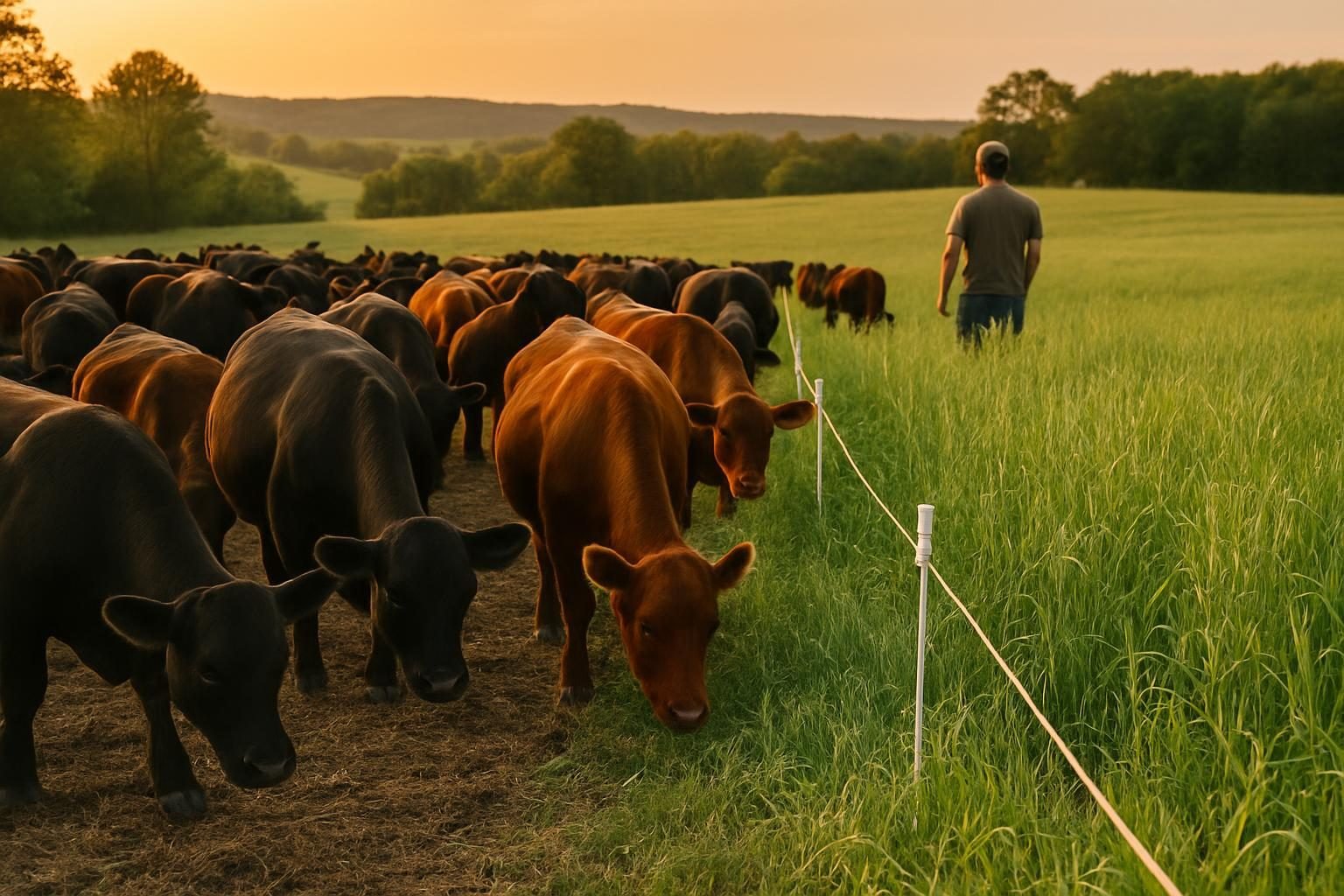
AMP grazing (adaptive multi paddock grazing) is a management approach, not a fence layout. You split a grazing area into many paddocks, put the herd or flock in one at a time, and move them often. Each paddock then gets a long rest while the plants regrow and rebuild roots. This approach can be combined with trees and other vegetation through practices like silvopasture for additional benefits.
The idea draws on decades of work by grazing managers and researchers who observed that grazing is not harmful by itself. The damage comes from animals staying too long, or returning too soon, to plants that are regrowing. AMP tries to control both of those.
If you are new to the wider topic, our complete guide to rotational and adaptive grazing covers the basics. This article goes deeper on the AMP method specifically.
AMP grazing vs. simple rotational grazing
Plenty of farms “rotate” between three or four big pastures every couple of weeks. That is better than set-stocking in many cases, but it is not AMP. The differences are mostly about intensity and flexibility.
| Feature | Simple rotation | AMP grazing |
|---|---|---|
| Number of paddocks | Often 3 to 6 | Often 12 to 50 or more |
| Time in each paddock | Days to weeks | Typically a day or a few days, sometimes less |
| Rest period | Fixed schedule | Variable; set by plant recovery |
| Stock density | Low to moderate | Moderate to high |
| Decision basis | Calendar | Observation of forage, weather and animals |
The practical difference: with simple rotation, animals can still graze regrowth in a paddock if they stay long enough. With AMP, short grazing periods are meant to prevent that.
The four levers of AMP grazing
1. Stock density
Stock density is how many animals are on a given area at one moment, often expressed as pounds of live weight per acre. It is different from stocking rate, which is animals per acre over a whole season or year. If you want help with that second number, see our planned guide on how many acres per cow.
Higher density makes grazing more even. Animals have less room to be picky, so they eat more of the plant species in the paddock and trample some residue onto the soil surface. Typical AMP densities run from a few tens of thousands of pounds of live weight per acre upward. Extreme densities fall under mob grazing, which is a more intense relative of AMP. These principles apply across livestock species, including pastured poultry.
2. Frequent moves
Short stays protect regrowth. Cattle often take a new bite of a plant within a few days of grazing it, and that is the bite that sets the plant back. Moving the herd daily, or even twice a day on lush pasture, keeps them off plants that have just been bitten.
3. Long recovery periods
Rest is where most of the benefit is supposed to come from. Plants need time to regrow leaf area and refill root and crown reserves. Typical recovery periods are:
- About 30 to 60 days in fast-growing, humid-season conditions
- 60 to 100 days or more in slower seasons or drier regions
- Sometimes well over 100 days in arid rangeland, where one grazing pass per year may be all the land can handle
These are general ranges. Your local extension office or NRCS conservationist can give you figures for your forage species and climate.
4. Adapting to conditions
This is the “adaptive” part, and it is the one people skip. Instead of moving on day 3 because the calendar says so, you decide based on what you see:
- How tall and how dense the forage is, and how fast it is growing
- Whether recovery is complete in the paddock you plan to enter next
- Rainfall, heat and soil moisture
- Animal needs, such as lactating cows or finishing animals that need higher-quality bites
In a drought, you may need to slow the rotation, shrink the herd or feed hay. In a flush of spring growth, you may need to speed up and even cut surplus for hay. A plan that cannot flex is not really AMP.
What the research says
The evidence is encouraging but mixed, and it is worth being clear about both sides.
Soil carbon
Several comparisons of AMP ranches with conventionally grazed neighbors, including work in the southeastern and south-central United States, have found higher soil carbon on the AMP land. That is the finding often cited in the regenerative movement. Researchers have also reported improvements in soil structure and microbial activity in some of these studies.
Honest caveats:
- Many studies compare working farms side by side rather than randomized trials, so differences in soil type, past land use or management history can muddy the results.
- Soil carbon varies a great deal across a single field, and results depend on sampling depth and method.
- Soil can only hold so much carbon. Gains tend to slow over time, and they can be reversed if management changes.
- When researchers tally whole-farm greenhouse gas balance, including methane from cattle, soil carbon gains may offset only part of the emissions.
Forage production and animal performance
Reviews of small-plot grazing experiments have often found that rotational grazing does not consistently beat continuous grazing for plant growth or animal gain when the stocking rate is the same. Farmers who report big improvements are often also changing other things: lowering the stocking rate, adding water points, managing for rest, or paying closer attention overall.
That does not make AMP a failure. It suggests the benefits come from managing recovery, utilization and timing, and not from a particular fence pattern. Many producers also report better drought resilience, more even manure distribution, and more usable days of grazing per year, and those are real management gains even if they are harder to capture in a plot trial.
The takeaway: treat AMP as a promising approach to test on your own land and measure, not a guaranteed fix. For the bigger picture, our overview of regenerative agriculture principles explains where grazing fits.

How to start AMP grazing with temporary fencing
You do not need to subdivide the whole farm with permanent fence. Temporary electric fence lets you start small, learn, and adjust the layout before committing.
- Map your land. Print an aerial photo from a free mapping tool and mark water, shade, slopes, wet spots, trees and existing fence. Note where forage differs.
- Start with one manageable block. Pick a pasture of 5 to 20 acres or so, depending on herd size, and divide it into at least 8 to 12 paddocks. You can add more later.
- Choose your fence gear. A typical temporary setup includes a properly sized energizer (solar or plug-in), polywire or polytape, step-in posts, a few sturdy corner posts, and reels. Make sure the energizer is rated for the length of fence and the type of animal. Good grounding matters more than most beginners expect.
- Plan water first. Animals need water in or near every paddock, or a lane that reaches it. Portable troughs and hose lines work well. Our planned guide to water systems for rotational grazing will cover pipelines and tank options in detail.
- Train the animals. Introduce them to electric fence in a small, secure pen so they learn to respect it. Once trained, a single strand of polywire is often enough for cattle.
- Set a move rule. A beginner-friendly target is to graze roughly a third to half of the available forage and leave the rest standing. Typical residual heights are around 3 to 4 inches for many cool-season pastures, but this varies with species and region.
- Keep records. Write down move dates, paddock names, rainfall and how many days of rest each paddock got. A simple notebook or spreadsheet is enough, and these records are what let you adapt.
- Review and adjust. After one grazing season, walk each paddock. Look at residual height, bare ground, species mix and manure distribution, then change paddock sizes and rest periods accordingly.
Cost-share for fence and water is sometimes available through USDA NRCS programs. Programs and amounts change, so confirm current details with your local NRCS office. If you plan to sell the beef or lamb with regenerative claims, our guide to regenerative farming business, funding and certification is a good next stop.
Regional differences to plan for
- Humid East and South: Fast growth means short recovery periods in peak season, but heat, parasites and fescue endophyte issues can complicate things. Summer slumps may need warm-season forage or a slower rotation. You can also plan stockpiling forage for fall and winter grazing.
- Corn Belt and Midwest: Pasture is often a small part of the farm. Temporary fence works well on grass paddocks and on annual forages or cover crops. See our cover crops for beginners guide for grazing-friendly options.
- Arid and semi-arid West: Rainfall is unpredictable and growth is slow. Recovery periods are very long, and the most important adaptation may be adjusting animal numbers. Fewer, larger paddocks with well-placed water often make more sense than dozens of tiny ones.
Common mistakes
- Too few paddocks, too soon. Three paddocks with long stays is simple rotation, not AMP.
- Returning too early. Pressure to “keep the rotation going” leads to grazing regrowth. Slow down when growth slows.
- Overstocking. No grazing system can make up for too many animals on too little forage.
- Ignoring water and shade. Long walks to water reduce gains and cause trails and compaction.
- Skipping monitoring. Without records, you cannot tell whether a change worked.
Once your herd is comfortable moving every day or two, you can experiment with extras such as multi-species grazing or following cattle with poultry. Browse more in our Grazing & Livestock section.
Key takeaways
- AMP grazing means many paddocks, short grazing periods, higher stock density and long, flexible recovery.
- The adaptive part, deciding by observation rather than the calendar, is what separates it from simple rotation.
- Research suggests soil carbon and structure benefits in some cases, but evidence on forage and animal performance is mixed, and results depend on context.
- Start small with temporary fence, plan water first, keep records and adjust each season.
- Adjust for your region and confirm program details with local NRCS or extension.
Frequently asked questions
Is AMP grazing the same as mob grazing?
Not exactly. Mob grazing is a more extreme form of AMP with very high stock density, short stays and often very long rest. AMP covers a broader range of densities and paddock sizes, and many farms use moderate densities that fit their forage and labor.
How many paddocks do I need for AMP grazing?
There is no single number. A common starting point is 8 to 12 paddocks, and many AMP operations use 20 or more. The right number depends on herd size, how long you want to rest each paddock and how fast your forage grows. More paddocks give you more control but require more fence, water and time.
Does AMP grazing really build soil carbon?
Some studies have found higher soil carbon under AMP than under conventional grazing, but the evidence is not universal. Soil type, climate, past management, and sampling methods all affect results, and carbon gains eventually level off. Treat it as a possible benefit and monitor your own soil over time.
Can I do AMP grazing on a small acreage?
Yes. Small farms and homesteads often find AMP easier because moves are quick and temporary fence is inexpensive. The principles are the same: small paddocks, short stays and long rest. Just be careful not to overstock, since limited land has limited recovery capacity.
What equipment do I need to begin?
At minimum: an energizer, polywire or polytape, step-in posts, a good ground system, reels, and a way to bring water to each paddock, such as hose and portable troughs. A fence tester and a notebook for records are also worth having. Start with what fits your first block and expand as you gain experience.