Pastured poultry means birds that spend their days on living pasture, eating forage and bugs alongside their feed, and moving to fresh ground often. Done well, it turns a small flock into a soil-building tool and a tidy income stream. This guide walks through the main systems, the broiler-versus-layer decision, how to run birds behind cattle, predator protection, processing rules, and what the numbers typically look like.
Quick answer: Pastured poultry is raising chickens on fresh grass that they are moved onto regularly, using one of three common systems: floorless chicken tractors (best for broilers and small flocks), day-range with mobile coops (more labor-light, more predator exposure), or eggmobiles that follow ruminants (best for layers on a grazing operation). Broilers finish in roughly 8 to 12 weeks and are processed; layers produce for years. Check your state’s processing and sales rules before you buy a single chick.
Why put chickens on pasture at all?
Chickens are not ruminants, so they do not replace cattle or sheep in a grazing plan. What they add is a different set of behaviors: scratching apart manure pats, eating fly larvae and insects, and concentrating nutrients in a small area for a short time. That fits the core regenerative idea of mimicking natural patterns with managed movement, which we cover in What Is Regenerative Agriculture? Principles and How to Start.
Be honest about the trade-offs, though. Poultry are fed grain, so a lot of the nutrients they deposit were imported, not grown on site. Pasture typically supplies a modest share of a bird’s diet, and the share depends on forage quality and season. The benefit is real but is often more about nutrient redistribution, pest suppression and product quality than about carbon storage. For what the evidence supports, see Benefits of Regenerative Agriculture: What the Evidence Shows.
Three ways to run pastured poultry
Chicken tractors
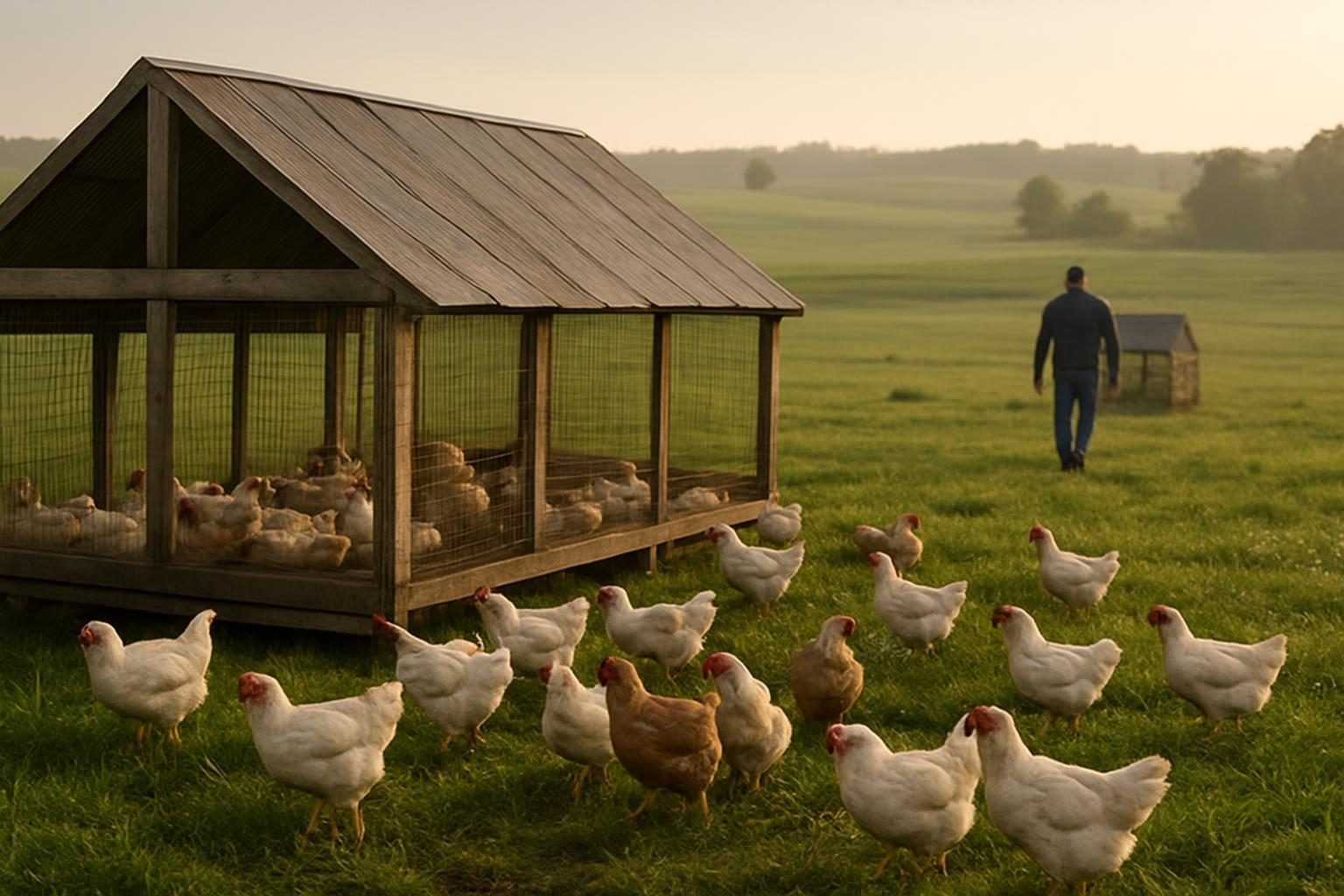
A chicken tractor is a floorless, lightweight pen, often 10 by 12 feet or similar, moved by hand or small vehicle once or twice a day. Birds always have fresh forage and are protected from most predators. This is the classic broiler system and a good starting point for beginners because the capital outlay is small and the learning curve is forgiving. The downside is labor: daily moves, in all weather, add up fast.
Day-range with mobile coops
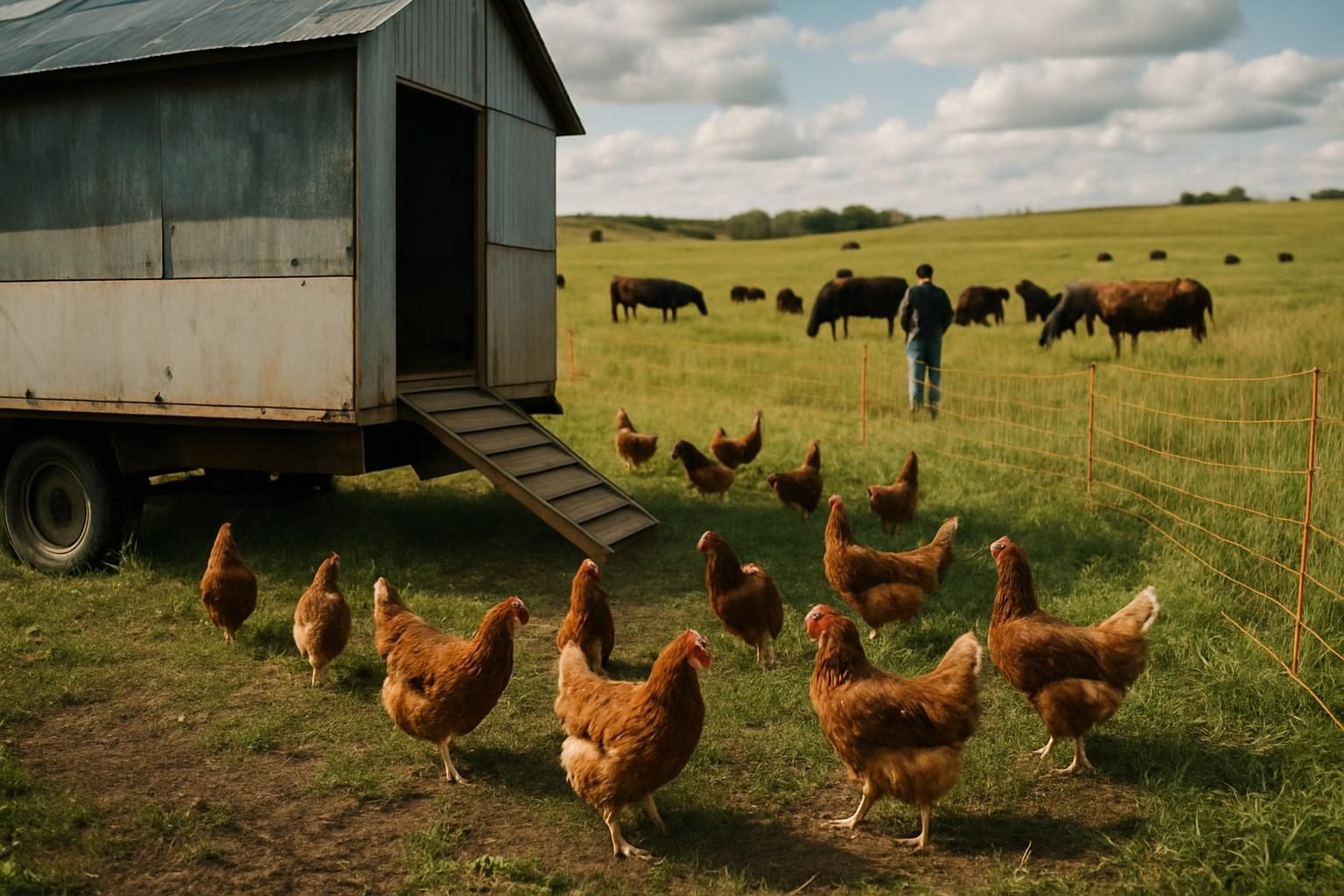
Here birds sleep in a wheeled or skid-mounted shelter and roam a fenced or netted area during the day. Move the shelter every few days, and shift the electric netting as needed. It is less labor per bird than tractors at larger scale, and birds can express more natural behavior. The trade-off is predator pressure, especially from hawks, owls and foxes, plus more risk of bare, over-scratched ground if you move too slowly.
Eggmobiles
An eggmobile is a mobile laying house, often a converted trailer or hoop structure with nest boxes, that follows ruminants through the paddocks by several days. Hens scratch through the dung, eat fly larvae and clean up leftover forage, then the whole system rotates on. It pairs naturally with an existing grazing plan; see Rotational Grazing: A Complete Guide to Adaptive Grazing and Adaptive Multi-Paddock (AMP) Grazing Explained for the underlying paddock system.
| System | Best for | Typical flock size | Labor | Main risk |
|---|---|---|---|---|
| Chicken tractor | Broilers, beginners | Roughly 50 to 75 birds per pen | High (daily moves) | Heat stress, weather exposure |
| Day-range | Broilers or layers, moderate scale | Hundreds | Moderate | Predators, bare ground |
| Eggmobile | Layers on a grazing farm | Roughly 100 to 500 hens | Moderate | Timing behind livestock, winter logistics |
Flock sizes are typical ranges and vary with pen design, stocking density and local guidance. Check your extension service for density recommendations.
Broilers versus layers
The two enterprises behave very differently, so choose deliberately.
Broilers (meat birds)
- Timeline: Commonly 8 to 12 weeks from chick to processing, depending on breed. Fast-growing hybrids finish sooner but struggle in heat and on rough ground; slower heritage-type or pasture-adapted strains take longer and forage more.
- Cash flow: Fast turnaround. You can run several batches in a season, usually between spring and early fall in most regions.
- Labor peaks: Brooding, daily moves and processing day.
- Soil effect: Concentrated, short-term nutrient deposition in tractors, great for pasture renovation behind grazers if managed.
Layers (egg hens)
- Timeline: Hens typically start laying around 5 to 6 months and stay productive for a couple of years before declining.
- Cash flow: Slower start, steady revenue, but winter production dips and feed costs continue.
- Labor: Daily egg collecting, washing and packing, plus coop moves.
- Soil effect: Lower per-acre intensity, spread over a longer period, fits well with ruminant rotations.
A mixed approach, with layers as the base and a few broiler batches for peak-season cash, is common. Do not start with both at scale in year one.
Following cattle: how it works
Running poultry behind ruminants is the most regenerative-flavored version of the practice, and it works because of timing. Cattle graze a paddock and move on. Three to five days later, which is roughly the window before fly larvae mature in the pats, the birds go in. They scratch the manure apart, eat larvae and bugs, and spread nutrients before the herd returns, ideally weeks later, once the paddock has recovered. This follows the same principles as high stock density grazing.
A few practical points:
- Plan the sequence. Birds go in only after cattle have left and only for a short stay. Longer stays risk scratching bare ground.
- Match flock to herd. A small herd moving slowly needs a small flock. Oversized flocks tear up sod.
- Watch the weather. Wet conditions raise parasite and disease risk when birds follow livestock. Dry, warm spells make this system shine.
- Keep water mobile. You will likely need a portable water plan for both species; see water systems for rotational grazing for options as that guide goes live.
The same logic extends to other combinations, including multi species grazing with sheep and goats, and to pastured pigs in separate rotations. If your operation is built around grass finished beef, poultry can add a second enterprise on the same acres without competing for the same forage, since the main inputs for birds are purchased feed and labor.
Predator protection
Losses are the quiet budget killer in pastured poultry. Plan for them from day one.
- Overhead: Hawks and owls are the main daytime and dusk threats. Tractors with solid or netted tops solve this; open day-range needs cover, guardian animals or both.
- Ground: Foxes, coyotes, raccoons, weasels and dogs. Electric poultry netting works well when charged properly and kept clear of vegetation. Tractors should have skirts or be tight to the ground.
- Night: Shut birds into a secure shelter every evening. Most losses happen at dusk and after dark, so a reliable closing routine matters more than any piece of gear.
- Guardians: Livestock guardian dogs, and sometimes donkeys or llamas, can reduce losses, but they need training and are not a substitute for fencing and shelter.
- Ranging distance: The farther from the shelter, the higher the risk. Start tight and widen only as you learn your local predator pressure.
Predator mix differs by region. Hawks and raccoons dominate in much of the East and South, coyotes and eagles are bigger concerns in the arid West, and open Corn Belt ground gives little cover, which raises aerial risk. Talk to local growers.
Processing rules: verify locally
This is where beginners get tripped up. Rules vary by state, and sometimes by county, and they change. In broad terms, the United States has federal exemptions that allow small-scale on-farm slaughter and sale of poultry under specific volume limits, while larger volumes or sales across state lines generally require inspected facilities. Many states layer their own licensing, labeling, sales-channel and facility requirements on top.
Before you order chicks:
- Contact your state department of agriculture and ask what is allowed for on-farm processing and direct sales at your intended volume.
- Ask your extension office about local inspected processors and whether they take poultry; capacity is often limited and booked months ahead.
- Confirm labeling, record-keeping and sales-channel rules (farmers markets, CSA, restaurants, retail).
- Check egg rules separately: washing, refrigeration, candling, carton labeling and registration requirements differ by state.
Nothing here is legal advice. Confirm current details with your state and federal agencies.
Economics as ranges
Numbers vary hugely by region, breed, feed cost, scale and sales channel, so treat the following as a framework, not a forecast.
- Startup costs: Brooder, tractors or mobile coops, fencing or netting, waterers and feeders, and processing equipment if doing it yourself. Expect a modest outlay for a small broiler run, and more for a mobile laying house or fenced day-range.
- Feed: Usually the largest operating cost. Organic or non-GMO feed costs more than conventional, and the premium varies by supplier and region.
- Per-bird margins: Pastured broilers often sell at a clear premium over supermarket chicken, but labor, processing fees and losses can eat most of it. Many small producers find that margins are thin until they have streamlined their systems.
- Eggs: Pastured eggs also command a premium in many markets, but hen replacement, feed and packing labor matter. Demand is local and seasonal.
- Labor: Track your own hours honestly. A profitable-looking enterprise can turn out to pay very little per hour.
Build a simple per-batch spreadsheet covering chick cost, feed, processing, packaging, mortality and sale price, then compute net return per bird and per hour. For funding, certification and sales channels, see Regenerative Farming Business: Funding, Certification, Sales. Some cost-share programs may support fencing and water infrastructure for grazing systems, so check EQIP for Regenerative Farmers: Get NRCS Cost-Share and confirm current eligibility with your local NRCS office.
Getting started: a simple first-season plan
- Check regulations and line up a processor or confirm your on-farm limits.
- Start small: one batch of 50 to 100 broilers in tractors, or a small laying flock.
- Pick suitable genetics. Ask hatcheries about pasture-adapted strains for your climate.
- Prep the ground. Healthy, diverse sod pays back; thin or bare areas will degrade faster under birds.
- Record everything: losses, feed conversion, hours, weather, sales.
- Scale only after one clean season.
If you are weaving this into a broader plan, How to Transition to Regenerative Agriculture: 3-Year Plan shows where a poultry enterprise can fit. Trees can help too: shade lowers heat stress and gives cover from raptors, which ties into Silvopasture: How to Combine Trees, Forage and Livestock.
Key takeaways
- Pastured poultry adds nutrient redistribution, pest suppression and product value, but birds still depend on purchased feed.
- Tractors suit beginners and broilers; day-range cuts labor but raises predator risk; eggmobiles pair layers with grazing livestock.
- Timing behind ruminants, usually a few days after they leave, is the key to a good sequence.
- Predators and processing rules decide many first-year outcomes, so plan for both before buying birds.
- Track costs and hours per batch; margins can be thin without efficient systems.
Frequently asked questions
How much of a chicken’s diet can come from pasture?
It depends on forage quality, season, breed and stocking density, but pasture typically supplies a modest portion of the diet, with the bulk still coming from supplemental feed. Pasture mainly adds greens, insects and better bird behavior. Ask your extension service for local guidance.
Can chickens graze with cattle at the same time?
Usually it works better in sequence than together. Birds placed a few days behind cattle can break up manure and eat fly larvae, similar to how bale grazing leverages animal impact for soil benefit. Mixing them in the same paddock at the same time raises predator, parasite and management complications for little gain.
What is the easiest way to start with pastured poultry?
Most beginners do best with a single batch of broilers in floorless chicken tractors during warm weather. The system is cheap, predator-resistant and teaches brooding, moving, feeding and processing in a manageable package.
Do I need a license to sell pastured chicken or eggs?
Often yes, or at least you must meet specific conditions, and the rules differ by state and by sales channel. Contact your state department of agriculture before selling, and confirm egg and poultry requirements separately.
Is pastured poultry profitable?
It can be, especially with strong direct-market demand and efficient systems, but margins are often thin once labor, feed, processing and losses are counted. Run a per-batch budget, track your hours and scale gradually.