Grass finished beef sounds simple: cattle eat grass, then we sell the meat. In practice, finishing an animal to a consistent, tender, well-marbled carcass on forage alone is one of the hardest things a grazier can do. It rewards good planning more than almost anything else on the ranch.
This guide covers what the labels actually mean, which cattle finish well on grass, what forage quality has to look like, how long it takes, and how to market the result without overpromising.
Quick answer: Grass finished beef comes from cattle that eat only forage (grazed pasture, stored hay or haylage) from weaning to harvest, with no grain finishing. Success depends on three things: moderate-framed, early-maturing genetics, a steady supply of high-quality, high-energy forage in the last 90 to 120 days, and a finishing timeline of roughly 20 to 30 months. Expect trade-offs in cost, time and carcass variability.
Grass-fed vs grass-finished: what the labels mean
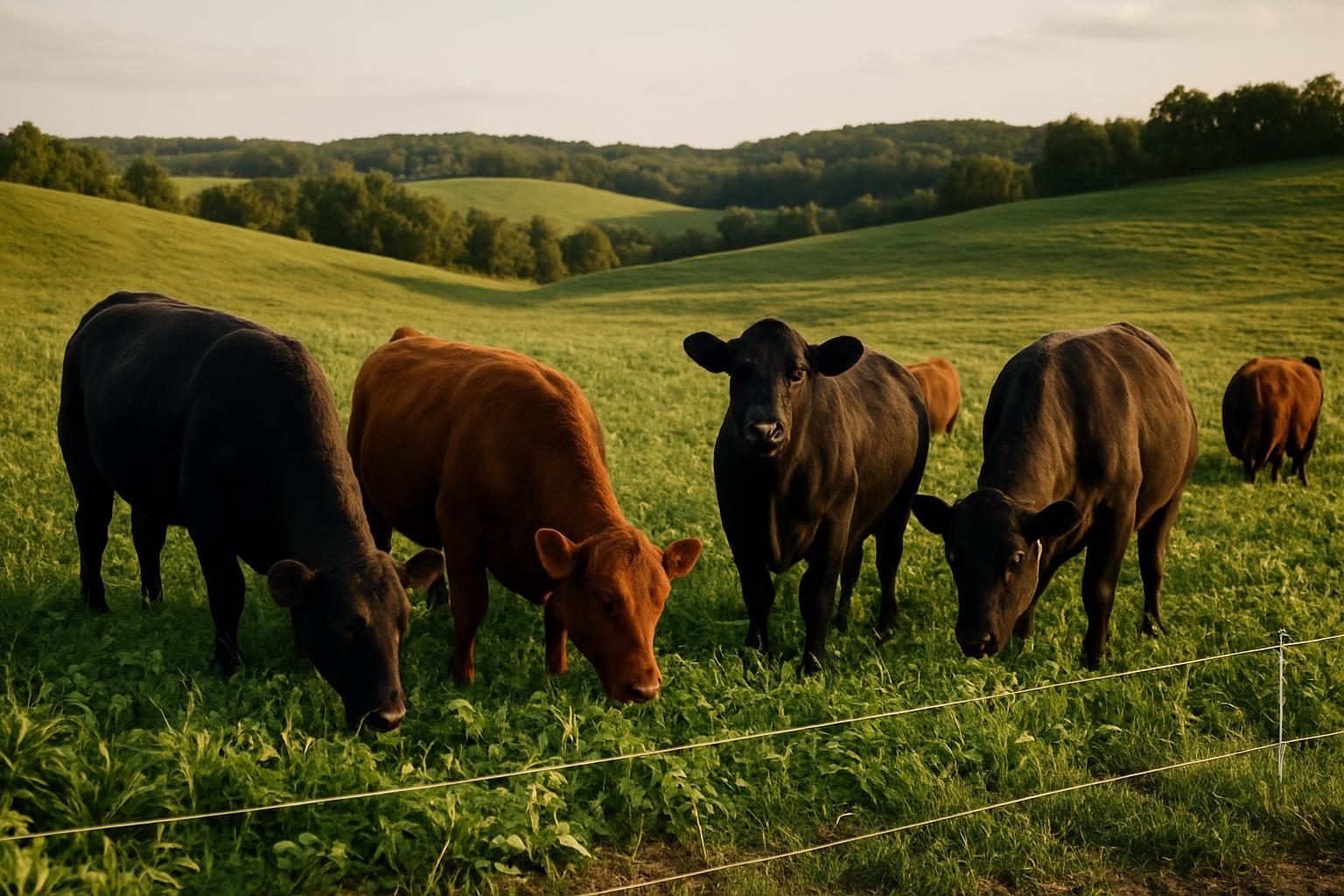
Every calf starts on milk and then forage, so nearly all beef cattle are “grass fed” for part of their lives. The difference is what happens at the end. Conventional feedlot cattle spend roughly the last four to six months on a grain-based ration. Grass-finished cattle never leave forage.
Be careful with the wording on packages. “Grass-fed” alone has historically been loosely applied, and federal label oversight has changed over the years. Third-party programs (such as certified grassfed or pasture-raised standards) set their own rules on feed, antibiotics, confinement and record keeping. If you plan to use a specific claim, check current requirements with USDA FSIS and with the certifier before printing a single label.
Be honest with customers, too. “Grass finished” describes the diet. It does not by itself guarantee a regenerative system, though good grazing management is how most producers get there. See our guide to what regenerative agriculture is for how the pieces fit.
Genetics and frame size: the foundation
Genetics is where many first-time grass finishers fail. Cattle bred for the feedlot are selected to reach finish weight on dense, starchy rations. They are often large framed and late maturing, which means they keep growing muscle and bone and fatten late, if at all, on forage.
For grass finishing, you generally want:
- Moderate frame size (often frame score 3 to 5), with mature cow weights commonly in the 900 to 1,200 lb range.
- Early maturity, so animals deposit fat at lighter weights.
- Good forage conversion and a docile temperament, since stress hurts gain.
- Adaptation to your climate: heat-tolerant types in the South, cold-hardy types in the northern Plains.
Many graziers cross British breeds (Angus, Hereford, Shorthorn, Devon and others) and select within their own herd for animals that finish on grass. This is a multi-year project. Keep records on which calves hit finish at what age and weight, and breed from the ones that do it on your ground. Buying in stockers is possible, but ask the seller about their genetics and how they were grazed, because a mismatched animal can drag out for months.
Forage quality for finishing
Growing an animal on grass is easy. Finishing one is a different job, because fat deposition needs surplus energy. Late-stage cattle need forage that is high in digestible energy and moderate in protein, and they need plenty of it. Mature, stemmy, or weathered grass will maintain an animal but rarely fattens it.
Good finishing forage tends to be:
- Leafy, vegetative and actively growing (not seed-headed or lignified).
- A mix of grasses and legumes. Legumes such as clover and alfalfa raise protein and intake, though watch for bloat.
- Sugar-rich. Cool-season grasses under bright, cool conditions and some brassicas can add energy.
- Offered in adequate quantity so animals can select the best bites.
Warm-season annuals like sorghum-sudangrass, millet and some summer mixes can fill gaps, but their quality varies, and some carry prussic acid or nitrate risks. Confirm management details with your local extension service.
The grazing system matters as much as the plant. Moving cattle to fresh paddocks often, and leaving enough residual, keeps plants in their leafy, high-quality stage and improves intake. Our guides to rotational grazing and adaptive multi-paddock grazing explain how to set that up, while mob grazing shows the high-density end of the spectrum. Just remember that very high density can reduce selectivity, which is a trade-off when you are trying to fatten animals.
Rate of gain and the finishing timeline
Rate of gain is the number that drives your profit. Feedlot steers may gain well over 3 lb per day. Cattle on good pasture commonly gain somewhere around 1.5 to 2.5 lb per day during peak growth, and far less when forage declines. Those are typical ranges, not promises, and they swing with genetics, season and management.
A rough grass-finishing timeline looks like this:
- Birth to weaning (6 to 8 months): Calves nurse and graze alongside their dams.
- Weaning to the second grazing season: Steady growth on the best pasture you have. Avoid setbacks, because lost gain is hard to recover.
- The last 90 to 120 days: Put finishing cattle on your highest-quality forage, giving them first access in the paddock rotation.
- Harvest: Typically between 18 and 30 months, depending on genetics and forage. Many grass-finished systems land at the older end of that range.
Compared with feedlot beef at roughly 14 to 18 months, you are carrying each animal longer. That means more days of land, labor and risk per pound of beef. Run the numbers using real stocking rates before you commit. Our article on how many acres per cow walks through the math.
Seasonality: planning around the grass curve
Forage does not grow evenly, and neither does your beef supply. Plan your finishing window around when your best grass is actually available.
| Region | Typical finishing window | Common challenge |
|---|---|---|
| Humid East and Upper Midwest | Late spring through fall on cool-season grasses | Summer slump, wet weather, parasites |
| Corn Belt | Spring flush plus cover crop or annual pasture in summer | Competing land use, higher land costs |
| South and Southeast | Year-round possible with cool- and warm-season mix | Heat stress, lower-quality warm-season grass |
| Arid West and northern Plains | Short growing season; depends on irrigation or rangeland condition | Drought, low stocking rates, winter feed |
Winter is the big question. Cattle that need to finish in cold months require high-quality stored feed or standing forage. Techniques like stockpiling forage can carry animals into early winter, and bale grazing can feed them in place while building soil. Be realistic, though: fattening on stockpiled or baled forage is harder than on fresh growth, so many graziers time harvest for late fall rather than pushing through the winter.
Do not forget infrastructure. Cattle moving often need reliable water in every paddock, so review our guide to water systems for rotational grazing. Shade and windbreaks also reduce stress and protect gains.
Common problems and how to handle them
- Cattle stall out: Often a forage quality issue. Move them to leafier pasture, reduce competition, or supplement with high-quality hay or haylage.
- Lean or yellow fat, inconsistent carcasses: Fat color and tenderness depend on genetics, age, diet and stress. Cull what does not finish for your system.
- Drought: Keep a destocking plan and a reserve of feed. Weigh the cost of buying feed against selling early.
- Parasites and health: Manage with rotation, genetics and monitoring, and consult your veterinarian for a plan suited to your region.
Healthy pasture underpins all of it. Good soil health improves forage quality and drought resilience, and a program of soil testing helps you spot fertility gaps that limit energy-rich growth.
Marketing grass finished beef
Grass-finished beef usually sells at a premium, but it only pays if your costs and your customers line up. Direct sales through whole, half and quarter shares, farmers markets, restaurants and online ordering often capture more of the retail value than selling at the sale barn.
Practical marketing points:
- Set expectations on eating quality. Grass-finished beef is leaner and has a distinct flavor. Educate buyers on cooking it, and it will earn repeat customers.
- Use a USDA-inspected or custom-exempt processor as appropriate for how you sell. Rules differ for custom-exempt (shares sold live) versus retail cuts. Confirm requirements with your state department of agriculture and the processor.
- Book processing early. Slaughter slots are limited in many regions and fill months ahead.
- Keep records. Birth dates, feed, and treatment records support any claims you make.
- Price on cost, not hope. Calculate your cost per finished animal, including land, labor, processing and your extra months of carry.
If you are building the business side, our hub on the regenerative farming business covers funding, certification and sales. Diversifying with products such as pastured poultry or, down the road, pastured pigs can smooth cash flow, and multi-species grazing can make better use of the same acres.
For the wider picture of how livestock fit into adaptive systems, start at our Grazing & Livestock section.
Key takeaways
- “Grass finished” means no grain at the end. Verify label and certification rules with USDA FSIS and your certifier.
- Moderate-framed, early-maturing genetics suited to your region are the foundation.
- Finishing needs leafy, high-energy forage in the last 90 to 120 days, not just any grass.
- Expect slower gains and 18 to 30 months to harvest, so cost out the extra carry time.
- Plan the finishing window around your region’s grass curve and winter feed.
- Market directly, set expectations on flavor, and book processing early.
Frequently asked questions
How long does it take to finish a steer on grass?
Most grass-finished steers reach harvest between about 18 and 30 months, depending on genetics, forage quality and season. Early-maturing, moderate-framed cattle on excellent pasture are at the shorter end. Large-framed or poorly matched animals can take considerably longer, or never fully finish.
Is grass finished beef healthier than grain-finished beef?
Research generally shows grass-finished beef is leaner and has a somewhat different fatty acid profile, including more omega-3s and certain antioxidants, though absolute amounts remain modest. The nutritional differences are real but small, so market on flavor, production practices and land stewardship rather than health claims.
What breeds finish best on grass?
There is no single best breed. Moderate-framed British types such as Angus, Hereford, Shorthorn and Devon, and crosses selected for early fat deposition, are common choices. Selection within your own herd for animals that finish on your forage matters more than the breed name.
Can I finish cattle on grass year-round?
It depends on your region. Mild, longer-season areas of the South can come close with mixed forage plans. In colder climates, winter finishing relies on stockpiled or stored forage, which makes fattening harder, so many producers time harvest for late fall.
Do I need certification to sell grass finished beef?
Not always, but making specific claims may require approval of the label by USDA FSIS or compliance with a third-party program. Requirements change, so confirm current rules with the agency, your state department of agriculture and any certifier before marketing.