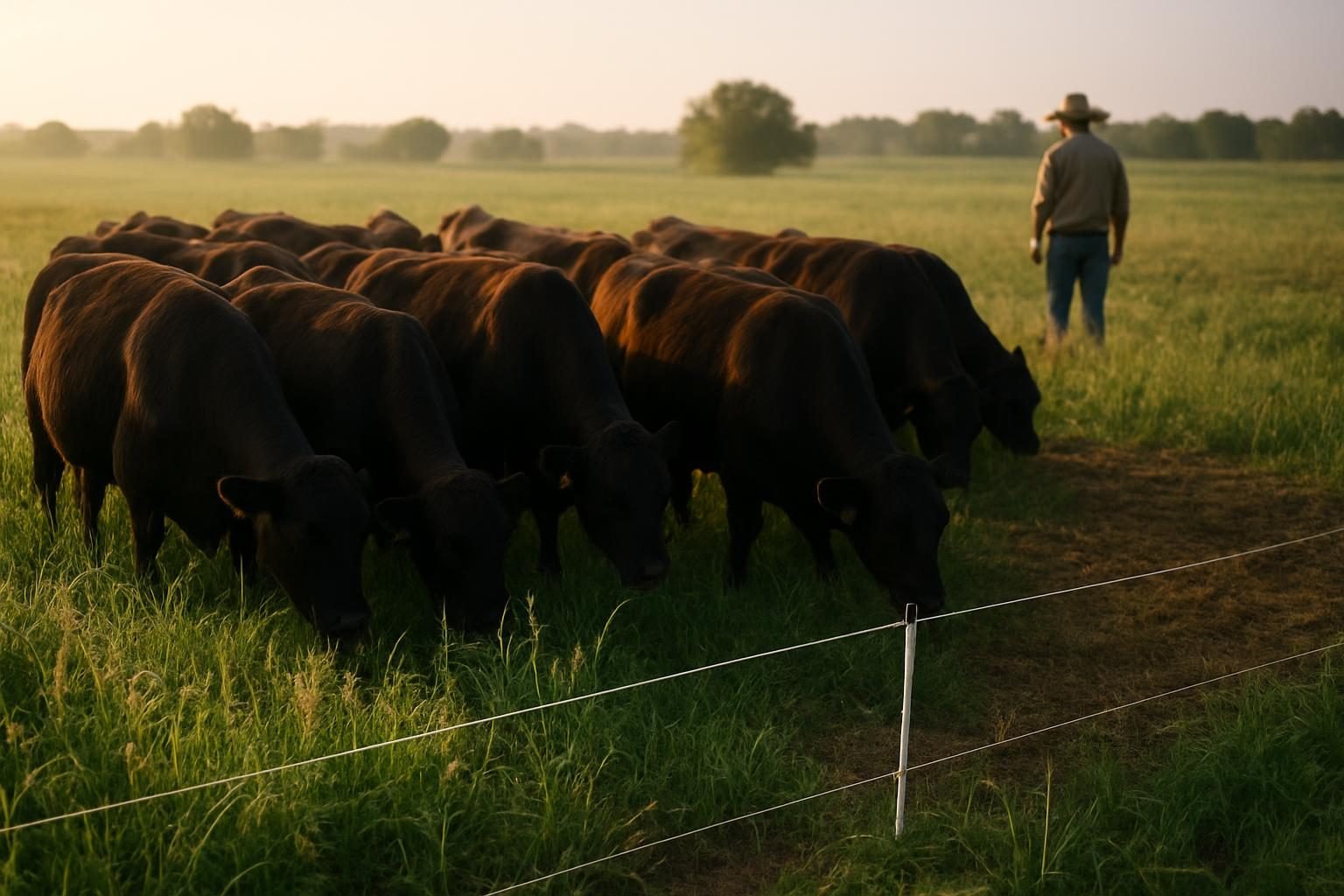
Mob grazing packs a lot of animals onto a small piece of pasture for a short time, then gives the land a long rest. Done well, it can build residue, spread manure evenly and wake up tired pastures. Done badly, it costs you animal performance and a lot of extra labor for little return.
Quick answer: Mob grazing is a form of rotational grazing that uses very high stock density (often tens of thousands of pounds of live weight per acre) for short stays, commonly a day or less, followed by long recovery periods. It can improve forage residue, manure distribution and soil cover, but it usually lowers individual animal performance and raises labor and infrastructure needs. It works best as a tool inside an adaptive grazing plan, not as a fixed rule.
What mob grazing actually is
The term is used loosely, so it helps to pin it down. Mob grazing is defined by stock density, not stocking rate. Stocking rate is how many animals a farm carries over a season or year (see our guide on how many acres per cow). Stock density is how many animals are on a given area at one moment.
A conventional rotational system might run 15,000 to 30,000 pounds of live weight per acre during a graze. Mob grazing is often described as 100,000 pounds per acre or more, sometimes far higher on very small daily moves. These are typical ranges, not rules; there is no official threshold, and different practitioners draw the line in different places.
The animals are moved often, from several times a day to once every day or two, and the pasture then rests for a long time, frequently 60 to 120 days or more depending on climate and growth rate. This approach differs from complementary winter feeding methods like bale grazing, which can also build soil during dormant seasons.
Why high density? The idea behind trampling and residue
When animals are crowded, they compete for bites. That changes behavior in ways proponents value:
- Less selective grazing. Animals eat a wider range of plants, including coarser grasses and some weeds they would skip at lower density.
- Trampled residue. Uneaten forage gets laid down onto the soil surface as litter, which shades the ground, feeds soil life and can reduce evaporation.
- Even manure and urine. Nutrients are spread across the paddock rather than concentrated at camp spots and water points.
- Long recovery. Plants regrow from a rested state, which supports deeper roots and a more diverse sward over time.
The soil-building claim is the one to treat carefully. Trampled residue and rest are consistent with building cover and organic matter, but results vary by rainfall, soil and starting condition, and carbon gains are hard to measure and not guaranteed. Our piece on how to increase soil organic matter covers realistic timelines.
When mob grazing helps
Mob grazing tends to earn its keep in particular situations:
- Rank, overmature or stockpiled pasture. Dense groups can use coarse stands and convert the leftover into ground cover. This pairs naturally with stockpiling forage for winter.
- Dry animals and stockers. Dry cows, replacement heifers and growing stockers can tolerate lower-quality forage better than lactating cows or finishing animals.
- Renovating bare or weedy ground. Hoof impact and manure can help seed contact and break up capped soil, especially when paired with overseeding.
- Productive, well-watered pastures. Humid regions and irrigated ground recover quickly, which makes short stays and long rests practical.
- Using cover crops as forage. Grazing a multispecies cover crop at high density can graze part and trample the rest (see our cover crop mix guide).
When it does not help
Be honest about the limits. Mob grazing is a poor fit when:
- Animals need top-quality forage. Lactating cows, young calves and animals being finished on grass lose weight or gain slowly when forced to eat mature material. If you are working toward grass finished beef, quality matters more than trampling.
- Soils are wet and soft. Heavy animals concentrated on saturated ground cause compaction and pugging. Clay soils in wet seasons are especially vulnerable.
- Recovery is slow. In arid or short-season regions, rest periods may need to stretch far longer than most operations can manage, and “long rest” can become “never used.”
- You lack water or fencing. Moving a dense herd daily demands reliable water at every move.
- Labor is the limit. If daily moves are not realistic, a simpler rotation will usually do better than a mob system done halfway.
Research on high stock density grazing is mixed. Some trials find little difference in plant or soil outcomes compared with well-managed lower-density rotation, while others and many farmer reports show benefits under specific conditions. Treat it as a tool to test, not a guaranteed upgrade.

Animal performance trade-offs
The most common cost is lower individual animal performance. When animals are forced to eat more of the pasture, including stemmy or lower-protein material, average daily gain per head usually drops compared with giving them first pick of the best forage.
The argument in favor is that gain per acre, or cost per pound of gain, can hold up or improve because inputs fall and forage use rises. That depends entirely on your numbers. Track both per-head and per-acre results for a season before deciding.
| Factor | Lower-density rotation | Mob grazing |
|---|---|---|
| Stock density | Moderate | Very high |
| Typical stay | Several days | Hours to a day or two |
| Rest period | Weeks | Often months |
| Individual gain | Usually higher | Often lower |
| Residue left behind | Moderate | High, trampled |
| Labor | Moderate | High |
| Fencing and water | Moderate | Intensive, portable |
Labor, fencing and water
Mob grazing is labor-hungry. Frequent moves mean daily or twice-daily trips, and every move needs fence, water and a quick check on animals and forage. Plan for it honestly.
What you will typically need
- Portable electric fence: polywire or step-in posts, a good energizer and a reliable ground system.
- Portable water: hoses, quick couplers and moveable troughs. Our upcoming guide on water systems for rotational grazing will cover layouts in detail.
- Back fence discipline: keep animals off regrowth, or the long rest you are paying for disappears.
- Time: budget moves around your real schedule, including bad-weather days.
Cost-share may help with fencing and water development; check current options with your local NRCS office and see EQIP for regenerative farmers. Confirm eligibility and payment details with the agency, as they change.
How to try mob grazing: a step-by-step approach
- Start small. Pick one or two pastures and one group of animals, ideally dry stock or stockers on mature forage.
- Measure what you have. Estimate forage on offer per acre and animal demand per day to set paddock size. A rising-plate meter or simple clip-and-weigh sample works.
- Size paddocks to the day or half-day. Aim to graze roughly a third to a half of the standing forage and trample the rest, adjusting for your goals.
- Set up water first. If animals cannot drink at every move, the system fails.
- Move on schedule and back fence. Keep a calendar so no area is regrazed before it has recovered.
- Watch the animals. Body condition, manure consistency and gain tell you quickly if the forage is too poor.
- Record and adjust. Keep photos, move dates, rest lengths and weights, then decide next year whether to scale up, scale back or mix approaches.
Where mob grazing fits in adaptive grazing
Mob grazing is one setting on a dial, not a separate philosophy. In adaptive multi-paddock grazing, stock density, stay length and rest are all adjusted to forage growth, season, animal class and goals. You might mob graze stockpiled fescue in winter, run lower density on lush spring growth for lactating cows, and rest everything during drought.
If you are new to managed grazing, build the basics first with our complete guide to rotational grazing. Many farms get most of the benefit from simply moving animals and resting pasture, and add density only where it pays. Other options like multi species grazing and silvopasture can also deliver benefits that do not depend on extreme density. For the bigger picture, see what regenerative agriculture is.
Regional notes
- Humid East and South: Fast regrowth makes shorter rests feasible, but wet soils and summer heat require attention. Warm-season forages tolerate density well when soils are firm.
- Corn Belt and Midwest: Good for grazing cover crops and crop residue; watch compaction in spring.
- Arid West: Recovery is slow and variable. Long, flexible rests and conservative use matter more than hitting a density number.
- Northern and mountain regions: Short seasons favor stockpiled or dormant-season mob grazing over summer use.
Key takeaways
- Mob grazing means very high stock density, short stays and long rest; there is no single official definition.
- Its main benefits are residue, even nutrient spread and use of coarse forage, though results vary and are not guaranteed.
- Expect lower gain per head, higher labor and more fence and water work.
- It suits dry stock, stockers and mature or stockpiled forage better than lactating or finishing animals.
- Start small, measure per-head and per-acre results, and treat it as one tool within adaptive grazing.
If you sell what you raise, remember that how you graze shapes your product and your story; see how to sell grass-fed beef direct. More guides live in our Grazing & Livestock section.
Frequently asked questions
What is the difference between mob grazing and rotational grazing?
Rotational grazing moves animals through paddocks with rest in between. Mob grazing is an intense version of it, using much higher stock density, shorter stays and typically longer rest periods. All mob grazing is rotational, but most rotational grazing is not mob grazing.
How many animals per acre is mob grazing?
It is measured as pounds of live weight per acre rather than head count. Figures of 100,000 pounds per acre or more are commonly cited, but there is no universal cutoff. The right density depends on forage amount, animal class and how long they stay.
Does mob grazing build soil?
It can support soil cover, residue and organic matter, especially when paired with long rest and good forage diversity. Measured results vary widely by region, soil and management, and research is mixed, so do not assume a specific carbon gain. Test and monitor on your own land.
Is mob grazing good for beef cattle performance?
Usually individual animal gain is lower than on a managed rotation with first pick of high-quality forage. It may still make sense for dry cows and stockers, or if lower input costs and better forage use improve results per acre. Track both measures before deciding.
Can I mob graze on a small farm?
Yes, and small acreage can be easier because moves are short and fence lines are simple. The main constraints are water access, daily labor and having enough paddocks to give real rest. Start with one group and a few paddocks, then expand if it works.