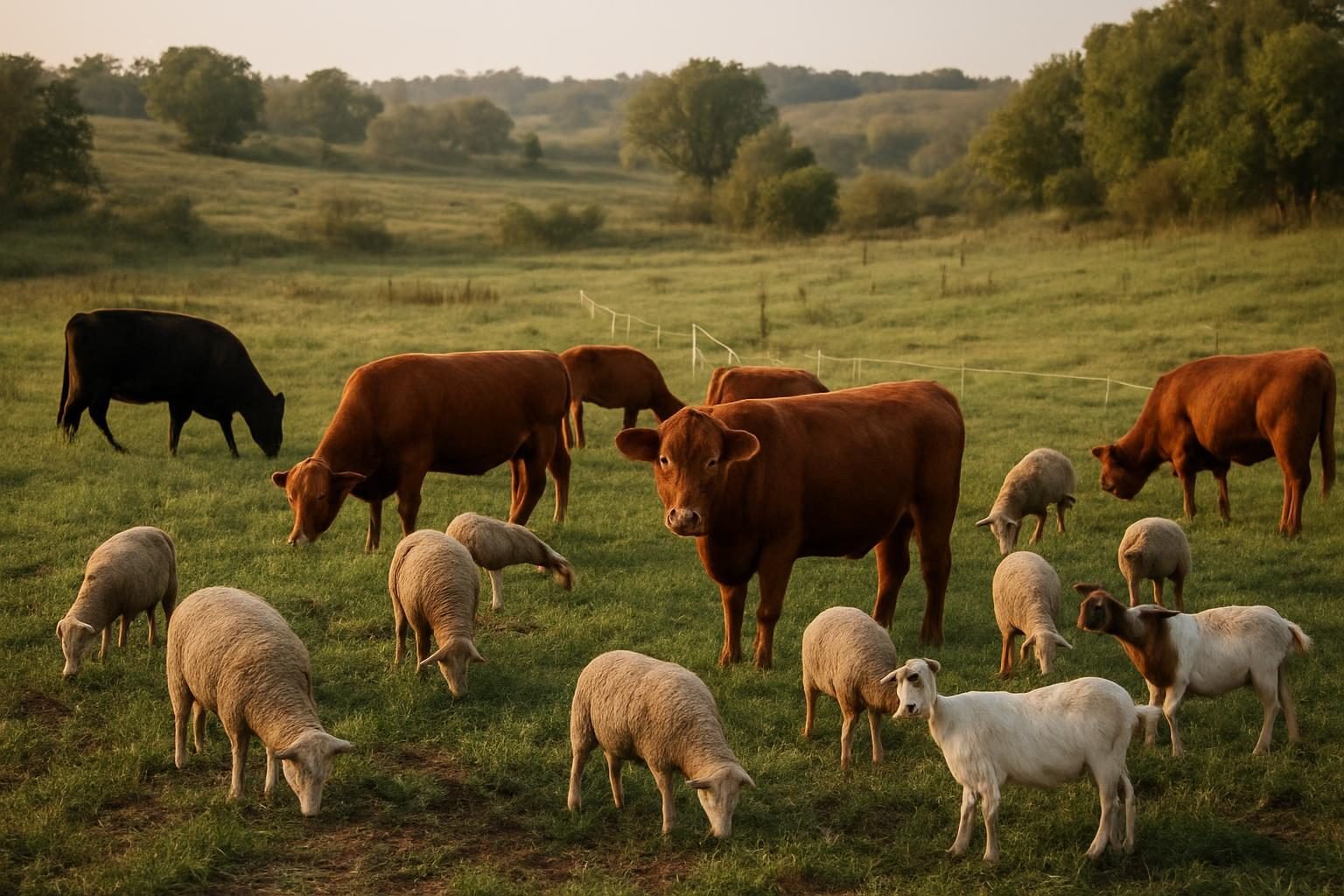
Multi-species grazing means running two or more kinds of livestock on the same pasture, either together or in sequence. Cattle, sheep and goats each eat differently, so a mixed herd uses more of what the land grows than any single species can. Done well, it can mean fewer parasites, fewer weeds and more products to sell, but it also asks more of your fencing, handling and record keeping.
Quick answer: Multi-species grazing combines animals with different diets, such as cattle (grass), sheep (grass and forbs) and goats (browse and brush), on the same land. The main benefits are fuller forage use, lower parasite pressure, better weed and brush control and more diversified income. The main costs are tighter fencing, more complex management and extra marketing work. Start with one added species at a modest ratio, and build from there.
Why different species make better use of the same land
Pasture is not one uniform feed. It is a mix of grasses, clovers, forbs (broadleaf “weeds”), shrubs and young trees, and each livestock species prefers a different slice of that mix. When one species grazes alone, it leaves some plants untouched and over-grazes others. A second or third species fills those gaps.
Diet differences at a glance
| Species | Grazing style | Typical diet preference | Best at controlling |
|---|---|---|---|
| Cattle | Wrap tongue around forage, graze taller grass | Mostly grasses, some legumes | Coarse, mature grass; rank growth |
| Sheep | Selective, bite close with lips | Grasses, clovers and many broadleaf forbs | Broadleaf weeds, short regrowth |
| Goats | Browsers; nibble leaves, bark and shoots | Brush, shrubs, vines, woody plants | Multiflora rose, blackberry, brush, some thistles |
Exact preferences vary by breed, season and what is available, so treat this as a general pattern rather than a rule. Your local extension office can tell you which weeds in your region sheep or goats will actually eat.
Parasite benefits (and their limits)
Many internal parasites are species-specific. The barber pole worm that sickens sheep and goats generally does not complete its life cycle in cattle, and the reverse is true for several cattle parasites. When cattle graze a paddock, they can pick up sheep and goat larvae and act as a kind of dead-end host, reducing the larval load on the pasture before small ruminants return.
That is a real advantage, but it is not a cure. Some parasites cross between species, and heavy stocking can still build contamination. Practical ways to get the benefit:
- Graze in sequence. Put cattle through a paddock before or after small ruminants, with enough rest between passes.
- Rest paddocks. Long recovery periods do more for parasite control than the species mix alone. See our guide to adaptive multi-paddock grazing for how to plan recovery.
- Keep grazing height up. Larvae live in the bottom few inches of the sward, so avoid grazing animals down to the dirt.
- Test, do not guess. Use fecal egg counts and FAMACHA scoring (for sheep and goats) to guide treatment decisions. Work with your veterinarian on a program, because dewormer resistance is a serious and growing problem.
Treat parasite benefits as one tool among several, not a reason to drop monitoring.
Weed and brush control without herbicide
This is where goats and sheep earn their keep. Cattle tend to leave brush and many broadleaf plants alone, which lets them spread. Goats will browse woody regrowth, and sheep will work over forbs that cattle skip. Used with intent, they can reduce the pressure on a pasture over several seasons.
A few cautions:
- Results take time. Expect gradual change over multiple seasons, not a one-summer fix.
- Targeted, higher-density grazing works better than light, season-long grazing. Goats put on a brushy area for a short, intense period often outperform goats given free rein.
- Check plant toxicity before you graze anything. Some plants that one species tolerates can harm another. Your extension service can provide a regional poisonous plant list.
- Do not expect animals to clear mature, large woody growth. Mechanical clearing may need to come first.
The same logic applies to dense stocking in general. If you are curious how short, heavy grazing events change plant communities, read about mob grazing.
Fencing and water needs
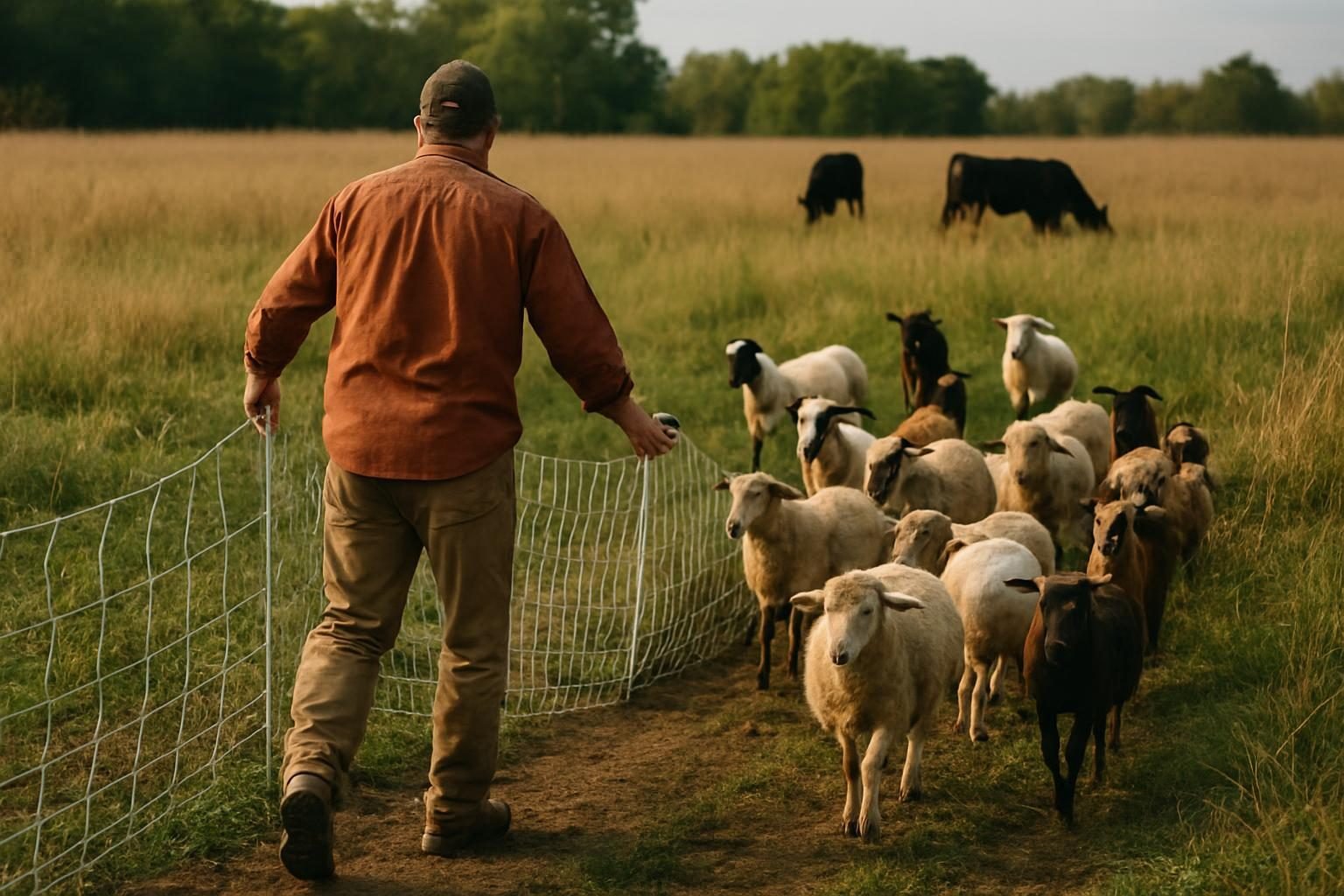
Fencing is the biggest practical hurdle. Cattle respect a single strand of electric wire. Sheep, with wool that insulates them from shocks, and goats, which test every gap, do not. A fence that holds your cows may be a suggestion to your goats.
What usually works
- Start with the most demanding species. Design the perimeter for goats or sheep, then cattle will be contained too.
- Use multi-strand or netting. Electrified woven-wire netting is popular for sheep and goats. Multi-strand high-tensile electric, with tightly spaced lower wires, can hold mixed groups when it is well charged.
- Train animals to electric fence. Introduce them in a small, secure pen first so they learn to respect it.
- Keep the charger strong and maintained. A weak charge or heavy vegetation on the wire is the usual cause of escapes. Check voltage regularly.
- Plan for predators. Sheep and goats are far more vulnerable to coyotes, dogs and other predators than adult cattle. Guardian animals, good fencing and night penning may be needed, and requirements vary widely by region.
Water must reach every paddock the group uses, with troughs sized and positioned so smaller animals can drink without being bullied off by cattle. Our guide to water systems for rotational grazing covers pipes, tanks and troughs in detail.
Stocking rates and ratios
Mixed grazing does not mean simply adding animals on top of a full single-species herd. The usual approach is to adjust totals so that overall grazing pressure stays within what the land can carry. Many graziers think in animal units and then divide them among species.
Typical starting points, which you should adapt to your forage, climate and goals:
- Several sheep or goats are often counted as roughly one-fifth to one-seventh of a cow-calf animal unit, depending on size and production stage.
- Many mixed operations begin with a mostly cattle base and a modest number of sheep or goats added for a specific job, like brush or weed control.
- Ratios shift with the plant community: brushier land supports more goats, while grassy, forb-rich land suits more sheep.
Because carrying capacity varies so much by region and rainfall, work through the basics in how many acres per cow first, and check with your local NRCS office for stocking guidance on your soils.
Leader-follower systems with poultry
Multi-species systems often extend to a leader-follower grazing pattern, where animals move through a paddock in order. Ruminants go first and take the best forage. Chickens follow a few days later, scratching through manure to spread it, eat fly larvae and pick at insects. This can break up pest cycles and recycle nutrients while giving you eggs or meat birds as another product.
Timing matters. Many people wait three to four days after ruminants before bringing in poultry, so the manure has begun to break down but fly larvae have not yet hatched out. Mobile coops or electric poultry netting make the moves manageable. For housing, predator protection and flock health, see our guide to pastured poultry.
Some farms add pastured pigs to the sequence too, though pigs bring their own fencing, rooting and regulatory considerations.
Management complexity: the honest trade-offs
Multi-species grazing is not simply “more of the good stuff.” Each added species brings its own handling needs, nutrition requirements and health program. A few examples:
- Mineral needs differ. Sheep are sensitive to copper, which is often added to cattle and goat minerals. Feeding the wrong mineral can be dangerous, so provide species-appropriate minerals and keep them separate where needed.
- Handling facilities. Working chutes and corrals sized for cattle will not hold lambs or kids. You may need separate setups.
- Different calendars. Breeding, birthing, weaning and shearing or hoof care all land at different times. You are running several enterprises, not one.
- Dominance and bullying. Mixed groups usually settle, but young or small animals can lose out at feeders and water.
- Winter feeding. Hay and supplemental feed must suit every species in the group. If you feed bales on pasture, see bale grazing for how to do it without damaging soil.
Complexity is the main reason many farms pilot a small flock alongside an existing herd before committing. Start small, learn, then scale.
Marketing more products
Each species opens a different market, which spreads risk when one product has a bad year. Possible outputs include beef, lamb, goat meat, wool, fiber, breeding stock, and eggs or poultry if you add birds. Goat and lamb demand is strong in some communities and ethnic markets, but it is very regional, so research buyers before you commit.
More products also mean more selling work: separate processing arrangements, labeling, and in some cases different inspection rules. Confirm current requirements with your state department of agriculture and your processor. If you are building a diversified product line, our pieces on how to price farm products and the wider regenerative farming business guide will help you decide which enterprises actually pay.
If you are aiming for finished beef, remember that adding species changes forage competition and timing. Our guide to grass-finished beef explains what finishing on forage requires.
How to get started: a simple path
- Define the job. Brush control, weed management, parasite relief, extra income? A clear goal tells you which species and how many.
- Audit your fencing and water. Upgrade the weakest paddock first rather than the whole farm.
- Add a small group. A handful of sheep or goats alongside your cattle lets you learn at low risk.
- Set up a health plan. Talk to a vet familiar with small ruminants about parasites, vaccines and minerals.
- Monitor and record. Track forage height, animal condition, fecal egg counts, escapes and losses.
- Adjust. Change ratios, timing and paddock sizes based on what you see.
For the broader framework behind all of this, see our main rotational grazing guide, and browse the full Grazing & Livestock category for related topics.
Key takeaways
- Cattle, sheep and goats eat different plants, so mixing them uses more of your pasture and reduces unwanted growth.
- Parasite benefits are real but partial. Rest periods, grazing height and fecal testing still matter.
- Fence for the hardest species to contain, usually goats or sheep, and plan for predators.
- Mineral, handling and health needs differ by species, so start small and learn before scaling.
- More species can mean more income streams, but also more processing, labeling and marketing work.
- Check stocking guidance and any regulations with your local extension, NRCS and state agriculture offices.
Frequently asked questions
Can cattle, sheep and goats really graze together?
Yes, many farms do it, either in the same paddock or in sequence. Together works when fencing, water and minerals suit all species. Many producers prefer sequential grazing, with cattle first and small ruminants after, because it limits bullying and simplifies mineral feeding.
Do sheep and goats really reduce parasites in cattle?
It is more accurate to say cattle can help reduce parasite pressure for sheep and goats. Many of their worms do not thrive in cattle, so cattle grazing acts as a cleanup step. Parasites vary by region and some cross species, so keep testing and work with a veterinarian.
What fencing do I need for mixed species?
Design for the species that is hardest to hold. Electrified netting or multi-strand high-tensile wire with closely spaced lower strands often works for sheep and goats, and cattle respect it too. Train animals to the fence and keep a strong charge. Add predator protection if you run small ruminants.
Is multi-species grazing worth it on a small farm?
It can be, particularly if you have brush or weeds to manage or want more products to sell. The catch is the extra management and marketing. Many small farms start with a few animals of a second species and expand only if it pays.
How do I decide the ratio of cattle to sheep or goats?
Start from your overall carrying capacity, then split it among species based on your forage and goals. Brushy ground favors goats, and forb-rich pasture favors sheep. Begin with a small share of the second species and adjust after a season. Consider stockpiling forage for winter to extend your grazing season. Your local NRCS or extension office can help with numbers for your area.