Stockpiling forage means letting pasture grow in late summer and fall, then grazing it standing in winter instead of feeding hay. Done well, it is one of the cheapest ways to cut winter feed costs, and it keeps animals on the land instead of in a feedlot or hay yard. This guide covers which forages stockpile well, when to close paddocks, how nitrogen fits in, and how to strip graze it.
Quick answer: Stockpiling forage is deferring grazing on selected paddocks so the grass accumulates for winter use. Tall fescue is the classic stockpiler because it holds quality under frost and snow. Close paddocks roughly 60 to 100 days before your first killing frost (timing varies by region), optionally apply 40 to 80 lb of nitrogen per acre, then strip graze in daily or every-few-day allotments. Typical estimates put savings at a meaningful share of winter hay costs, though results depend on your weather, forage and stocking rate.
Why stockpile forage?
Hay is expensive. Between baling, hauling, feeding and the losses that come with storage and waste, winter feeding is often the biggest single cost on a livestock farm. Stockpiled pasture swaps all of that for standing feed you already grew, harvested by the animals themselves with no equipment, no fuel and no manure spreading.
There are soil benefits too. Animals deposit manure and urine right where they graze, which spreads nutrients without a spreader. Keeping living or standing plant cover on the ground through winter also protects against erosion and compaction better than bare, trampled sacrifice areas. If you already run rotational grazing, stockpiling is a natural extension: you are simply planning one or more paddocks to be “saved” instead of grazed.
Which forages stockpile well?
Not every pasture species holds up after frost. The best stockpilers keep their leaf quality and structure as temperatures drop and stay palatable under cold, wet conditions.
| Forage | Stockpile performance | Best region | Notes |
|---|---|---|---|
| Tall fescue | Excellent; waxy leaves retain quality after frost | Transition zone, mid-South, humid East | Endophyte-infected varieties can cause toxicosis; novel-endophyte types avoid this |
| Orchardgrass | Fair to good | Humid East, Upper South | Quality declines faster than fescue |
| Bermudagrass | Fair; frost kills leaves, quality drops quickly | South | Usually better for early-fall stockpile than deep winter |
| Bahiagrass | Fair | Gulf Coast, Southeast | Low quality; best for maintenance-level animals |
| Kentucky bluegrass / perennial ryegrass | Fair to good depending on climate | Northern and cool-season regions | Ryegrass can winterkill in harsh climates |
| Warm-season native grasses (e.g., big bluestem, switchgrass) | Standing dormant forage; lower protein | Plains, Midwest | Works as standing roughage; may need supplementation |
| Brassicas and cool-season annuals (turnips, kale, oats) | High quality, but not a “stockpiled perennial” | Most regions | Planted specifically for fall and winter grazing |
Tall fescue gets the most attention because it does something rare: its leaves keep nutritive value deep into winter. In much of the mid-South and the humid East, it is the backbone of stockpiling programs. In the arid West and Plains, dormant native grass or cured standing forage often plays a similar role, though protein is lower and supplementation is more common. Check with your state extension service for the species and varieties that suit your area.
When to close paddocks
The goal is to give the grass enough time to build a good stand before growth stops. Too early and the forage goes stemmy, matures and loses quality. Too late and there is not enough yield to be worth saving.
A common rule of thumb for cool-season grass is to stop grazing or clip the paddock roughly 60 to 100 days before your average first killing frost. In the humid East and mid-South, that often lands between mid-August and mid-September. In northern areas, it can mean late July or early August. Warm-season grass in the South usually needs closing earlier.
- Pick the paddocks. Choose fields with productive, well-drained soil and a dense stand of your target forage. Avoid your wettest ground, since pugging in winter will wreck it.
- Graze or clip it down. Start from a uniform height, ideally 3 to 4 inches, so you are not stockpiling old, rank growth.
- Apply nitrogen if you are using it (see below), ideally just after the last grazing or clipping.
- Stay out. Resist the temptation to graze it “just once” in fall.
- Estimate yield in late fall so you can budget how many days of feed you actually have.
Nitrogen: is it worth it?
Nitrogen is the main lever for boosting stockpile yield on grass-only pastures. Research and extension guidance commonly point to applications in the range of about 40 to 80 lb N per acre, applied in late summer, as a typical way to increase fall growth. The return is highest on fescue and other grasses with low legume content.
Some things to weigh:
- Cost versus response. Fertilizer prices swing a lot. Run the math on cost per additional ton of dry matter against what that feed would cost as hay.
- Legumes as an alternative. Pastures with a solid clover component may need little or no nitrogen, and the clover adds protein. Frost-killed legumes, though, lose quality fast.
- Timing and weather. Applying right before a dry spell wastes money. Spread it when moisture is likely.
- Environmental risk. Keep fertilizer away from waterways and follow your state’s rules. A riparian buffer helps protect streams, and soil tests tell you whether you are applying what you actually need.
Regenerative operators often try to build fertility with grazing management, legumes and manure rather than relying on purchased nitrogen. Both approaches can work; the point is to decide on purpose, not by habit. The soil health principles are a good frame for that decision.

Strip grazing stockpiled forage in winter
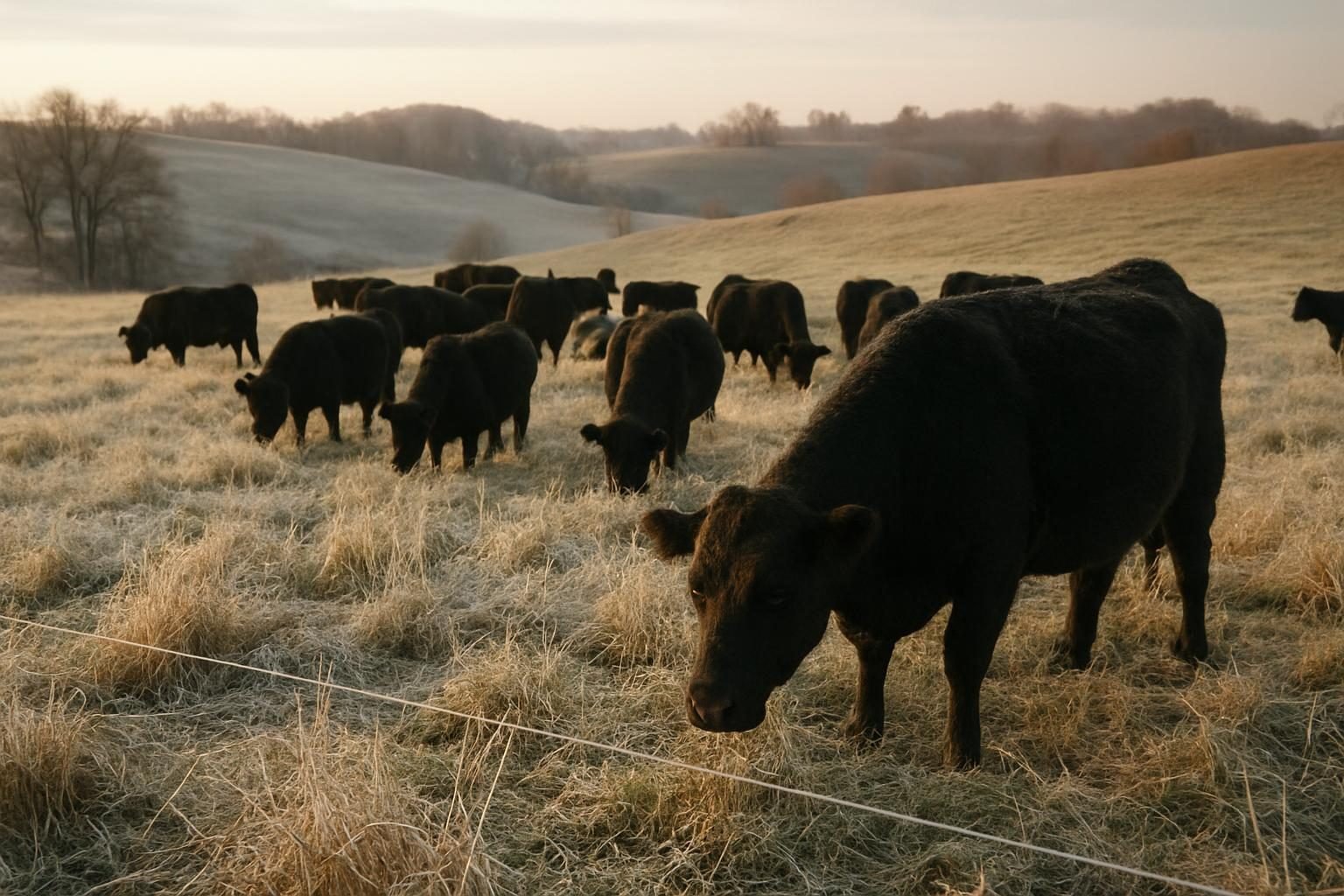
The single biggest mistake with stockpile is turning animals into the whole paddock at once. They trample and foul a large share of it, and the last weeks of feed are gone early. Strip grazing fixes this by giving them just enough feed for a day or a few days at a time.
How to set it up
- Run a temporary polywire or tape fence across the paddock with step-in posts. One or two moves per week is common; some graziers move daily.
- Use a back fence or leave the line fence in place so animals cannot return to grazed ground and trample new growth.
- Size each strip to the herd. Estimate dry matter available per acre, subtract roughly 30 to 50 percent for trampling and refusal, then divide by what the animals eat per day (typically around 2 to 3 percent of body weight in dry matter for beef cattle).
- Plan water. Frozen lines are the number-one winter headache. Freeze-resistant tanks or buried lines pay off; see our guide to water systems for rotational grazing.
- Watch snow and ice. Light snow is fine; animals will paw through it. A heavy ice crust can lock up the feed, so keep a hay reserve.
Strip grazing is a close cousin of mob grazing, and the same principles about stock density, rest and recovery apply, just adapted for cold-season conditions.
Quality over time: what to expect
Stockpiled forage is not static. Even the best species lose quality as winter drags on, and the decline is usually gradual rather than sudden.
- Early winter (first frosts into December): Quality is often good, sometimes surprisingly high in protein and energy for tall fescue. Dry cows and growing stock do fine.
- Midwinter: Protein and digestibility drift downward as leaves weather and decay. Lactating or late-gestation animals may need supplementation.
- Late winter: Leaf loss, rain and freeze-thaw cycles accelerate decline. This is when hay or a supplement often fills the gap.
The practical answer is to forage-test. Pull a representative sample from the paddock you are about to graze and send it to a lab, then match animals to feed: graze the best stockpile with the animals that need the most, and save lower-quality feed for dry cows or maintenance stock. If you are finishing animals, stockpile alone will rarely deliver the energy you need; see grass finished beef for what that takes. Multi-species setups can also help use stockpile more completely, as described in multi-species grazing.
Cost savings versus hay (estimates)
No two farms are the same, so treat these as rough illustrations, not guarantees. The comparison below is structural: it shows what each system costs you, not specific prices.
| Cost category | Hay feeding | Stockpiled forage |
|---|---|---|
| Equipment, fuel, labor | Haying, hauling, unrolling or feeding daily | Moving a fence line |
| Storage and waste | Often 10 to 30 percent loss depending on storage and feeding method | Trampling and refusal losses, but no storage loss |
| Inputs | Fertilizer if you make your own hay, or purchase price | Optional nitrogen and seed or overseeding |
| Manure handling | Concentrated in feeding areas | Spread by the animals |
Many extension budgets suggest stockpiled grazing can cost substantially less per day of feed than hay, with the gap widening when hay prices are high or when you would otherwise buy it. The savings shrink if your stockpile is poor, weather forces hay feeding for long stretches, or you apply a lot of nitrogen to marginal ground. To see how this fits into your overall numbers, our farm business plan guide walks through building a feed budget. For stocking math, how many acres per cow explains how to match herd size to your forage base.
Stockpiling pairs well with other winter strategies. You can use stockpiled paddocks for most of the season and rely on bale grazing on thin or heavily used areas to build fertility. Some farms also run pastured pigs on separate winter ground, though their needs differ from ruminants.
Common mistakes to avoid
- Closing too late and ending up with thin, short feed.
- Stockpiling poor-quality or weedy fields and expecting great forage.
- Skipping the strip fence and burning through stockpile in half the time.
- Not testing the feed and discovering late that it will not meet your animals’ needs.
- Using wet, heavy ground that turns to mud under hooves.
- Having no backup hay for ice storms or deep snow.
Key takeaways
- Stockpiling is deferring grazing so standing forage accumulates for winter use.
- Tall fescue is the standout stockpiler; other species work with more limited windows or quality.
- Close paddocks roughly 60 to 100 days before first frost, adjusting for your region.
- Nitrogen can boost yield on grass stands, but run the cost-benefit and watch water quality.
- Strip grazing with a back fence stretches stockpile and reduces waste.
- Quality declines through winter, so forage-test and match feed to animal needs.
- Keep a hay reserve for ice, deep snow and late-winter shortfalls.
- Confirm species, timing and fertilizer rules with your local extension or NRCS office.
Stockpiling fits inside the larger picture of adaptive grazing. For more on how this connects to planning, recovery and stocking, see our guide to adaptive multi-paddock grazing, and browse the rest of the Grazing & Livestock section.
Frequently asked questions
What is the best grass for stockpiling?
Tall fescue is generally considered the best stockpiler in the humid East and mid-South because it keeps its quality under frost and cold. Orchardgrass and some bluegrasses can work but decline faster. In drier regions, standing dormant native grasses serve a similar purpose at lower protein levels. Ask your local extension service which species suit your climate.
How long can you graze stockpiled forage?
It depends on yield, herd size and weather, but many operations in the mid-South and transition zone graze stockpiled fescue from late fall into January or February. Quality drops as winter progresses, so plan to supplement or switch to hay in late winter. Colder, snowier regions usually get a shorter window.
Do I have to fertilize with nitrogen to stockpile?
No. Nitrogen increases yield on grass pastures, and typical applications run around 40 to 80 lb per acre in late summer, but it is optional. Pastures with healthy legume content or good soil fertility may stockpile fine without it. Do the math on cost versus the hay you would replace, and test your soil first.
Can stockpiled forage replace hay entirely?
Rarely. Stockpiled forage can cover a large share of winter feed in suitable climates, but ice storms, deep snow and late-winter quality declines mean most farmers keep some hay on hand. Think of stockpiling as reducing hay use, not eliminating it.
Is stockpiled forage good enough for lactating cows or growing animals?
Early-winter stockpile, especially fescue, can be solid feed for many classes of livestock, but lactating cows, late-gestation animals and young stock may need supplemental energy or protein as winter advances. A forage test tells you what the feed offers so you can match it to each group’s requirements.