Compost tea has a loyal following and a stubborn skeptic camp, and both can point to results. Add a booming market of microbial inoculants, biostimulants and “soil probiotics,” and it gets hard to know what is worth your money. This guide separates what is well supported from what is hopeful, then shows you how to find out for yourself on your own ground.
Quick answer: Compost tea works sometimes, but the evidence is mixed. Results are most consistent for foliar disease suppression in some crops and for small-scale gardens and greenhouses; field-scale yield and soil-carbon claims are weakly supported. Solid compost, cover crops and reduced tillage reliably build soil biology, so treat tea and biologicals as an optional add-on, and trial them on strips with untreated controls before committing.
Compost tea vs. compost extract: what is the difference?
The two terms get used interchangeably, and they should not be.
- Compost extract is made by soaking or rinsing finished compost in water, usually for minutes to hours, with little or no added food. It carries soluble nutrients, humic compounds and whatever microbes wash off.
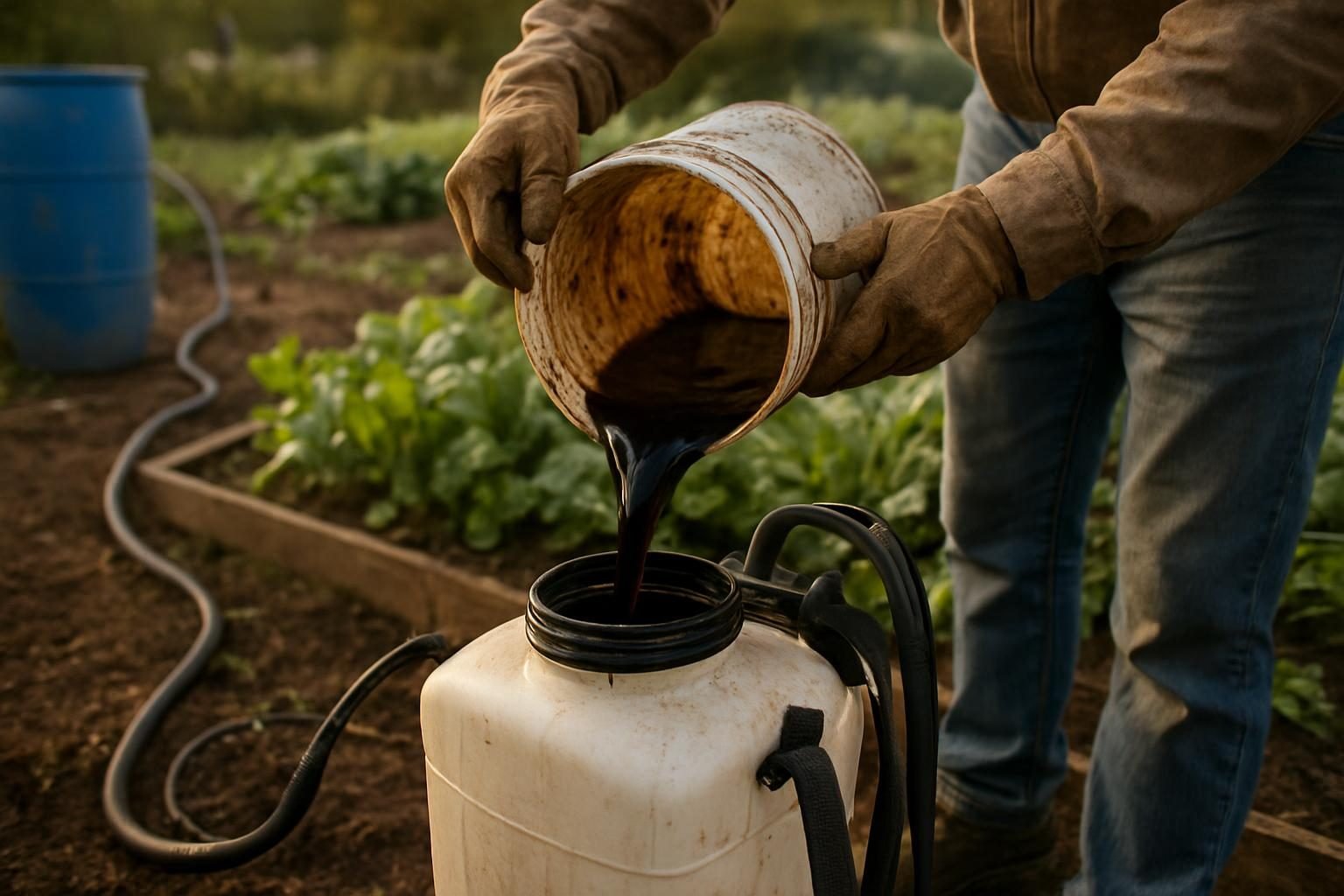
- Compost tea is brewed longer, typically 12 to 48 hours, with aeration and a food source such as molasses, kelp or fish hydrolysate. The goal is to multiply microbes, especially bacteria and sometimes protozoa, beyond what the compost itself contained.
Whether that multiplication translates into a better product is exactly where the debate sits. A brew that goes anaerobic can be worse than plain water, and the biology in a finished tea changes by the hour.
What the evidence actually says
Research on compost tea is real but inconsistent. Peer-reviewed studies and extension reviews tend to agree on a few themes:
- Disease suppression: Some trials show reduced foliar disease (powdery mildew, certain blights and leaf spots) when tea is sprayed on leaves, but other trials show no effect. The compost source, brew method, crop and weather all seem to matter.
- Fertility: Most teas deliver modest nutrients. They are not a substitute for compost applied at tons per acre, or for lime and fertilizer where soil tests call for them.
- Soil biology: Applying a few gallons per acre of microbes to a soil with millions of resident organisms per gram rarely changes the community on its own. What feeds and shelters biology matters more than what you add. See our guide to soil health principles for the habits that do the heavy lifting.
- Food safety: Teas made with manure-based compost and sugary foods can grow pathogens if brewed poorly. Follow your buyer’s, certifier’s and the USDA National Organic Program’s rules on applications to edible crops, and confirm current requirements with them directly.
Honest summary: promising in specific cases, unproven as a general soil-building tool, and highly dependent on execution.
Brewing basics
If you decide to try it, consistency and cleanliness matter more than fancy equipment.
- Start with good compost. Mature, sweet-smelling, fully finished compost. Avoid anything that smells sour or ammonia-sharp.
- Use clean, non-chlorinated water. Let tap water sit for a day or use well or rain water. Chlorine and chloramine can suppress the microbes you are trying to grow.
- Keep it aerated. A common ratio is roughly 1 part compost to 10 to 20 parts water, with an air pump and diffuser running continuously. Without oxygen, the brew turns anaerobic.
- Feed modestly. A small amount of unsulfured molasses or other food source. Too much food crashes the oxygen.
- Brew 12 to 36 hours. Warmer weather speeds things up. If it smells like rotten eggs or sewage, discard it.
- Use it fresh. Apply within a few hours, strained through a screen so nozzles do not clog.
- Clean everything. Biofilm builds up in brewers and hoses; scrub between batches.

The biologicals market: where to be skeptical
Compost tea is the low-cost end of a much larger category: microbial inoculants, bio-stimulants, humic and fulvic products, “soil conditioners” and branded consortia. Some products, like rhizobial inoculants for legumes, have decades of solid evidence. Others make broad claims with thin or proprietary data.
Questions worth asking any seller:
- Is there independent, replicated, peer-reviewed or university field trial data in a region and soil like mine, not just company-run trials?
- What organisms are in the product, at what count, and how long do they stay viable on the shelf?
- What is the cost per acre per year, and what yield or input savings would I need to break even?
- Does the claimed benefit already come from something I can do cheaper, such as covering the soil or adding compost?
Mycorrhizal inoculants are a good example of where context matters: they can help in sterile or heavily disturbed soils and in transplants, but add little where native fungi are already thriving. Our mycorrhizal fungi guide covers when inoculation makes sense and when to skip it.
Where biology comes from first
Before spending on any amendment, check whether the basics are in place. Living roots, diverse plant cover, minimal disturbance and organic inputs feed soil organisms every day. Building living soil through these fundamentals is often more valuable than purchased inputs:
- Cover crops keep roots in the ground and feed microbes with root exudates. Mix selection matters; see our cover crop mix guide.
- No-till and reduced tillage protect fungal networks and soil structure.
- Compost at meaningful rates adds organic matter and biology in one pass. Our guide on how to increase soil organic matter explains realistic timelines.
- Compacted ground limits biology no matter what you spray on it; see how to fix compacted soil without heavy tillage.
How to trial compost tea or a biological on your farm
You do not need a research budget. You need discipline and a notebook.
- Pick one question. For example: “Does weekly foliar tea reduce powdery mildew on my squash?” One product, one crop, one outcome.
- Lay out strips. Use at least three treated and three untreated strips of equal width, alternating them (treated, control, treated, control…) so soil variation does not bias the result. Run strips the full length of the field where possible.
- Keep everything else equal. Same variety, planting date, fertility, irrigation and equipment passes. The control strips should get water or a plain-water spray if the application itself could matter.
- Record the baseline. Take soil samples and photos before you start. Our soil testing guide covers standard, Haney and biological tests and their limits.
- Measure what matters. Yield, disease ratings on a simple 0 to 5 scale, input costs, labor hours. Weigh or count; do not rely on memory.
- Repeat the trial. One season in one weather pattern proves little. Aim for at least two seasons before changing your whole system.
- Do the math. Include brewing equipment, labor, and application time. A small benefit can still lose money.
Your local extension office, NRCS field office or a regional SARE project can often help design on-farm trials and may know of cost-share or farmer-led research opportunities. Confirm current availability with them.
| Option | Typical cost | Evidence strength | Best fit |
|---|---|---|---|
| Finished compost (tons/acre) | Moderate to high, varies by source and hauling | Strong | Nearly all systems |
| Cover crops and reduced tillage | Low to moderate | Strong | Row crops, vegetables, pasture renovation |
| Legume rhizobial inoculant | Low | Strong where legume is new to the field | New legume plantings |
| Compost tea (foliar) | Low materials, labor-intensive | Mixed | Gardens, greenhouses, small plots |
| Proprietary microbial blends | Varies widely | Often limited or company-run | Only after a trial on your own strips |
Does it pay? The business angle
For market gardeners, a modest tea program might be worth it if it reduces a recurring disease or supports a premium “biology-forward” story with customers. For large acreage, logistics and cost per acre usually make it hard to justify without clear trial results. Whatever you decide, track costs against returns and be honest in your marketing; overstated soil-health claims erode trust. Our regenerative farming business guide covers how to build a sustainable operation, and the farm product pricing guide helps you see whether inputs fit your margins. For the bigger picture, start with what regenerative agriculture is, and browse more in our soil health category.
Key takeaways
- Compost tea and extract are different products; tea is brewed longer with food and aeration.
- Evidence is mixed: some foliar disease benefits, little proof for field-scale yield or soil carbon.
- Poorly brewed tea can be worse than nothing and may pose food safety risks.
- Living cover, low disturbance and compost build biology more reliably than inoculants.
- Trial any product on replicated treated and control strips for at least two seasons, and count the full cost.
Frequently asked questions
Is compost tea worth it for a home garden?
It can be, if you enjoy the process and brew it cleanly. Expect modest nutrient delivery and possible disease suppression, not dramatic yield jumps. Spending the same effort on making or buying more compost, mulching beds, or growing green manure crops will usually return more.
Can compost tea make people sick?
Yes, if it is made from poorly composted manure, brewed anaerobically, or sprayed on edible parts close to harvest. Use fully finished compost, keep it aerated and clean, and follow your certifier’s, buyer’s and food safety rules. Check current guidance with your extension office or the relevant agency.
How often should I apply compost tea?
There is no universal schedule. Trials that report benefits often spray foliage every one to three weeks during disease pressure, or apply to soil at planting. Test a schedule on a strip trial rather than assuming a rate from a label or video.
Do microbial inoculants replace compost?
No. Compost supplies organic matter, nutrients and a diverse community together, while most inoculants add a few strains in small quantities. Without food and habitat (roots, residue, stable structure) that support soil health, added microbes struggle to persist.
How do I know if a biological product is legitimate?
Look for replicated, independent trials in conditions like yours, clear organism lists and counts, a stated shelf life, and a price you can compare against a trial result. Be wary of products that promise to replace fertilizer, fix all soils or work everywhere.