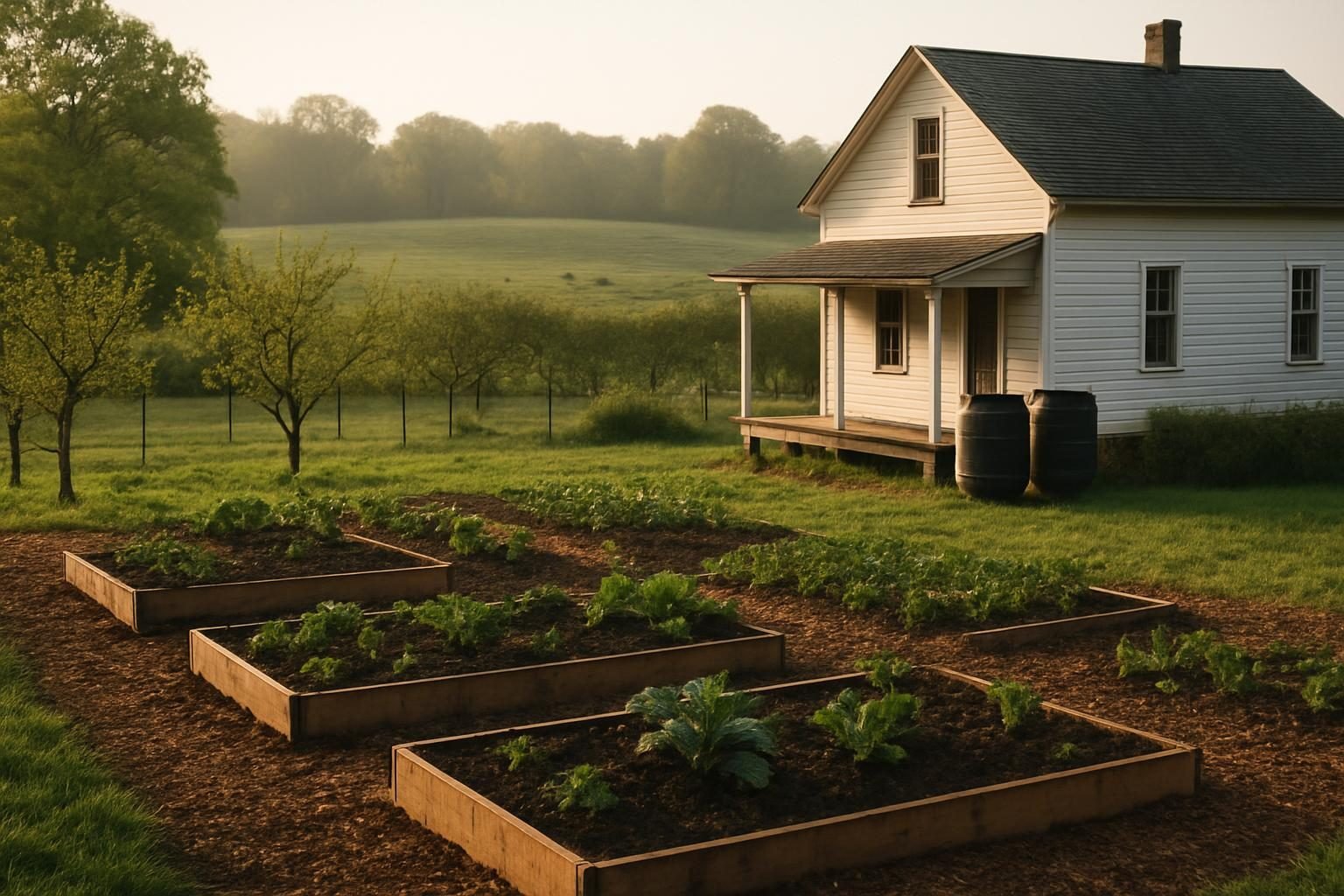
No dig gardening is exactly what it sounds like: you build and feed garden beds from the top down, layering organic matter onto the soil surface instead of turning it over with a spade or tiller. It works in a backyard raised bed, on a city lot, and on a half-acre market garden. This guide covers why it works, how to build a bed, what it costs, and how to deal with the two things everybody worries about, weeds and slugs. You can also use no-dig methods as part of a food forest design.
Quick answer: To start a no-dig bed, mow or flatten the vegetation, lay overlapping cardboard (no tape or glossy ink), wet it thoroughly, and cover it with 3 to 6 inches of finished compost. Plant or sow directly into the compost. Each year, top-dress with 1 to 2 inches of compost and leave the soil undisturbed. The method suppresses weeds, protects soil life, and holds moisture, at the cost of needing a reliable compost supply.
Why no-dig works
Soil is not just mineral particles. It is a structure built by fungal threads, bacteria, earthworm channels, root pathways, and the sticky compounds microbes exude to glue particles into aggregates. Digging or tilling breaks that structure, burns through organic matter faster, and brings buried weed seeds to the surface where they germinate. It also leaves bare soil exposed to crusting and erosion.
No-dig flips the approach. Worms and microbes do the mixing, pulling organic matter down from the surface. Aggregates stay intact, water infiltrates and holds better, and the weed seed bank stays mostly buried and dark. These are the same principles behind field-scale no-till farming, scaled down to hand tools and garden beds. They also line up with the soil-health principles in regenerative agriculture: minimize disturbance, keep the soil covered, and feed the biology.
A fair note on the evidence: research on tillage is strong at the field-crop scale, and extension services and SARE publications document the soil-health benefits well. Research specifically on small-scale no-dig vegetable beds is thinner, and results vary by soil, climate, and how much compost you use. Treat the method as a well-reasoned practice with plenty of grower experience behind it, not a guarantee of bigger yields in year one.
Materials you need
- Cardboard: plain brown, single-wall, with tape, staples, and labels removed. Avoid glossy or heavily printed sheets.
- Finished compost: the main input. It should smell earthy, look dark and crumbly, and have no recognizable food scraps.
- Mulch (optional): wood chips for paths, straw or leaves for covering beds over winter.
- Edging (optional): boards, logs, or nothing at all. Raised frames are a choice, not a requirement.
- A hose and a mower or string trimmer. That is nearly the whole tool kit.
How to build a no-dig bed, step by step
- Mark the bed. A width of about 3 to 4 feet lets you reach the middle from either side without stepping on the soil. Keep paths 18 to 24 inches wide, wider if you use a wheelbarrow.
- Cut down what’s growing. Mow, scythe, or trim tall vegetation and leave the clippings in place. For perennial weeds like bindweed or quackgrass, plan for a thicker barrier or a longer wait.
- Lay cardboard. Overlap every seam by at least 6 inches so light cannot sneak through. Soak it thoroughly.
- Add compost. Spread 3 to 6 inches over the cardboard. Use the thicker end of that range on weedy ground.
- Plant. Transplants go straight into the compost. For direct seeding of small seeds like carrots, a fine top layer of well-sifted compost helps.
- Mulch the paths. Wood chips or more cardboard keep paths weed-free and stop foot traffic from compacting beds.
Most beginners get the best results building in fall for spring planting, because the cardboard breaks down over winter. But you can plant the same day you build if you use deep enough compost. Roots of transplants will find their way through softened cardboard within weeks.
Sheet mulching versus compost-on-top
These two names get mixed up. They share the cardboard base but differ in what goes on top.
| Method | What goes on the cardboard | Best for | Trade-offs |
|---|---|---|---|
| Compost-on-top | 3 to 6 inches of finished compost, plant right away | Vegetable beds, quick starts, small spaces | Needs a lot of compost up front |
| Sheet mulching (lasagna) | Alternating layers of green and brown organic matter (manure, leaves, straw, kitchen scraps), often a foot or more deep | Large areas, perennial plantings, using on-site waste | Slower; the pile settles and needs weeks to months to mature |
If you have free leaves, grass clippings, or manure, sheet mulching stretches your budget. If you want a seedbed this month, compost-on-top is the faster path.

Maintaining no-dig beds
Maintenance is the quiet strength of the system. Each year, after you clear spent crops, cut them off at the soil line rather than pulling them, so roots decompose in place. Then top-dress with about 1 to 2 inches of compost. That is typically enough to replace what soil life has consumed.
- Keep the soil covered. A thin mulch or a cover crop over winter protects structure. See cover crops for beginners for choices and termination methods that fit no-dig beds, such as cutting and leaving the residue.
- Stay off the beds. Compaction is the one thing that hurts no-dig. Walk on paths only.
- Water by need. The compost layer holds moisture, so beds usually need less watering than bare tilled soil, though arid West growers still need reliable irrigation.
- Add fertility lightly. A soil test every few years tells you whether you need anything beyond compost. Your state extension service can point you to a lab.
Weeds and slugs
Weeds
Year one is usually the toughest. Annual weeds seldom push through a good cardboard-and-compost layer, but airborne seeds will land on top of the compost. Pull them young; they come out easily from loose compost. Perennial weeds with deep or creeping roots may re-emerge at bed edges or through gaps. Fix gaps in the cardboard, add more compost, and be patient. A tarp laid over a bed for several weeks before building can help on stubborn ground.
Slugs
Slugs are the real downside, especially in the humid East, the Pacific Northwest, and anywhere with wet springs. Moist, mulched surfaces suit them. What helps in practice:
- Keep mulch back a couple of inches from seedlings and do not over-mulch.
- Water in the morning so the surface dries before evening.
- Go out at dusk or after rain and hand-pick, or trap them under boards you check daily.
- Grow bigger, sturdier transplants instead of tender direct-seeded lettuce when pressure is high.
- Encourage predators: ground beetles, toads, and birds. Ducks, if you can keep them, are effective. Backyard chickens can also help in the right season, though they will scratch up beds if let in at the wrong time.
The cost of compost
Compost is the main expense, and you should plan for it honestly. One cubic yard covers roughly 100 square feet at 3 inches deep (a bit over 300 square feet at 1 inch). Prices vary a lot by region and source: bulk municipal or landscape-supply compost is generally far cheaper per yard than bagged compost, and delivery fees can matter more than the material. Check local prices rather than trusting a national average.
Ways to lower the bill:
- Buy in bulk by the cubic yard, and verify quality: ask about feedstock, maturity, and any herbicide residue concerns, since persistent herbicides in manure or hay can damage crops.
- Make your own with hot composting, or process food scraps with vermicomposting.
- Use sheet mulching with free leaves, wood chips, and manure for large areas.
- Start with a smaller footprint you can do well, then expand.
Scaling to a market garden
No-dig works on production scale, with some realism. Moving dozens of yards of compost is labor- and equipment-intensive, and tractor-based growers often modify the idea: permanent beds, shallow compost applications, tarping to kill weeds and prepare seedbeds, and minimal surface disturbance rather than none. Many market gardeners find that fixed bed widths and permanent paths make compost spreading efficient. For growers interested in scaling up further, urban farming approaches offer additional models for intensive food production in constrained spaces.
Before committing, run the numbers. Compare compost cost and spreading labor against the savings in weeding time and tilling, and look at which crops earn enough per bed foot to justify the inputs. Our guides on how to start a market garden and the most profitable crops for small farms help with that math. Season extension through a hoop house pairs well with permanent no-dig beds, since the soil is never disturbed and the compost mulch retains heat and moisture.
City growers dealing with limited space or questionable native soil often use no-dig on top of cardboard or in raised frames; get any urban soil tested for lead and other contaminants first. More on this in our small and urban farms coverage, including the Small & Urban Farms section.
Key takeaways
- No-dig protects soil structure and biology by feeding from the surface and avoiding tillage.
- The core build is cardboard, then 3 to 6 inches of compost; top-dress 1 to 2 inches each year.
- Sheet mulching is cheaper and slower; compost-on-top is faster and more expensive.
- Compost cost and slugs are the main trade-offs. Source in bulk and manage moisture and habitat.
- At market scale, adapt the idea with permanent beds and shallow applications, and check the economics first.
- Look into programs such as EQIP cost-share for possible support, and confirm current details with your local NRCS office.
Frequently asked questions
Do I need raised beds for no dig gardening?
No. You can build no-dig beds directly on the ground. Raised frames help with drainage, tidy edges, and keeping compost in place, and they are useful on poor or contaminated soil, but they are optional.
Will cardboard harm my soil?
Plain brown cardboard breaks down and feeds soil life. Remove tape and labels, and skip glossy or heavily inked sheets. If you farm under organic certification, check your certifier on what materials are acceptable.
How much compost do I need per bed?
For a new bed, plan on 3 to 6 inches, so about one cubic yard per 50 to 100 square feet. After that, 1 to 2 inches a year is typically enough. Actual needs depend on your soil and crops.
Is no-dig better than tilling for yields?
Not automatically. Many growers report equal or better yields over time with less weeding, but results depend on compost quality, climate, and management. Expect benefits to build over seasons rather than appear overnight.
Can I do no-dig in clay or sandy soil?
Yes. Surface-applied organic matter improves both over time, since worms and roots work it down. Clay benefits from avoiding compaction, and sandy soil from the added moisture retention, though arid regions may need more frequent top-ups.