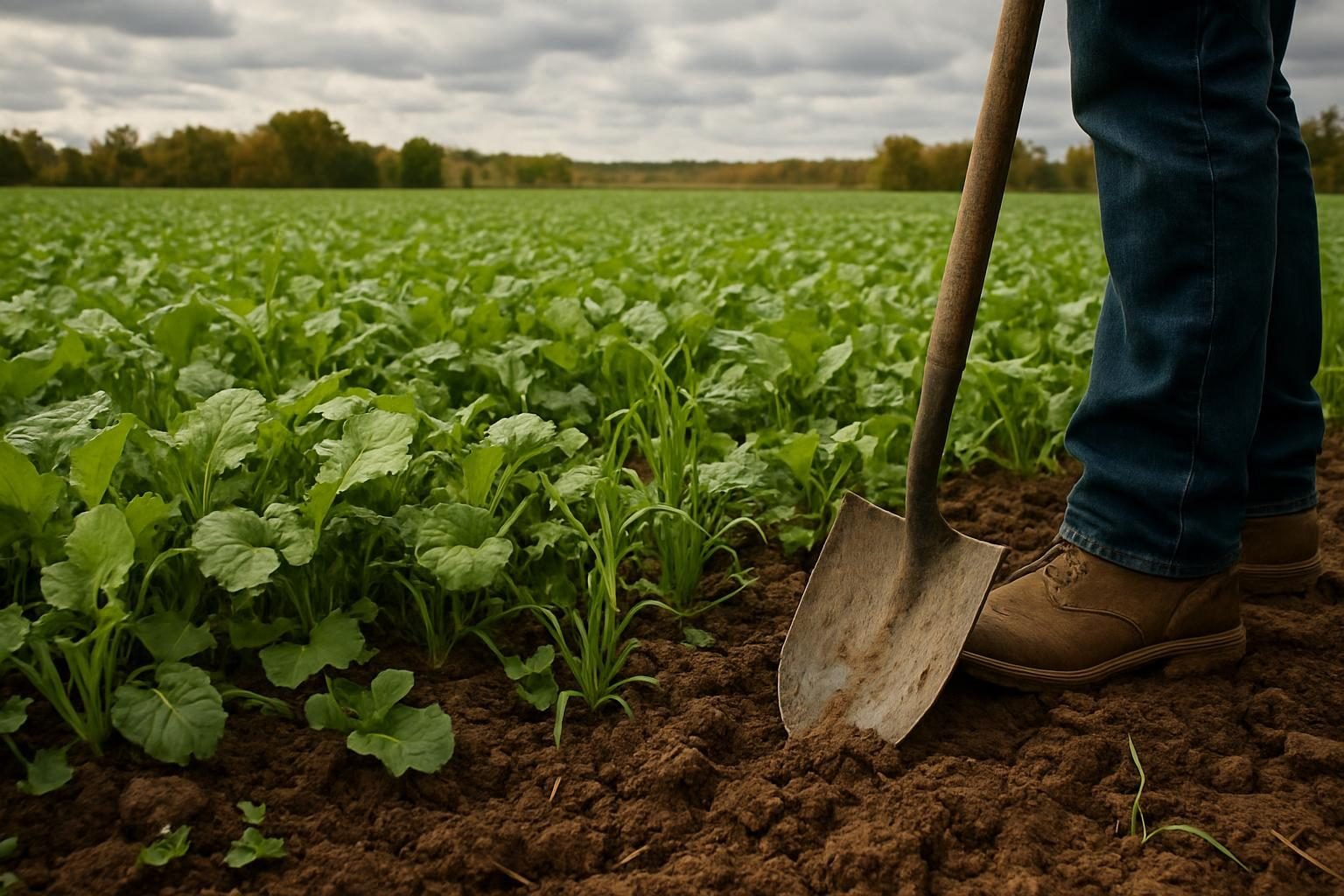
Clay soil is rich in nutrients and holds water well, but it can turn to concrete in August and soup in April. The best cover crops for clay soil use roots, residue and time to open that structure up, no deep tillage required. Here is what each major species does, how to seed it, and how to kill it cleanly.
Quick answer: For clay soil, start with cereal rye (fall seeding, 60-120 lb/acre drilled) for fibrous roots and biomass, tillage radish (6-10 lb/acre in late summer) for biopores, and oats (50-100 lb/acre) as a winter-killing, easy-to-manage option. Add crimson clover for nitrogen and sorghum-sudangrass (25-40 lb/acre drilled, summer) for deep, aggressive roots. Mixes usually outperform single species. Seeding rates are typical ranges; check local extension recommendations.
Why Clay Soil Needs Cover Crops
Clay particles are tiny and pack tightly. That gives you high nutrient-holding capacity, but poor pore space, slow drainage, and a narrow window when the soil is workable. Tilling clay when it is wet makes things worse: you smear the soil, create a pan, and set yourself up for crusting and compaction.
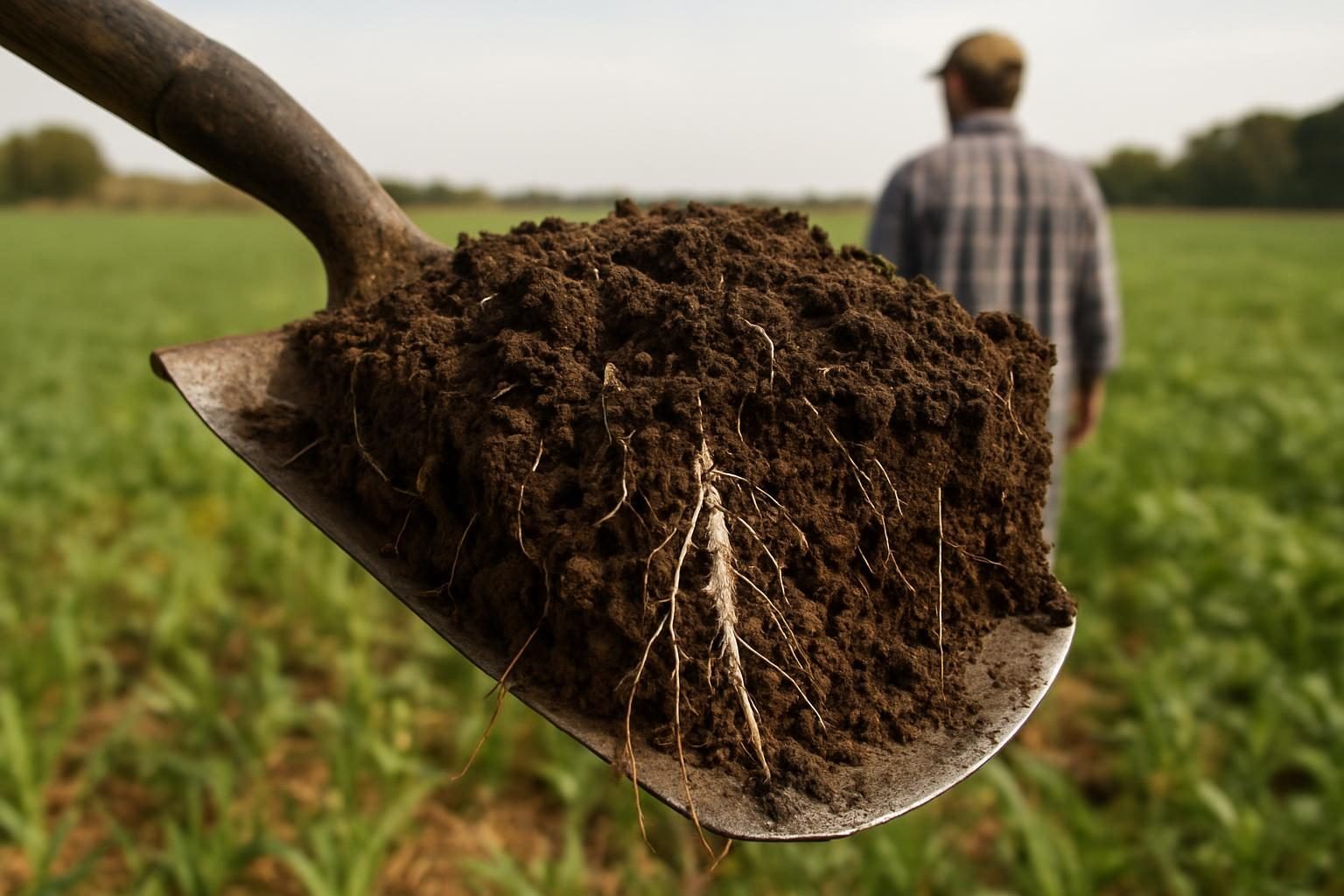
Cover crops work on the problem biologically. Roots push through tight soil and leave channels behind. Decaying roots and residue feed microbes that glue particles into stable aggregates. Living cover also protects the surface from raindrop impact, which is what causes crusting. If you want the bigger picture on structure and function, our complete guide to building living soil covers the principles.
One honest caveat: cover crops are a slow fix. Expect noticeable change in two to four years, not one season. If you have a hard, dense layer already, read how to fix compacted soil without heavy tillage alongside this guide.
The Best Cover Crops for Clay Soil
1. Cereal Rye
Cereal rye is the workhorse. It germinates in cold soil, builds a dense fibrous root system, and produces a lot of residue that feeds soil life and suppresses weeds. Its roots hold clay together and improve infiltration over time.
- Seeding: roughly 60-120 lb/acre drilled; 90-150 lb/acre broadcast. Sow from late summer through late fall, as long as it has time to establish before hard freeze.
- Watch for: it can tie up nitrogen as it matures, and tall mature rye is harder to terminate. Kill it at boot stage or earlier if you are planting corn behind it.
2. Tillage Radish (Daikon-Type Radish)
Radish sends a thick taproot down into tight soil. When it winterkills and rots, it leaves open channels that water and later crop roots can follow. It also scavenges nitrogen and releases it in spring.
- Seeding: about 6-10 lb/acre alone, or 1-3 lb/acre in a mix. Plant in late summer, roughly 6-8 weeks before your first hard frost.
- Watch for: it leaves little residue, so the soil can be bare by spring. Pair it with rye or oats. Heavy stands can smell when they decompose in a wet spring.
3. Oats
Oats are forgiving and cheap. They establish fast in fall, build good fibrous roots, and winterkill in most of the northern half of the country, which makes spring planting simple. In the South they may overwinter.
- Seeding: about 50-100 lb/acre drilled; higher if broadcast. Sow late summer to early fall, 6-8 weeks before hard freeze for good growth.
- Watch for: winterkill leaves a mat of residue that is great for no-till, but it can slow soil warming in cold, wet springs.
4. Crimson Clover
Crimson clover is a nitrogen-fixing legume with a moderately deep root system. It does well on well-drained clay and adds nitrogen for the following crop. It is also a pollinator magnet when it blooms.
- Seeding: roughly 15-25 lb/acre alone, or 8-15 lb/acre in a mix. Sow late summer to early fall in the South and mid-Atlantic; hardiness limits it in colder regions.
- Watch for: it struggles in waterlogged ground and in very cold climates. Inoculate seed with the right rhizobia if your field has no history of clover.
5. Sorghum-Sudangrass
This is the summer option. It grows fast in heat, produces huge biomass, and sends roots deep, which makes it useful for breaking up compacted clay in a fallow window.
- Seeding: about 25-40 lb/acre drilled, 35-50 lb/acre broadcast. Plant once soil is warm (generally above 60-65°F) in late spring or summer.
- Watch for: prussic acid risk if grazed young or after frost stress. Do not graze until it is tall enough and follow extension guidance. It can also tie up nitrogen; mow or crimp before it gets rank.
6. Mixes
On clay, a mix usually beats a single species because you get different root types working at different depths. A simple, effective combination is cereal rye or oats plus radish plus crimson clover, adjusted for your region. For specific blends by goal, see our guide to the best cover crop mixes for soil health, grazing and weeds.
Quick Comparison
| Cover crop | Main benefit on clay | Typical seeding rate (drilled) | Best planting window | Winter behavior |
|---|---|---|---|---|
| Cereal rye | Fibrous roots, biomass, erosion control | 60-120 lb/ac | Late summer to late fall | Overwinters |
| Tillage radish | Biopores, nutrient scavenging | 6-10 lb/ac (1-3 in mix) | Late summer | Winterkills below about 20-25°F |
| Oats | Quick fibrous roots, easy termination | 50-100 lb/ac | Late summer to early fall | Winterkills in most northern areas |
| Crimson clover | Nitrogen, moderate roots | 15-25 lb/ac (8-15 in mix) | Late summer to early fall | Overwinters in milder regions |
| Sorghum-sudangrass | Deep roots, big summer biomass | 25-40 lb/ac | Late spring to summer | Killed by frost |
All rates are typical ranges. Confirm with your state extension service or NRCS office, since local conditions, seed quality and equipment change the numbers.
How to Plant Cover Crops on Clay Soil
- Check moisture first. Do not seed or run equipment on saturated clay. Wait until a handful crumbles rather than smears.
- Pick your window. Fall cover seeded after harvest needs enough warm days to establish. Earlier is almost always better. In the Corn Belt, consider interseeding cover crops into standing corn and soybeans to gain weeks of growth.
- Get seed-to-soil contact. A no-till drill is best. If broadcasting, increase the rate by about 30-50% and lightly rake, harrow or let rain settle the seed. Clay surfaces that crust can block emergence.
- Mind your fertility. Small grains benefit from available nitrogen early on. A soil test tells you what you actually need; see soil testing for regenerative farmers.
- Stay off it when wet. Traffic on wet clay undoes a lot of the benefit.
How to Terminate Cover Crops Without Wrecking Clay
Termination is where many clay growers get into trouble, because the temptation is to disk it in. Tilling clay can destroy the aggregates your cover crop just built. Better options include mowing, roller-crimping, or letting residue build soil structure further through methods like biochar for soil enhancement:
- Winterkill: oats, radish and sorghum-sudangrass die on their own in cold climates. No work required.
- Roller-crimper: works well on rye at the milk-to-soft-dough stage and on other grasses at flowering. See our guide to roller crimpers and terminating cover crops without herbicide.
- Mowing: effective for sorghum-sudangrass and clovers at the right stage, though regrowth can occur.
- Grazing: livestock can terminate and recycle cover crops if managed well. Our rotational grazing guide shows how to fit this in.
- Herbicide: some farmers use burndown as a transition tool. It is a legitimate choice, but know the label and local rules.
If you are weighing tillage versus living cover long term, our no-till farming guide lays out the trade-offs, and we are preparing a deeper look at when to till soil and when to skip it.
Regional Notes
- Humid East and Southeast: long growing seasons allow crimson clover and rye combos; radish does well. Wet springs can delay termination, so plan equipment access.
- Corn Belt: rye and oats dominate; interseeding or aerial seeding helps beat the short fall window.
- South: sorghum-sudangrass is a strong summer option; many cool-season covers overwinter.
- Arid West: water is the limiting factor. Cover crops must be matched to irrigation or residual moisture, and a poor stand can cost more than it returns. Check with local extension.
If drainage is your real bottleneck, cover crops help, but you may also need to look at how to improve soil drainage through field design and surface management.
What to Expect Over Time
In the first season, you may see better water infiltration and less crusting. By years two to four, many growers report easier workability, fewer ponding spots and improved crop root depth. Organic matter rises slowly, often fractions of a percent over several years. Our guide on how to increase soil organic matter explains realistic timelines. If you are new to all of this, cover crops for beginners is a good companion read. Cover crops used as soil-building inputs are sometimes called green manure, and the same selection logic applies.
Key Takeaways
- Clay improves through roots, residue and time, not through tillage.
- Cereal rye, tillage radish, oats, crimson clover and sorghum-sudangrass each solve a different clay problem.
- Mixes combine root types and usually beat single species.
- Seed on time, avoid working wet clay, and terminate without disking when possible.
- Expect gradual improvement over several seasons, and confirm rates and timing with local extension.
Frequently asked questions
What is the best single cover crop for clay soil?
Cereal rye is the most reliable single choice because it establishes in cool conditions, builds dense fibrous roots and produces lots of residue. For breaking up tight layers specifically, tillage radish is a strong addition, ideally in a mix.
Can cover crops fix compacted clay on their own?
They can improve it over time, but severe compaction may need help first, such as correcting traffic patterns and keeping equipment off wet ground. Deep-rooted species like radish and sorghum-sudangrass help, but they are not an overnight fix.
When should I plant cover crops in clay soil?
For fall plantings, aim for late summer to early fall so plants establish before frost. Radish needs the earliest window. Sorghum-sudangrass goes in after soils warm in late spring or summer. Local frost dates matter, so check with your extension office.
Do I need to till clay soil before planting cover crops?
Usually not. A no-till drill gives the best seed-to-soil contact with the least disturbance. If you broadcast, raise the seeding rate and lightly rake or let rain settle the seed. Avoid tilling wet clay, which can smear and compact it.
How do I terminate cover crops on clay without herbicide?
Use winter-killing species like oats, radish and sorghum-sudangrass where winters are cold enough, or terminate rye and others with a roller-crimper or mowing at the right growth stage. Timing matters more than the tool; kill rye at or after boot stage for best results.