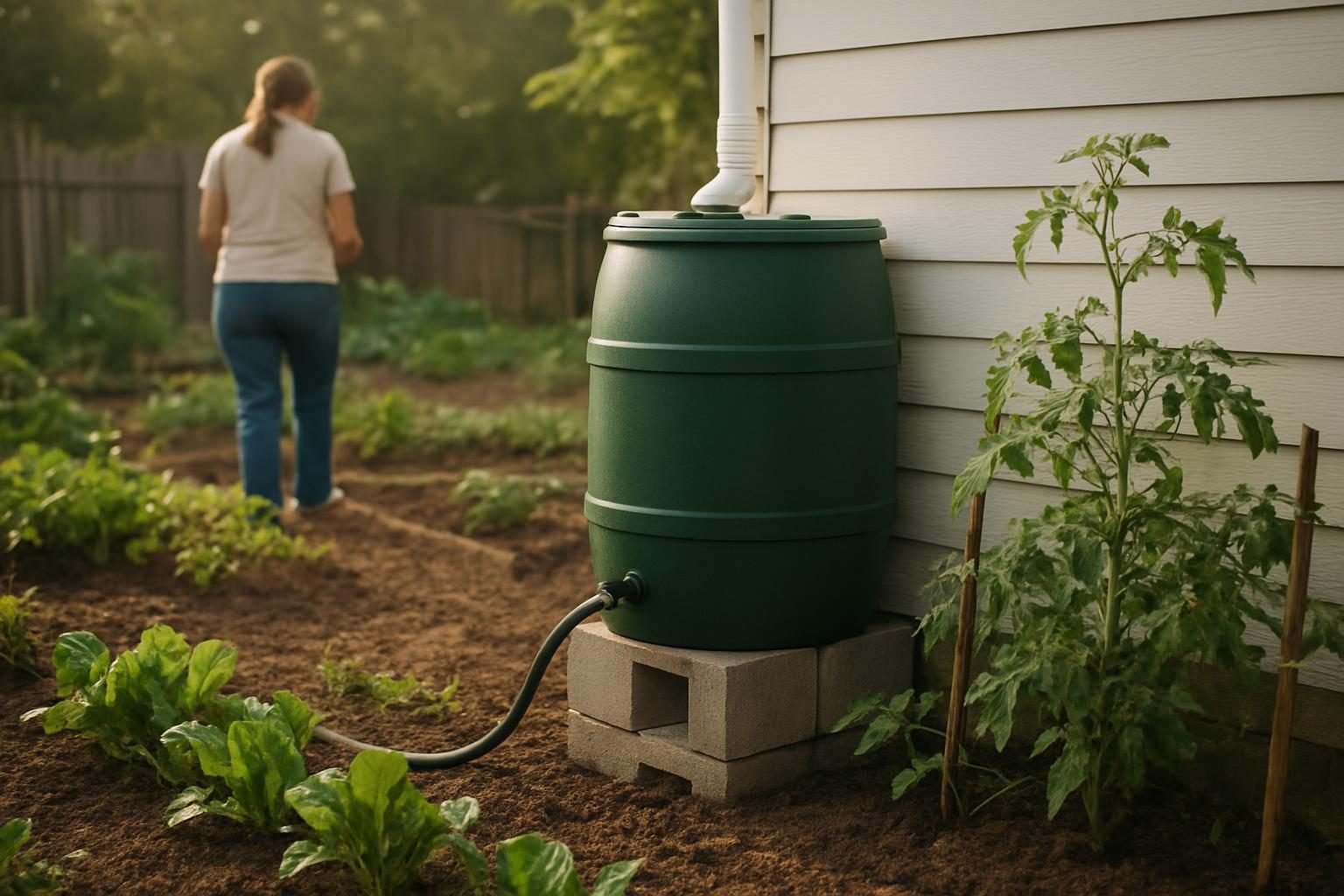
A rain barrel is a fine start, but a farm or homestead that wants real water security needs real storage. Rainwater collection tanks range from a few hundred gallons to tens of thousands, and the choices you make on material, location and size will shape how well the system works for decades.
This guide walks through the four main tank materials, the case for above- versus below-ground storage, a simple method for sizing your tank from roof area, rainfall and demand, and the site and overflow details that are easy to overlook. If you are still deciding whether harvesting makes sense for your place, start with our overview of rainwater harvesting for farms and homesteads.
Quick answer: For most farms and homesteads, a polyethylene (poly) tank placed above ground on a level, compacted gravel or concrete pad is the most practical and affordable choice. Size storage by multiplying roof area by local rainfall by about 0.6 (gallons per square foot per inch, after losses), then compare that to your dry-season demand. Choose steel, fiberglass or concrete when you need very large volumes, burial, or a specific lifespan, and always check local rules before you buy.
Rainwater collection tanks: comparing the four main materials
No material is best everywhere. The right one depends on volume, budget, whether you plan to bury it, and how much installation help you can get. Costs vary widely by region and year, so treat the comparisons below as relative, not as quotes.
| Material | Typical size range | Strengths | Trade-offs |
|---|---|---|---|
| Polyethylene (poly) | Roughly 50 to 10,000+ gal | Affordable, light, easy to plumb, widely available, resists corrosion | UV degrades it over time unless it is opaque and UV-stabilized; can float if buried empty; algae if light gets in |
| Galvanized or corrugated steel (often with a poly liner) | Roughly 1,000 to 20,000+ gal | Durable, good for large volumes, liner makes it suitable for potable-intent systems | Needs a solid base and a quality liner; can corrode at seams or cut edges; heavier to ship and set |
| Fiberglass | Roughly 500 to 20,000+ gal | Strong, long-lived, can be buried when rated for it, does not rust | Usually costs more than poly; can crack if mishandled; fewer local dealers |
| Concrete (precast or poured) | Roughly 1,000 to 30,000+ gal | Very long lifespan, strong for burial, stays cool, can slightly buffer acidic rain | Heavy, needs equipment to place; can crack or leach if poorly built; usually the highest installed cost |
Food-grade and potable considerations
If any of the water will touch food, drinking water or livestock, look for tanks and liners rated for potable water (NSF/ANSI 61 is the common marker in the US) and check the manufacturer’s literature. Dark, opaque tanks limit algae because they keep sunlight out. Whatever you store, plan on filtration; our guide to rainwater filtration for the farm covers the options.
Above-ground vs. below-ground cisterns
Most working farms store water above ground because it is simple, but burial has real advantages in some climates.
Above-ground tanks
- Pros: lower installation cost, easy inspection and repair, gravity feed to garden beds and troughs if you place the tank uphill.
- Cons: exposed to sun, heat and freezing; takes up visible space; needs a sturdy base because water weighs about 8.3 pounds per gallon.
Below-ground cisterns
- Pros: stays cooler, which slows algae; protected from freezing in colder climates when buried below frost depth; frees up surface space; can sit under a driveway or yard if rated for the load.
- Cons: higher excavation and installation cost; needs a pump to move water uphill; buoyancy and groundwater are real risks; harder to inspect and repair.
If you bury a tank, use one specifically rated for burial, follow the manufacturer’s backfill and anchoring instructions, and check the water table. An empty tank in saturated soil can float. In freezing climates, above-ground plumbing and fittings need protection too; see our guide to winterizing rain barrels, hoses and farm water lines.

How to size your tank: roof, rainfall and demand
Sizing comes down to two numbers: how much water you can collect and how much you need. Match them, then add a margin for dry spells.
Step 1: Estimate collection potential
- Measure the footprint of your roof (length times width of the area under the eaves, not the sloped surface), in square feet.
- Find your average annual rainfall in inches from NOAA, your state climatologist or your extension office.
- Multiply: roof area x rainfall in inches x 0.623 gives gallons per year if you caught every drop. Real systems lose water to first flush, splash and overflow, so apply an efficiency of roughly 75 to 90 percent.
Example: a 1,500 sq ft barn roof in an area with 40 inches of annual rain could shed about 37,000 gallons a year in theory, and perhaps 28,000 to 33,000 gallons in practice.
Step 2: Estimate demand
Demand varies a lot. As rough planning ranges: a cow or horse may drink on the order of 10 to 20 gallons a day depending on size, heat and lactation; small stock such as sheep, goats and poultry need far less per animal; and a vegetable garden often needs around an inch of water per week in the growing season, or roughly 0.6 gallons per square foot per week. Check your own animals and climate rather than relying on a single figure. If you irrigate, drip irrigation for small farms can stretch stored water considerably compared with overhead watering.
Step 3: Match storage to your dry period
Annual totals can mislead. What matters is how long you go between meaningful rains. In the humid East and South, a few weeks of storage may be enough. In the arid West or anywhere with a long dry season, you may need to store months of demand, and a tank that cannot hold that volume will overflow in wet months and run empty when you need it. A common approach is to size for your longest typical dry stretch and add 20 to 30 percent margin, then check that your roof can realistically refill it.
If your target is bigger than a few thousand gallons, it is worth comparing tanks with other storage, such as a farm pond, which can hold far more water per dollar where soils and regulations allow.
Site, placement and overflow
Good placement saves pumping, protects the tank and keeps the water you worked to harvest from causing problems.
- Elevation: put the tank above the point of use when you can. Every 2.31 feet of elevation gives about 1 psi of gravity pressure, which is gentle but enough for drip lines and troughs.
- Base: a level, compacted pad of gravel, a concrete slab or a reinforced foundation. A full tank is very heavy and any settling will stress fittings and walls.
- Distance from gutters: shorter runs mean less lost head and fewer clogs. Add leaf screens and consider a first flush diverter to keep the dirtiest initial runoff out of storage.
- Shade and light: shade or an opaque tank reduces algae and heat. A cool, dark tank keeps water usable longer.
- Setbacks and utilities: keep tanks clear of septic systems, wells, power lines and property lines per local rules.
Plan the overflow before you need it
Every tank fills eventually, and the overflow is where many systems fail. Size the overflow pipe at least as large as the inlet, screen it against mosquitoes and rodents, and send the water somewhere useful and safe: a rain garden, a swale, an infiltration area or an orchard. Used well, overflow feeds a food forest or a fruit tree guild instead of eroding a hillside. Keep it well away from foundations, septic fields and neighbors’ land.
For small setups and a stepping stone to larger storage, a linked rain barrel system can work alongside a main tank. As you plan, it helps to think about where water enters and leaves your land overall, as covered in permaculture design basics.
Check local regulations first
Rules on rainwater harvesting vary by state, county and sometimes city. Many states encourage it, some set limits on volume or use, and some require permits for large tanks, burial, or any connection to household plumbing. Setback, height and building-code rules may also apply to big structures. Before you buy, contact your county building or planning office, your state water agency and, for any potable use, your local health department. Your extension office is often a good starting point for local guidance. Regulations change, so confirm current requirements rather than relying on general advice.
Key takeaways
- Poly is the practical default for most farms; steel, fiberglass and concrete suit larger volumes, burial or longer service life.
- Above-ground tanks are cheaper and simpler; below-ground cisterns stay cooler and save space but cost more and need careful anchoring.
- Size storage from roof footprint, local rainfall and your longest dry stretch, not annual totals alone.
- Build a solid, level base and plan the overflow so it waters something useful.
- Check local regulations and potable-use rules before purchase and installation.
Rainwater storage works best as one piece of a larger water plan. Explore more in the Agroforestry & Water section, or see how tree systems use captured water in our agroforestry guide.
Frequently asked questions
How big should a rainwater tank be?
Compare how much your roof can collect with how much water you use during your longest dry spell. Roof footprint x rainfall (inches) x 0.623 x about 0.8 gives a realistic yearly yield. Size storage to cover your dry-season demand plus a 20 to 30 percent margin, and be honest about whether your roof can refill it.
Is a poly tank better than steel or concrete?
Not always. Poly is cheaper, lighter and easier to install, so it suits most small to mid-size needs. Steel and concrete make sense for very large volumes, and concrete or rated fiberglass is often preferred for burial. The best choice depends on size, budget, site and local rules.
Can I bury a plastic tank?
Only if it is rated for burial. Standard above-ground poly tanks can collapse under soil pressure or float when empty in wet ground. Follow the manufacturer’s instructions for excavation, backfill and anchoring, and check the water table before you dig.
Is harvested rainwater safe to drink?
Not by default. Roof runoff can carry bird droppings, dust and roofing residues. For potable use you need appropriate roofing and tank materials, filtration and disinfection, and often local approval. For livestock and gardens, basic filtration and good maintenance are usually enough, but confirm with local health authorities.
Do I need a permit for a rainwater tank?
It depends on where you live and how big the system is. Some places need none for small tanks, while others require permits for large tanks, burial or plumbing connections. Call your county or state agency before you buy to confirm current rules.