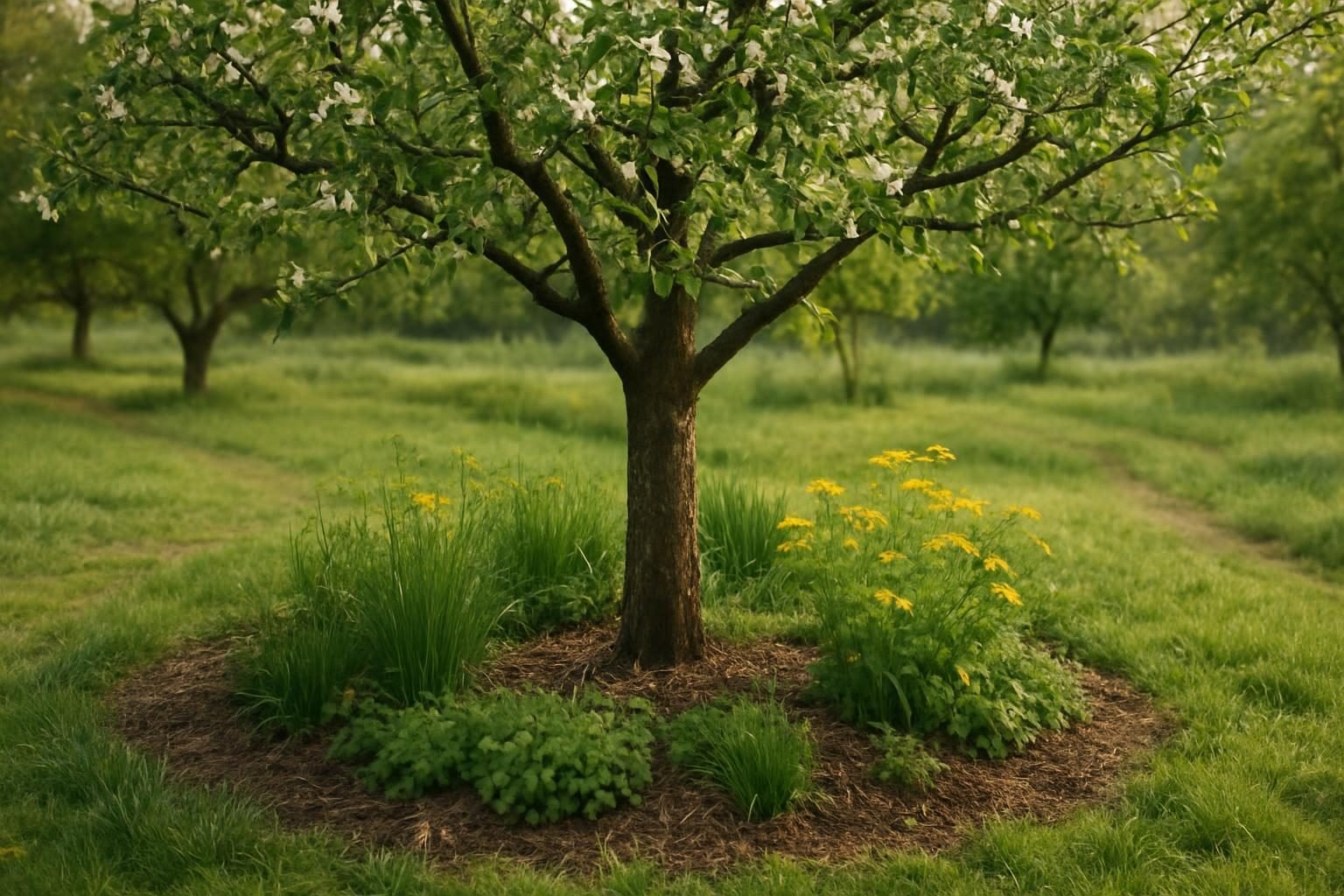
A fruit tree guild is a deliberate community of plants set around a single fruit tree so that the whole group does jobs the tree cannot do alone: fixing nitrogen, pulling up minerals, drawing beneficial insects, and shading the soil. Done well, it trades some of your fertilizer and mowing time for biology. Done badly, it hands your young tree a set of aggressive roommates.
This guide walks through the layers, the plant groups that do the work, and sample apple and pear guilds for different regions, with honest notes on what the evidence supports and where the permaculture lore runs ahead of the research.
Quick answer: A fruit tree guild surrounds a tree with 4-7 compatible plant types, usually a nitrogen fixer, a deep-rooted nutrient miner, flowering insectary plants, a groundcover, and a few edibles or herbs, planted outside the trunk zone. Keep turf and aggressive spreaders away from young trees, mulch heavily, and choose species suited to your climate. Expect modest, gradual gains in soil fertility and pest balance, not instant fertilizer replacement.
What a fruit tree guild actually is
The idea borrows from forest edges, where trees grow in company rather than alone. Instead of a lone apple in a mowed lawn, competing with grass for water and nitrogen, you design the ground beneath and around the tree as a working system. The guild sits inside your broader permaculture design, usually in the zones you visit often, since guilds need watching, mulching and occasional cutting back.
One honest caution: guilds are well supported by ecological principles (diversity supports beneficial insects, legumes fix nitrogen, mulch builds soil), but controlled research on specific guild recipes is thin. Treat plant lists as starting hypotheses and observe your own site. Your county extension office and local NRCS staff can tell you which species behave in your region and which turn invasive.
The layers of a guild
Think in layers, from the canopy down to the roots. A small guild does not need every layer.
- Canopy: the fruit tree itself, apple, pear, plum, peach, persimmon or whatever suits your climate.
- Shrub layer: nitrogen-fixing or berry shrubs placed at or just beyond the drip line.
- Herbaceous layer: flowering perennials and herbs that feed beneficial insects and confuse pests.
- Groundcover: low plants that shade soil and suppress weeds without choking the trunk.
- Root layer: alliums, root crops or deep taproots that work below the others.
- Soil surface: a mulch layer, wood chips or straw, which does as much work as any single plant.
If you are planting several guilds together, the same logic scales up in a food forest, and the broader agroforestry overview shows where guilds fit among larger tree-based systems.
The plant groups that do the work
Nitrogen fixers
Legumes and a few non-legumes host bacteria that convert atmospheric nitrogen into plant-available forms. Examples include clovers, lupines, baptisia, peas and beans, and shrubs like goumi, seaberry and bayberry. Much of that nitrogen reaches your tree only when fixer tissue dies back or is cut and dropped as mulch, so “chop and drop” a couple of times a season. Fixers also compete with young trees for water, so give a new planting a year or two to settle before crowding it.
Dynamic accumulators
Comfrey, chicory, dandelion, yarrow and similar deep-rooted plants are said to mine minerals from the subsoil and return them in leaf litter. The mechanism is plausible, since deep roots do reach deeper stores, but quantified benefits to fruit trees are not well documented. Value them for biomass, soil structure and pollinator forage, and do not count on them to replace soil testing. A basic test through your state lab is still the best way to know what your orchard needs, and the soil health guide explains how to read it.
Comfrey deserves a warning: common comfrey spreads by root fragments, so use a sterile cultivar such as Bocking 14 and plant it where you will not till.
Insectary and pest-confusing plants
Small-flowered plants such as alyssum, dill, fennel, yarrow, calendula, borage, phacelia and native asters feed predatory wasps, hoverflies and lacewings, which prey on aphids and other orchard pests. Staggering bloom times matters more than any single species. For a bigger pollinator investment, a pollinator hedgerow along the orchard edge complements what the guild provides at each trunk. Alliums like chives and garlic chives are often planted near trunks for a possible deterrent effect on some pests, though evidence is mixed.
Groundcovers and mulch makers
White clover, creeping thyme, strawberries and violets cover soil and cut weed pressure. Skip groundcover right at the trunk. A ring of bare mulch, with chips pulled back a few inches from the bark, reduces vole habitat and bark rot.
How to build a guild, step by step
- Pick the tree first. Choose a variety and rootstock suited to your hardiness zone, chill hours and disease pressure. The guild supports a good tree choice; it does not rescue a bad one.
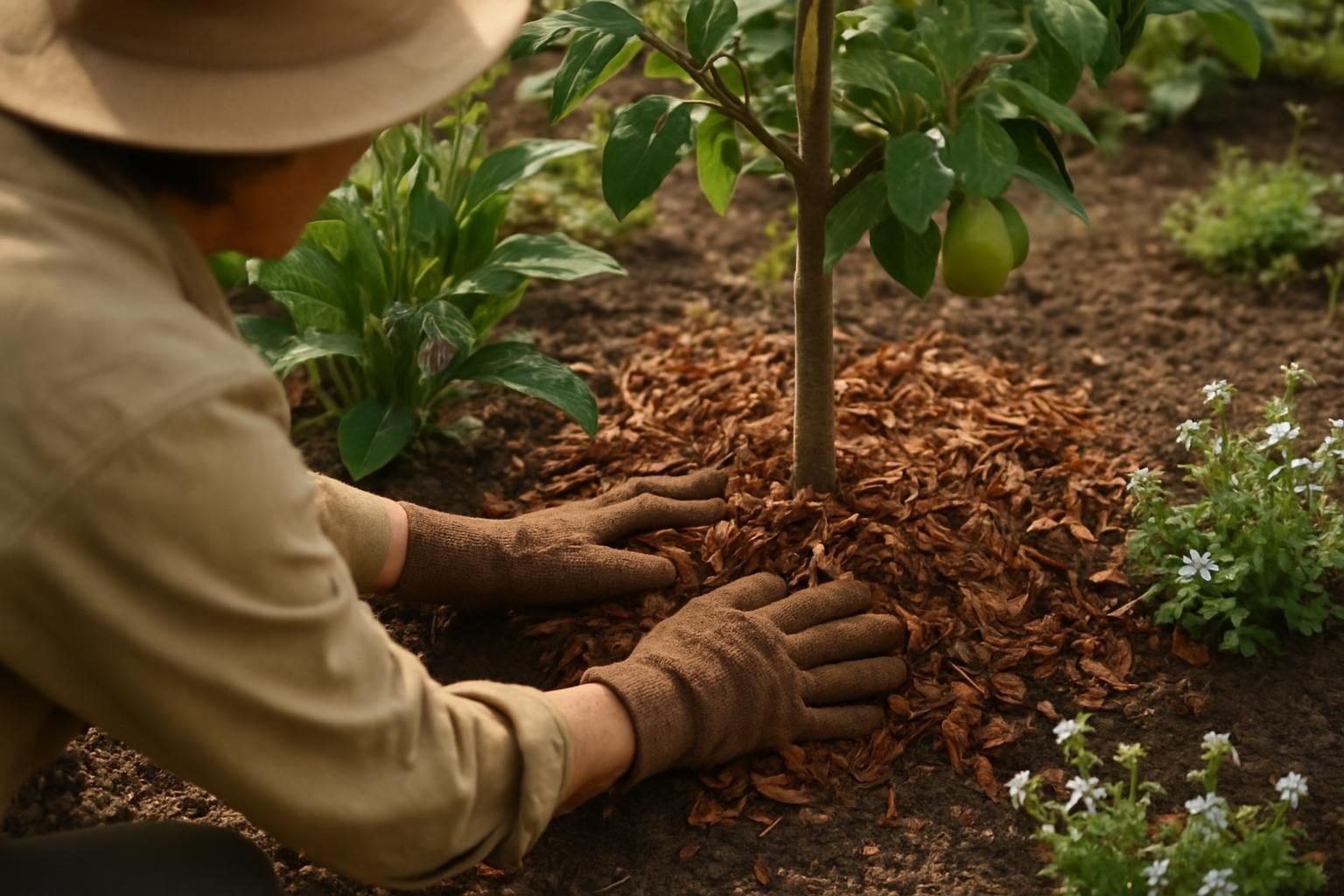
- Remove or smother turf. Cardboard topped with 3-4 inches of wood chips over a 4-6 foot radius works for most sites. See the no-till gardening methods for sheet mulching details.
- Plant the tree. Set it at proper depth, with the graft union above soil, and water in well.
- Add the first companions. Start with groundcover, a few insectary plants and one nitrogen fixer at the outer edge. Hold back the vigorous spreaders.
- Mulch and water. Maintain 3-4 inches of mulch. In dry regions, run drip irrigation for small farms to the whole guild footprint for the first two or three seasons.
- Observe and adjust. Cut back anything shading or crowding the tree, and add layers over the next one to three years.
Water is the quiet limiter in most guilds. If you are collecting roof runoff for the orchard, see rainwater harvesting for farms and homesteads, and in the arid West consider where mulch basins or swales can slow water to the root zone, though they do not suit every slope or soil.
Sample apple and pear guilds by climate
These are starting points, not prescriptions. Substitute native or locally proven species, and check invasive lists in your state before planting.
| Region | Nitrogen fixer | Accumulator / deep root | Insectary | Groundcover / edible |
|---|---|---|---|---|
| Humid East and Southeast (apple) | White clover, baptisia, goumi | Sterile comfrey, chicory | Yarrow, borage, native asters | Strawberry, chives, thyme |
| Midwest and Corn Belt (apple) | Lupine, red clover, seaberry (colder areas) | Chicory, dandelion | Dill, fennel, bee balm, calendula | Garlic chives, violets |
| Cool Northeast and Upper Midwest (pear) | White clover, siberian pea shrub in colder zones | Comfrey, burdock | Phacelia, alyssum, yarrow | Creeping thyme, daffodils (rodent deterrent) |
| Pacific Northwest (pear) | Clovers, lupine, ceanothus | Comfrey, chicory | Phacelia, calendula, native wildflowers | Strawberry, chives |
| Arid West, irrigated (apple or pear) | Clover under drip, desert-adapted legumes | Chicory, yarrow | Native buckwheat, penstemon, alyssum | Thyme, oregano, mulch-heavy bare zones |
Southern growers will find that apples need low-chill varieties and that heat and humidity make fire blight and fungal pressure the bigger issue; airflow between plantings matters more than plant diversity in those years. Pears tend to be tougher than apples on most pests but share fire blight risk, so avoid heavy nitrogen that drives soft shoots.
Common mistakes and trade-offs
- Planting too much, too soon. Overcrowded guilds compete with young trees. Phase in layers.
- Letting grass creep back. Sod is the biggest competitor for young fruit trees; keep the mulch zone clean.
- Ignoring rodents. Dense groundcover and deep mulch against the trunk shelter voles. Pull mulch back and use trunk guards.
- Skipping soil tests. If pH or phosphorus is off, no companion plant will fix it.
- Using aggressive spreaders. Mint, regular comfrey and some bamboo-like grasses become permanent problems.
Commercial growers should weigh guild-style plantings against mowing, spray access and food safety rules, and talk with their extension fruit specialist. Under-tree insectary strips can work in orchard rows; full guilds are better suited to home orchards, market-garden edges and small-scale regenerative farming plots under five acres. For a layout showing how guilds sit among beds and paths, see the permaculture garden layout guide.
Key takeaways
- A guild is a small plant community that supports one fruit tree through nitrogen, mulch, pollinators and predators.
- Keep the trunk zone clear, mulch deeply, and phase in companions over two or three years.
- Nitrogen fixers and chop-and-drop material help most when cut and left as mulch.
- Dynamic accumulator claims are plausible but weakly documented; value them as biomass, not fertilizer.
- Match species to your region, avoid invasives, and let a soil test guide your inputs.
Frequently asked questions
How big should a fruit tree guild be?
Plan for a planted zone roughly out to the drip line, commonly a 6-10 foot radius for a semi-dwarf tree, with the first 2-3 feet around the trunk kept as clear mulch. Smaller dwarf trees can have a tighter guild. Start smaller than you think and expand as the tree grows. Consider also installing downspout diverters for rain barrels to water your guild sustainably.
Do guild plants really replace fertilizer?
Not completely, and not quickly. Nitrogen fixers and mulch can reduce what you need to add over several years, but trees still draw down phosphorus, potassium and micronutrients. Use annual leaf or soil testing to decide whether supplements are needed.
When should I plant the guild plants?
Plant hardy groundcovers and insectary plants at the same time as the tree or in the first growing season. Add shrubs and vigorous fixers in year two once the tree has rooted in. Time planting to your region’s rainfall so seedlings do not need heavy supplemental water, or consider installing a rainwater harvesting system to reduce reliance on municipal sources.
Can I build a guild around an existing mature tree?
Yes, and it is often easier. Mature trees tolerate more competition. Sheet mulch the area, then add shade-tolerant understory plants and insectary flowers at the drip line. Avoid digging deeply near major roots.
Are fruit tree guilds worth the effort in a commercial orchard?
It depends on the scale and your equipment. Full guilds slow mowing and spraying, so most commercial growers use simplified versions such as flowering strips in the alleys. Consult your extension fruit specialist before changing floor management, especially for food safety and pest-monitoring requirements.