Regenerative agriculture and climate change are linked in ways that are real, but often oversold. Farms can store some carbon, cut certain emissions, and become far better at handling drought and flood, yet they cannot offset the fossil fuel economy on their own. This guide sorts what the evidence supports from what the marketing implies.
Quick answer: Regenerative practices can build soil carbon at modest, finite rates (often cited in the range of a fraction of a ton to about one ton of carbon per acre per year in the early years, then tapering), reduce some emissions, and make farms more resilient to drought, heavy rain and heat. They do not fully offset agriculture’s emissions or replace cutting fossil fuel use. Resilience is the strongest, most dependable benefit.
Why farms matter to the climate conversation
Agriculture touches the climate in three main ways. Soils hold carbon, crops and pastures pull carbon dioxide from the air, and farming also emits nitrous oxide (largely from nitrogen fertilizer and wet soils), methane (from ruminants, manure and flooded fields) and carbon dioxide (from tillage, fuel and lost soil organic matter).
That means farms are both a source and a potential sink. Regenerative management aims to tilt that balance by keeping soil covered, disturbing it less, growing diverse plants, keeping living roots in the ground and integrating livestock thoughtfully. If you are new to the framework, start with what regenerative agriculture is and how to start and the six soil health principles.
Soil carbon sequestration: potential and limits
How soil carbon actually builds
Plants capture carbon dioxide through photosynthesis and send part of that carbon below ground as root growth and exudates that feed soil microbes. Some of it ends up stabilized in soil organic matter, especially bound to minerals or protected in aggregates. Practices like cover cropping, diverse rotations, perennial plantings, compost and well-managed grazing can all increase inputs, while reduced tillage can slow losses.
The limits you need to know
Soil carbon is real, but it comes with caveats that honest producers should understand:
- It saturates. A soil under new management gains carbon quickly at first, then the rate slows over roughly 10 to 30 years as it approaches a new equilibrium. It is not a limitless sink.
- It is reversible. If you plow up a perennial pasture or abandon the practices, much of the stored carbon can return to the air. Permanence depends on continued management.
- It varies widely. Climate, soil texture, starting carbon level and management all change results. Cool, humid regions and clay-rich soils tend to hold carbon longer than hot, sandy or very arid ones.
- It is hard to measure. Soil carbon is patchy across a field and changes slowly, so detecting real change often takes several years and careful sampling at consistent depths.
- Depth matters. Some studies sample only the top few inches, which can overstate gains if carbon is simply redistributed rather than added across the profile.
Because of this, treat any single-number promise with caution. Practical, repeatable testing helps; see our guide to soil testing for regenerative farmers for how to track change on your own ground.
Carbon markets: proceed carefully
Selling soil carbon credits can look attractive, but programs differ in how they measure, verify, pay and handle permanence and reversal. Contracts can run many years. Read the terms closely, ask what happens if you change practices, and check how payments compare with your actual costs. Our overview of how carbon credit programs work for farmers walks through the questions to ask. Confirm current program details directly with the provider, and consider talking with a tax or legal professional before signing.
The methane and grazing debate
Ruminants produce methane through digestion, and methane is a potent but short-lived greenhouse gas. This is where the loudest arguments happen, and where nuance matters most.
What adaptive grazing can plausibly do
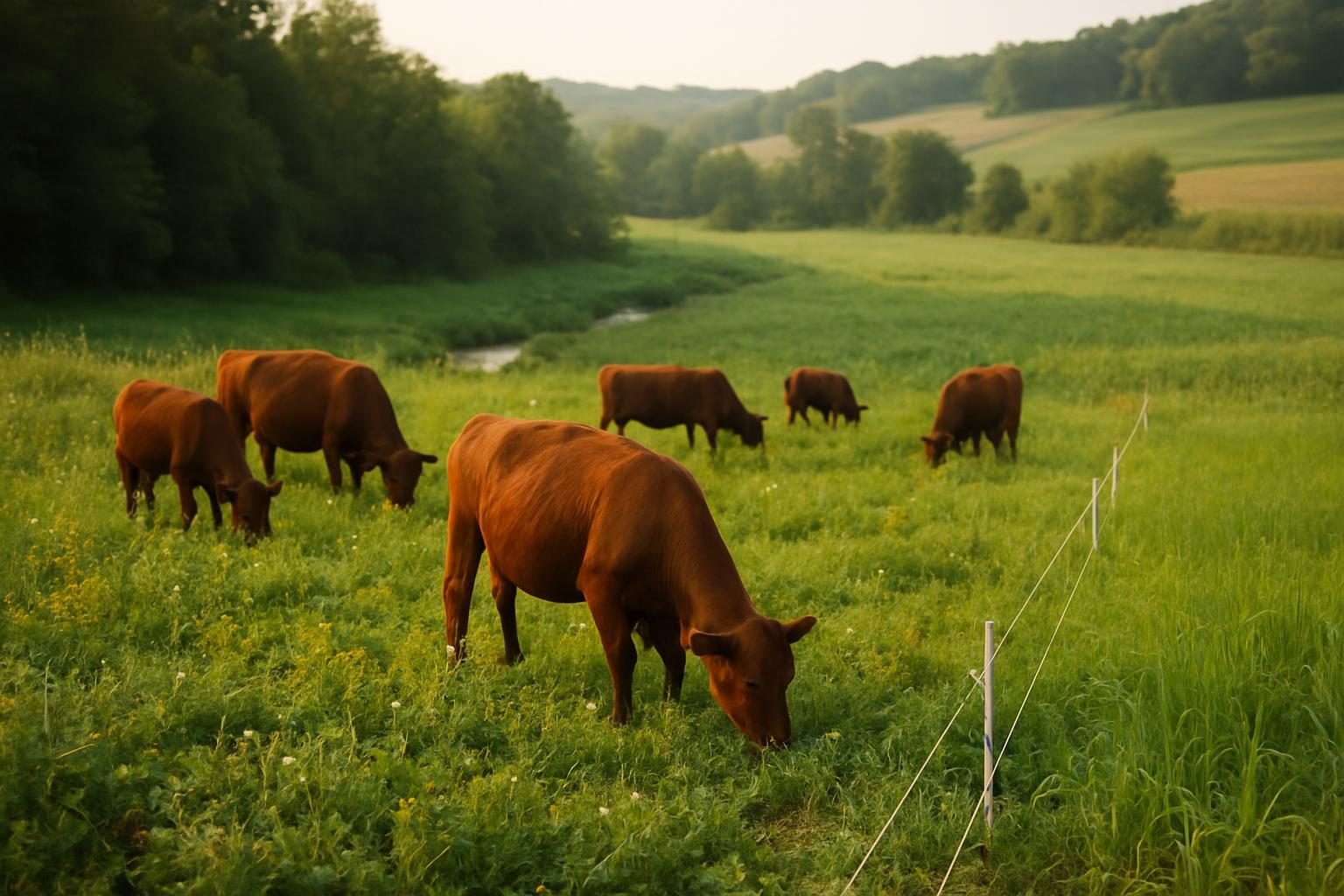
Well-managed grazing can improve forage growth, keep the soil covered, support deeper roots and in some cases build soil carbon. It can also improve animal performance and farm resilience. For the how-to, see our complete guide to rotational grazing.
What it generally cannot do
The carbon gained in pasture soil is usually smaller than the methane the animals emit when you count it over the same period, and the soil sink eventually saturates while methane emissions continue. Research on this is genuinely contested, with results depending on the system, the baseline and the accounting method. A balanced reading is that good grazing improves the picture compared with poorly managed grazing, but it does not make beef climate neutral. Grass finishing, for example, changes the land-use and soil story but often takes longer and can mean more total methane per pound of beef; see what it takes to finish on forage before assuming it is automatically better.
Practical ways to trim livestock emissions
- Improve forage quality and digestibility, since better feed can reduce methane per unit of gain.
- Raise animals efficiently, with healthy herds and good reproduction, so fewer animal-days are needed per pound produced.
- Manage manure well, spreading it on pasture rather than storing it wet, where it releases more methane.
- Cut off-farm inputs where you can, including purchased feed, fuel and synthetic nitrogen.
Where regenerative farming shines: resilience and adaptation
If you remember one thing, make it this: the most reliable, farmer-level payoff of regenerative practices is resilience. Climate change brings more erratic rainfall, hotter stretches, longer dry spells and heavier storms. Healthy, covered, biologically active soil handles all of it better.
| Climate stress | How regenerative practices help | Typical practices |
|---|---|---|
| Drought | Better water infiltration and storage; less evaporation from bare soil | Cover crops, mulch, residue, perennial pasture |
| Heavy rain and flooding | Less runoff and erosion; more stable aggregates | Reduced tillage, riparian buffers, living roots |
| Heat | Cooler soil surface; more shade and microclimate | Cover, agroforestry, alley cropping, windbreaks |
| Input price shocks | Less dependence on purchased fertilizer and feed | Legumes, diverse rotations, compost, grazing |
| Compaction after wet years | Roots and biology restore soil structure | Diverse covers, deep-rooted species, careful traffic |
Organic matter helps soil hold water, though the often-quoted claim that each 1 percent increase stores a huge extra amount of water varies a lot by soil and is easy to overstate. The safer takeaway is that better structure and cover improve infiltration and reduce runoff in most soils, which matters most in the storms and dry spells you are actually facing. Compacted ground is a common culprit, and you can address it without heavy tillage; see how to fix compacted soil.
Water management and trees extend this resilience. A farm pond can buffer dry spells, riparian buffers protect streams during floods, and systems like alley cropping add shade, habitat and perennial carbon storage in woody biomass.
Avoiding overclaiming: a practical checklist
Greenwashing hurts farmers and eaters alike, and the critics have fair points in some cases. Before you make or accept a climate claim, run through this list:
- Ask for the baseline. Compared with what? Gains relative to a degraded field look bigger than gains relative to already good management.
- Check the depth and method. Were samples taken at consistent depths and locations over multiple years?
- Consider the whole system. Count methane, nitrous oxide, fuel and inputs, not just soil carbon.
- Look at permanence. What happens if management changes or a drought or fire hits?
- Be wary of single-number promises. Real results vary by region and soil.
- Separate climate claims from other benefits. Water, biodiversity, soil health and profit are valuable even if the carbon number is modest.
For a fair look at common critiques, read regenerative agriculture criticism: myths and the evidence, and see the broader evidence on the benefits of regenerative agriculture.
Regional differences to keep in mind
The humid East and Southeast often see faster biomass growth and carbon building, but also faster decomposition in warm, wet conditions and heavy storm runoff to manage. The Corn Belt offers big opportunities through cover crops, longer rotations and integrating livestock, though winter conditions limit cover crop growth. The arid West is limited by water, so gains are slower and grazing and irrigation management matter most. Local extension and NRCS offices can tell you what is realistic where you farm.
Where to start on your farm
You do not need to wait for a perfect carbon number to get started. Build the practices that pay off in resilience and cost savings first, and treat carbon as a bonus you measure honestly. A phased approach helps; our 3-year transition plan and examples of regenerative agriculture show what that looks like in practice. Cost-share programs such as the Conservation Stewardship Program may help; confirm current eligibility and payment details with your local NRCS office. If you are weighing how this fits other systems, see regenerative vs organic farming and how permaculture and regenerative agriculture relate. For the money side, start with the regenerative farming business hub. You can also browse the full Regenerative Agriculture 101 category.
Key takeaways
- Regenerative practices can build soil carbon, but gains are finite, reversible and variable by region and soil.
- Grazing can improve soil and forage, but it does not erase livestock methane; the science is still debated.
- Resilience to drought, floods and heat is the strongest and most dependable benefit.
- Count the whole system, not just soil carbon, and be skeptical of single-number claims.
- Start with practices that pay off in the near term, measure honestly and confirm program details with the source.
Frequently asked questions
Can regenerative agriculture reverse climate change?
No. It can help, mainly by storing some carbon, trimming certain emissions and making farms more resilient, but the scale is limited and soil carbon eventually saturates. Real climate progress still requires large cuts in fossil fuel use across the economy.
How much carbon can regenerative farming store?
It varies a lot. Gains are usually fastest in the first several years and then taper, and results depend on climate, soil, starting carbon and management. Treat published figures as typical ranges rather than guarantees, and track your own fields with consistent soil testing.
Is grazing cattle good or bad for the climate?
It depends on the system and how you count. Well-managed grazing can improve soil and land health, but cattle still emit methane, and the carbon stored in soil often does not fully offset it. Better management helps, but it does not make beef carbon neutral.
Is regenerative agriculture worth it if the carbon benefits are small?
Often yes. Improved water infiltration, reduced erosion, lower input costs, better drought tolerance and healthier soil can justify the practices on their own. Think of carbon storage as a possible extra rather than the sole reason to change.
Should I sell carbon credits from my farm?
It depends on the program terms, payment levels, contract length and reversal rules. Compare the payment against your real costs, read the fine print, and confirm current details with the program. Consider reviewing regenerative agriculture certification programs and getting legal or tax advice before committing.