Carbon credits for farmers sound simple: change how you farm, store carbon in the soil, get paid. In practice, soil carbon programs come with measurement rules, multi-year contracts and eligibility catches that can make or break the deal. This guide walks through how the programs work, what they typically pay, and what to ask before you sign anything.
Quick answer: Carbon credits for farmers are payments from programs that reward practices like no-till, cover crops or better grazing that are expected to store carbon or cut emissions. Most programs pay per acre or per metric ton of CO2 equivalent, require verification and a multi-year contract, and often exclude farmers who already use the practice. Typical payments are modest, so treat them as a bonus, not a business plan.
How carbon credit programs actually work
A carbon credit represents one metric ton of CO2 equivalent that was removed from the atmosphere or kept out of it. In agriculture, the idea is that changing your management increases soil organic carbon (or reduces nitrous oxide and methane), and a buyer pays for that benefit. The buyers are usually companies trying to meet climate commitments, often through food and agriculture supply chains.
Between you and the buyer sits a program operator, sometimes called an aggregator or registry. They enroll farms, set the rules, hire verifiers, bundle the credits and sell them. They also take a cut, commonly somewhere in the range of 10 to 30 percent or more, so always ask what share reaches you.
Two main types of credits
- Sequestration credits: based on added soil organic carbon from practices like cover cropping, reduced tillage, rotational grazing or agroforestry.
- Emissions reduction credits: based on lower nitrous oxide, methane or fuel use, such as nitrogen management changes or improved manure handling.
How programs pay
Payment structures vary a lot between operators, and the structure matters as much as the headline number.
| Payment model | How it works | Main catch |
|---|---|---|
| Practice-based (per acre) | Flat payment for adopting listed practices, often modeled rather than measured | Payment may be lower; rules on eligible practices can be narrow |
| Outcome-based (per ton) | Paid on measured or modeled tons of CO2e stored | Results vary by year, soil and weather; payment can be uncertain |
| Hybrid | Part upfront for practice, part later for verified results | More paperwork; later payments depend on verification |
As a rough, estimate-only range, many programs have paid on the order of a few dollars up to a few tens of dollars per acre per year, depending on practice, region and carbon prices. Prices per ton have swung widely. Confirm current rates directly with any program, because they change.
Measurement, reporting and verification
This is where the science gets difficult, and where honest programs differ from sloppy ones. Soil carbon changes slowly, varies a lot across a single field, and is expensive to measure precisely. Detecting a real change usually takes several years and a lot of samples.
Programs generally use one or a mix of these approaches:
- Modeling: software estimates carbon change from your practice records, soil type and weather. Cheap and scalable, but only as good as the model and inputs.
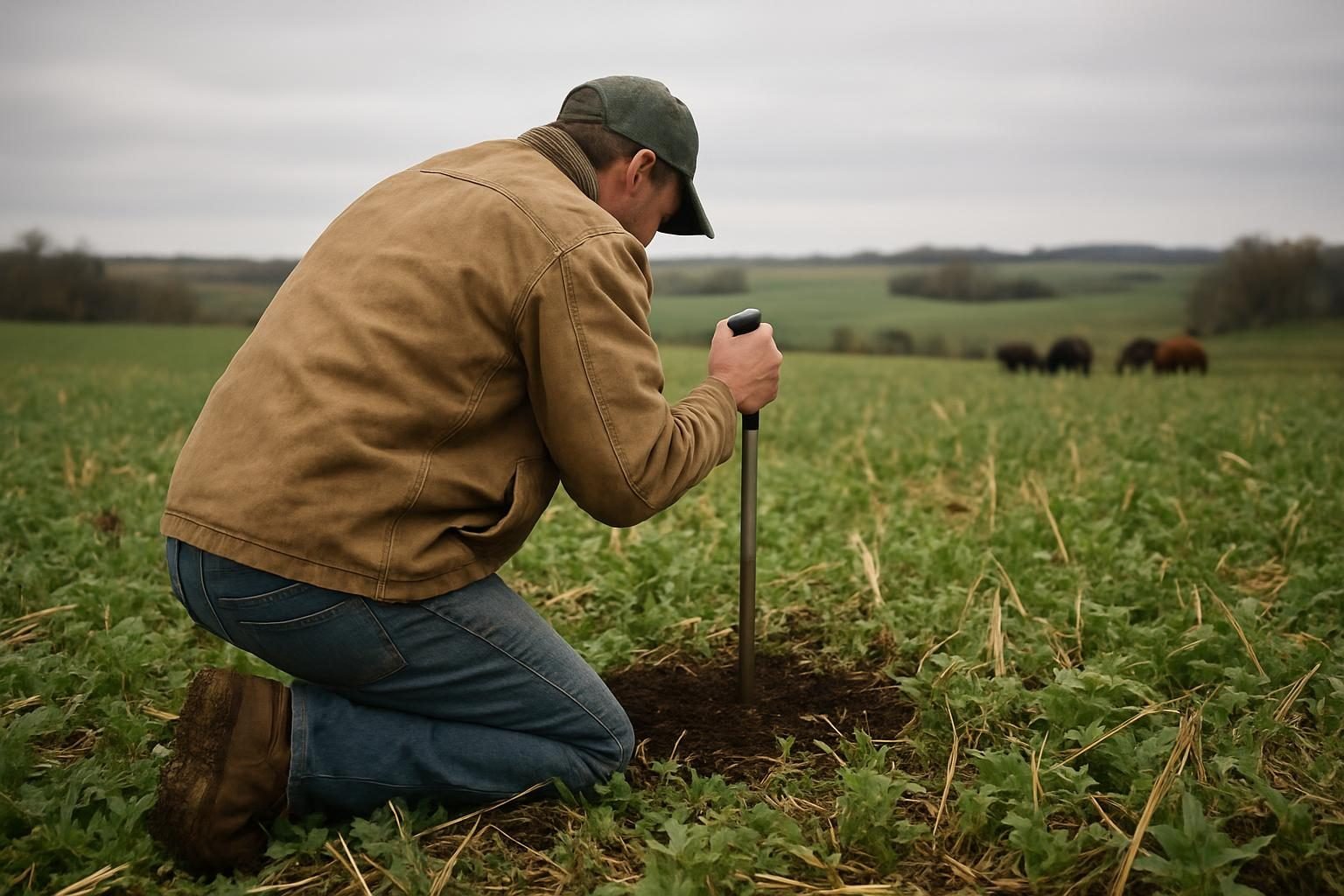
- Soil sampling: baseline and follow-up samples at set depths. More credible, but costs money and has high variability.
- Hybrid: sampling to calibrate and validate the model.
Ask which method is used, how deep sampling goes, who pays for it, and how often you will be re-tested. Understanding your own baseline helps a lot. Our guide to soil testing for regenerative farmers explains what standard tests, Haney tests and biological tests actually tell you, and what they do not.
Expect to keep records: field boundaries, planting and harvest dates, tillage passes, cover crop species and termination, grazing dates and stocking, and input applications. Good records are useful anyway, and they are the backbone of any verification.
Contract length and permanence
Carbon stored in soil can be released again if practices reverse. To address this, programs ask for permanence commitments. These range from short-term contracts of one to five years to long-term obligations of ten years or more, and a few registries expect carbon to stay stored for decades.
The key questions:
- How many years are you locked in, and can you exit early?
- What happens if you till, sell the land or lease it out?
- Does the contract run with the land or with you?
- Is there a buffer pool or reversal clause that makes you repay or forfeit credits if carbon is lost?
- What happens after a drought, flood or crop failure that is outside your control?
If you rent ground, check your lease carefully before enrolling. A landowner may need to agree, and a short lease can conflict with a long carbon contract. Have an attorney review anything with long-term obligations or title implications. That is not something to guess at.
Additionality: why past adopters are often excluded
Additionality means the carbon benefit would not have happened without the credit payment. Buyers want to know they are paying for change, not for what you were already doing. So many programs only pay for new practices, or for practices you adopt after a set start date or baseline period.
The result can feel unfair. A farmer who went no-till and planted cover crops a decade ago may be ineligible, while a neighbor who just switched gets paid. Some programs now recognize longtime adopters through different baselines or by paying for continued practice, but policies vary and keep changing.
If you already farm regeneratively, ask directly: how do you set my baseline, and do my existing practices count? If the answer is no, look at other funding. Cost-share programs such as EQIP for regenerative farmers and the Conservation Stewardship Program are designed in part to reward ongoing stewardship, so they may fit better. Confirm current eligibility with your local NRCS office. You can also see broader options in our regenerative farming business guide.
What practices tend to qualify
Eligible practices differ by program and region, but common ones include:
- No-till or reduced tillage
- Cover crops (see our cover crop mixes guide for species choices)
- Extended rotations and perennial crops
- Adaptive and rotational grazing
- Nutrient management to reduce nitrous oxide
- Agroforestry, such as alley cropping and windbreaks
Region matters. Row-crop programs have been strongest in the Corn Belt and Great Plains. Grazing and orchard options are thinner in some programs, and humid-East or small diversified farms are often underserved because the per-farm paperwork does not pencil out. Ask whether your acreage type and size are actually supported.
Questions to ask before you sign
- What exactly do I get paid, and when? Get the per-acre or per-ton figure, the payment schedule and any fees in writing.
- What is the operator’s cut? Ask what percentage of credit sales reaches you.
- How long is the contract, and what are the exit terms?
- How is carbon measured, and who bears the cost?
- How is additionality defined? Does my history of practices disqualify me?
- Who owns the credits and the data? Can you stack other payments, or does the contract limit that?
- What happens if I sell, lease or change practices?
- What risk do I carry if yields drop or the weather turns?
Before committing, run the numbers. A short farm business plan helps you see whether the practice change pays on its own merits, with the credit as a bonus. If the practice only works with the credit, the deal is riskier than it looks. Also consider whether you can capture value on the product side, through how you price farm products or direct sales. Many regenerative farmers earn more from premium markets than from carbon. Our guide on selling grass-fed beef direct shows one example, and certification comparisons in Regenerative Organic Certified vs other labels can help you weigh market-based premiums.
Honest expectations
Carbon markets are young and still shifting. Prices, protocols and buyer demand change, and critics raise fair concerns about measurement uncertainty and permanence. That does not make participation foolish, but it does mean going in clear-eyed. For context on the broader debate, see our piece on regenerative agriculture criticism and the evidence.
A reasonable approach: adopt practices because they improve soil, cut input costs and build resilience. If a carbon program pays you to do what you were already planning, and the contract terms are fair, take it. If the contract locks you in for little money, walk away.
Key takeaways
- Carbon credit payments are usually modest and vary widely; treat them as a supplement.
- Know whether you are paid per acre for practices or per ton for measured results.
- Measurement is uncertain and slow; ask how it is done and who pays.
- Long contracts and permanence clauses can bind you and your land; get legal review.
- Additionality rules often exclude past adopters; ask about baselines up front.
- Compare against NRCS cost-share and premium markets before enrolling.
- Confirm current terms with the program, since prices and rules change.
Frequently asked questions
How much money can a farmer make from carbon credits?
It depends on the program, practice, region and carbon price. Typical payments have been a few dollars to a few tens of dollars per acre per year, with the operator taking a share. Treat any number as an estimate and confirm current terms directly.
Can I get carbon credits if I already use no-till and cover crops?
Often not, or only partly. Many programs require additionality, meaning they pay for new practices. Some now offer baselines that recognize existing adopters, so ask each program how it treats your history.
How long do I have to commit?
Contracts range from a few years to a decade or more. Longer commitments usually come with permanence clauses that can require repayment if you reverse practices. Read exit and sale-of-land terms carefully.
Is soil carbon measured or just modeled?
Both are used. Some programs rely on models fed by your records, others add soil sampling, and many combine them. Sampling is more credible but costlier and slower to show real change.
Should I pick carbon credits or USDA conservation programs?
They are not always either-or, but check whether stacking is allowed. NRCS programs like EQIP and CSP can pay for practice adoption and ongoing stewardship, and may suit past adopters better. Confirm eligibility and current payment rates with your local NRCS office.