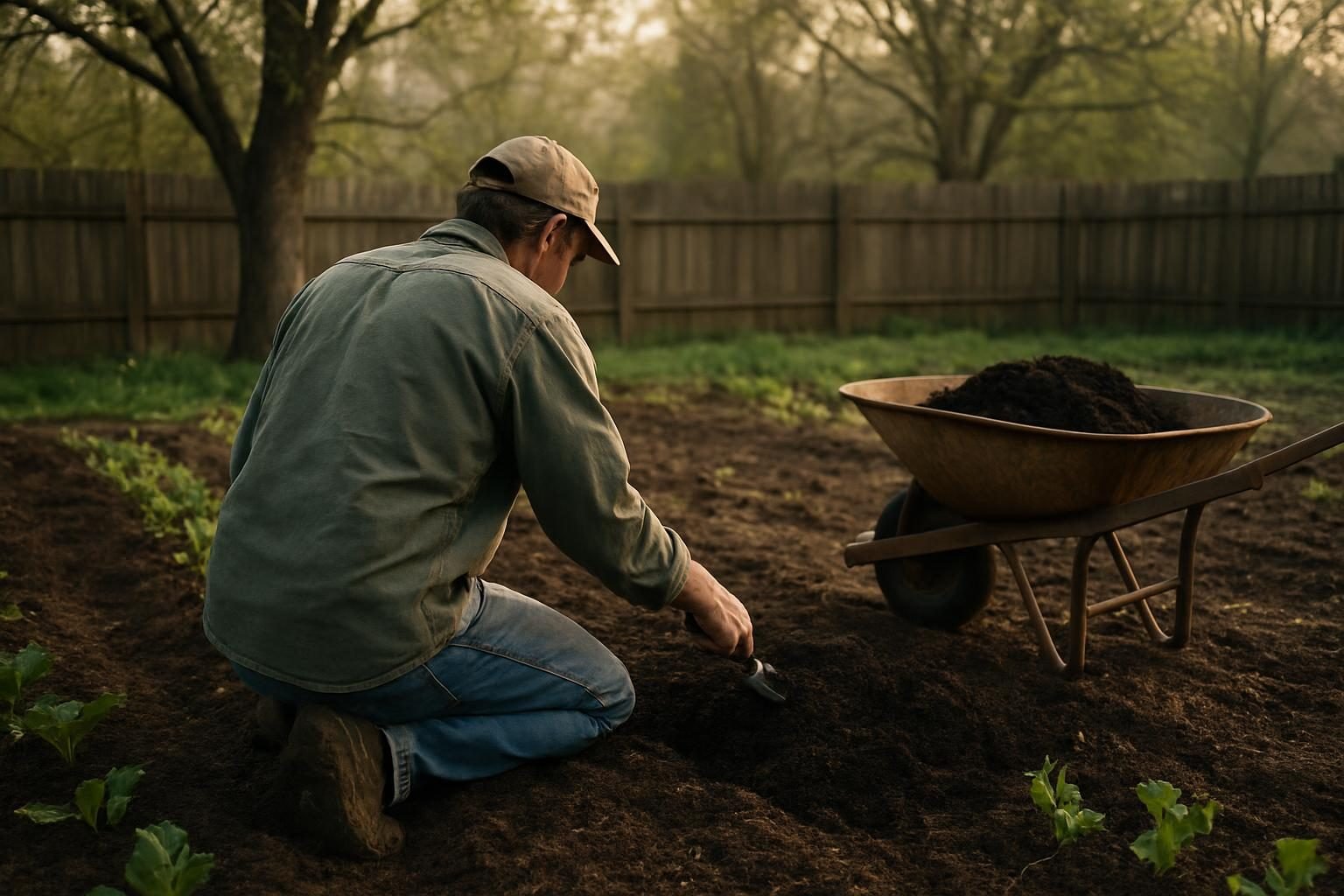
Most gardeners ask the same question before they plant: should I fix the dirt I already have, or haul in something better? The honest answer is that it depends on what a soil test says, what you stand on, and how much time you have. This guide walks through how to decide, and how to build good soil for garden beds without tilling it to death.
Quick answer: Amend your native soil if a test shows it is free of contaminants and has workable texture; it is cheaper, keeps existing soil life intact, and improves every year. Bring in new soil only when the ground is contaminated, shallow over rubble or bedrock, waterlogged, or you are building raised beds on pavement. In most in-ground beds, spreading 1-3 inches of compost on top and leaving the soil undisturbed beats tilling.
Start with a soil test, not a truck order
Before you spend money on anything, find out what you have. A basic test from your state land-grant extension service or a commercial lab usually costs somewhere in the range of $15 to $40 and tells you pH, major nutrients, and organic matter. Many extension offices also offer or recommend a heavy-metals screen, which matters if your lot is in an older neighborhood.
Here is what to look for:
- pH: Most vegetables do well between about 6.0 and 7.0. Blueberries want it lower; some brassicas tolerate higher.
- Organic matter: Many garden soils sit between 2 and 5 percent. Below about 2 percent usually means thin, hungry soil that benefits most from compost.
- Lead and other metals: Houses built before 1978 often have lead paint residue near the foundation, and old orchards may carry arsenic from past spraying. If results come back high, that is a strong argument for imported soil in raised beds, or at least a barrier and clean fill.
- Nutrients: Phosphorus and potassium are easy to overapply. Let the test, not habit, drive additions.
For a deeper look at what different tests measure, including biology-focused options, see our guide to soil testing for regenerative farmers. Many of the same principles apply at garden scale.
Amend or replace: a decision table
Use this as a starting point. Your local conditions may shift the answer.
| Situation | Better choice | Why |
|---|---|---|
| Clean test, loam or sandy loam, decent drainage | Amend in place | Little to gain from replacing it; compost and mulch do the rest. |
| Heavy clay, otherwise clean | Amend in place, plus cover crops | Organic matter builds structure over time; see drainage notes below. |
| Pure sand | Amend in place | Compost and mulch raise water and nutrient holding capacity. |
| Elevated lead or other contaminants | Raised beds with imported soil | Keeps roots and children away from contaminated ground. |
| Compacted fill, rubble, or a few inches of soil over rock | Raised beds or build-up | Roots need depth you cannot create by digging. |
| Standing water most of spring | Raised beds or fix drainage first | Amendments will not cure a high water table. |
| Beds on concrete, asphalt, or a deck | Imported soil | No native soil to work with. |
If you are leaning toward raised beds, our guide to using yard soil in raised beds explains how to test and fix it before you buy anything, and the raised bed soil calculator helps you work out volume so you do not over- or under-order.
Why amending native soil usually wins
Your existing soil already holds a community of bacteria, fungi, earthworms, and other organisms that took years to establish. Bringing in a truckload of fresh topsoil does not transplant that community; it often buries it under material of unknown origin and quality. Purchased soil also varies widely. Some is excellent; some is stripped subsoil mixed with sand and a little compost.
Amending native soil, by contrast, works with what is there. Organic matter improves aggregation, which helps clay drain and sandy soil hold water. It also feeds the biology covered in our piece on the soil microbiome. And it costs a fraction of imported soil.
The trade-off is time. Native soil improves over seasons, not weeks. If you need a productive bed by next month on bad ground, imported soil in a raised bed is the faster route.
What to add: compost and organic matter
Compost is the workhorse. It supplies slow-release nutrients, feeds soil life, and improves structure. Good finished compost smells earthy, looks dark and crumbly, and has no recognizable food scraps or hot, ammonia odor. Other amendments like biochar for sale can also enhance soil structure and biology.
How much compost
A typical range for established beds is 1 to 3 inches spread across the surface once or twice a year. New beds on poor soil may take the higher end for the first year or two. More is not always better: heavy repeated applications can build excess phosphorus and salts, so check your test every few years.
Other organic matter
- Leaves: Shredded or whole, they make excellent mulch and eventually leaf mold. See fall leaves as mulch, leaf mold, and compost carbon.
- Wood chips: Best as a path or surface mulch, not mixed deep into vegetable beds where they can tie up nitrogen at the contact zone.
- Aged manure: Useful, but must be fully composted. For poultry manure in particular, see our upcoming guide on composting chicken manure.
- Cover crops and green manures: Grown in place, they add biomass and roots where you need them. Read about green manure and the best cover crops for clay soil.
- Biochar: Can help hold water and nutrients, especially in sandy soils, but only when charged with compost or nutrients first. Limits and use are covered in our biochar guide.
If you make your own, the upcoming comparison of composter types compared will help you choose a system that fits your space.
How deep to amend
This is where many gardeners overdo it. Most vegetable roots do the bulk of their feeding in the top 6 to 12 inches. You do not need to dig compost down two feet.
- Surface application: Spread compost 1 to 3 inches thick and leave it. Worms, rain, and roots pull it down. This is the lowest-effort method and protects soil structure.
- Shallow incorporation (optional): If you want some mixed in, work it into the top 3 to 4 inches with a rake or broadfork, not a rototiller.
- Deep-rooted crops: Tomatoes, squash, and perennials like asparagus appreciate loose soil to 12 inches or more, but that is a matter of loosening with a broadfork, not burying compost deeply.
Mixing a thin layer of compost into subsoil can create a boundary where water pools and roots stall. Gradual, surface-driven improvement avoids that.
How to avoid tilling
Tilling feels productive but breaks soil aggregates, speeds up organic matter loss, and brings buried weed seeds to the surface. A no-dig approach builds soil from the top down. The same logic scales up to field production in our no-till farming guide.
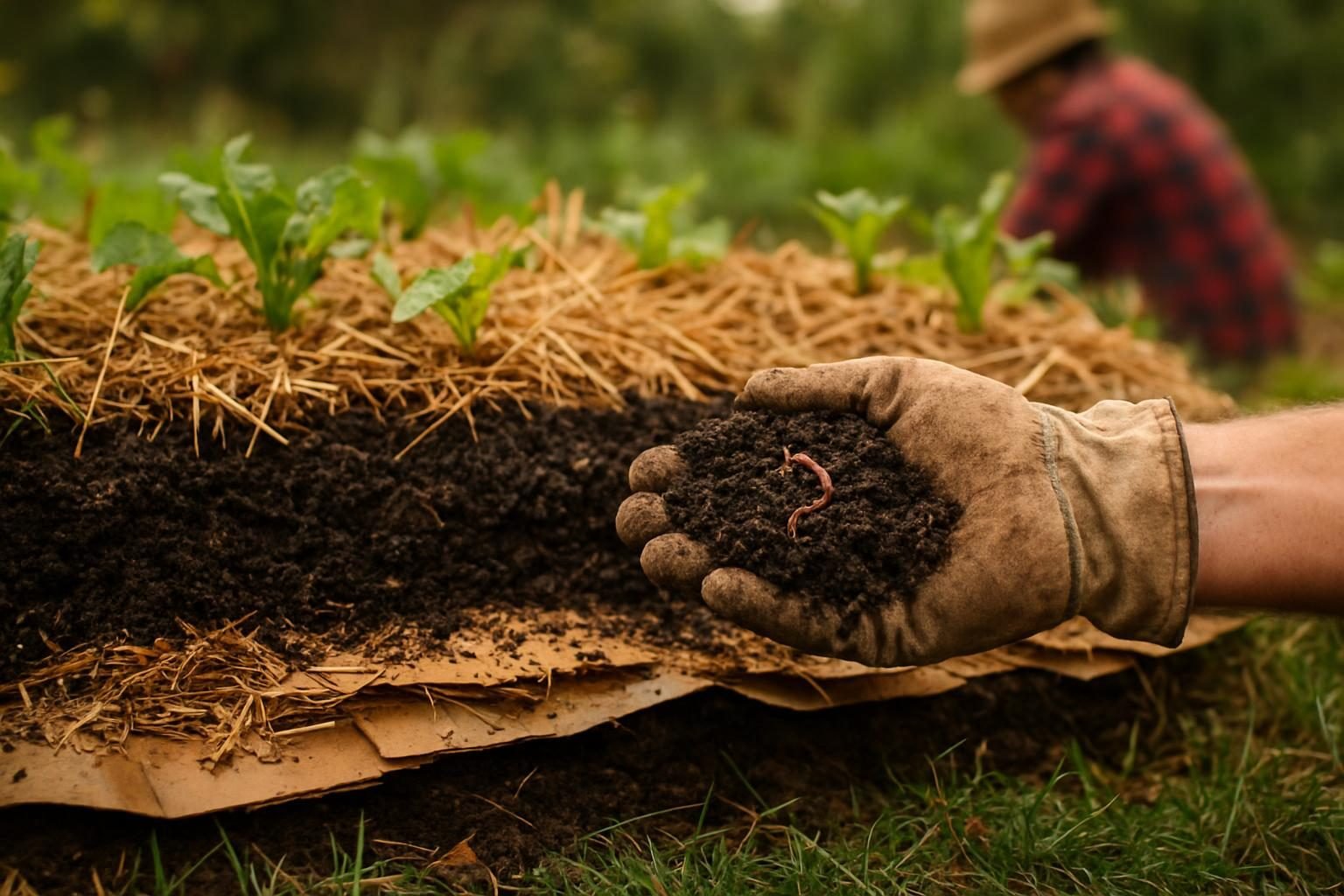
A simple no-dig bed, step by step
- Mark the bed and mow or cut existing vegetation as low as you can.
- Leave the roots in place. Do not pull sod unless it is thick turf grass you cannot smother.
- Loosen if needed. On compacted ground, push a broadfork in, rock it back, and step back. Do not flip the soil. More on this in how to fix compacted soil without heavy tillage.
- Smother weeds with a layer of plain cardboard (tape and staples removed), overlapped by several inches and wetted down.
- Add 2 to 4 inches of compost on top of the cardboard.
- Mulch with straw, leaves, or wood chips on paths and around established plants.
- Plant through the compost. For large transplants, cut an opening through the cardboard. Seeds can go straight into a fine layer of compost.
In-place composting methods, where you build or bury organic matter directly in the bed, are covered in our upcoming guide to composting in a garden bed.
Regional notes
Local conditions change the details.
- Humid East and Southeast: Organic matter breaks down fast in heat and rain, so expect to top up compost more often. Acidic soils may need lime based on test results.
- Corn Belt and Midwest: Many garden soils start with good organic matter. Test before adding, and watch compaction on former field ground.
- Arid West: Alkaline soils and low organic matter are common. Compost and mulch conserve moisture, but watch salts in compost and irrigation water.
- Cold North: Soil warms slowly in spring; raised or mounded beds can extend the season even when native soil is fine.
Drainage trouble anywhere may call for the steps in improving soil drainage without heavy equipment.
Key takeaways
- Test first. Contamination, shallow soil, or waterlogging are the main reasons to import soil.
- In clean, workable ground, amending native soil is cheaper and builds on existing soil life.
- Spread 1 to 3 inches of compost on the surface once or twice a year, and recheck your test every few years.
- You rarely need to amend deeper than the top 6 to 12 inches.
- Skip the tiller: use cardboard, compost, mulch, and a broadfork for compaction.
- Improvement takes seasons. Be patient, and keep soil covered.
For the bigger picture, our complete guide to building living soil ties these practices together, and you can browse more in the Soil Health category. To build organic matter over the long term, read how to increase soil organic matter and how long it takes.
Frequently asked questions
Can I just add compost to my existing soil and plant?
Yes, in most cases. If your soil test shows no contaminants and the soil is reasonably workable, spreading 1 to 3 inches of finished compost on top and planting into it is a sound approach. Improvement continues with each season’s additions.
Is bagged garden soil better than my native soil?
Not necessarily. Quality varies a lot between products, and bagged soil lacks the established biology of your ground. It makes sense for containers and raised beds, or when native soil is contaminated, but it is rarely a better deal for in-ground beds. For container-specific questions, see potting mix versus garden soil in raised beds.
How often should I test my garden soil?
Test once to set a baseline, then every two to three years, or sooner if plants struggle or you make large changes. Test before adding lime, phosphorus, or other mineral amendments rather than guessing.
Do I have to till to mix compost in?
No. Surface-applied compost works its way into the soil through rain, roots, and soil organisms. If you want some incorporation, a rake or fork in the top few inches is enough.
What if my soil is mostly clay or sand?
Both respond to the same remedy: steady additions of organic matter. In clay it improves structure and drainage; in sand it improves water and nutrient holding. Adding sand to clay or clay to sand is not recommended, since it can make the problem worse.