Every autumn, millions of bags of leaves leave American neighborhoods for the curb, while the same gardens and farms buy bagged mulch and carbon-rich amendments the following spring. Fall leaves are one of the best free sources of organic matter you will ever get. This guide covers how to use fall leaves as mulch and compost three ways: laid on beds, rotted into leaf mold, and mixed into compost as the carbon component.
Quick answer: Shred leaves with a mower and spread them 2-4 inches deep on beds as mulch, pile them (kept damp) for 6-24 months to make leaf mold, or mix them with greens at roughly 2-3 parts leaves to 1 part nitrogen-rich material by volume to feed a compost pile. Shredding and moisture matter most: whole, dry leaves mat down and shed water, while shredded, damp leaves break down and feed soil life.
Why fall leaves are worth keeping
Leaves are tree-scale nutrient recycling. Roots pull minerals from deep in the soil profile, and leaves return a portion of them to the surface each year. Typical leaf carbon-to-nitrogen ratios run from roughly 40:1 to 80:1 depending on species, which makes them a classic carbon-rich “brown.” They are also dominated by structural compounds that feed fungi, so leaf-based mulches tend to favor the fungal side of the food web. If you want background on that, see our guide to the soil microbiome and how bacteria and fungi feed crops.
Leaves are not a complete fertilizer. They add modest nutrients and a lot of carbon. Their real value is organic matter, surface protection, moisture retention and food for soil organisms. They fit a broader strategy of keeping soil covered and fed, which we cover in our complete guide to building living soil.
Before you start: collect and prepare
Shredding
Shredding is the single most useful step. Whole leaves, especially broad ones like maple, sycamore and oak, stack flat and form a dense mat. Running a mower over a pile (bag attachment on, or rake windrows and mow across them) cuts leaves to dime-to-quarter-sized pieces. Shredded leaves can be a fifth to a tenth of the volume of whole ones, breathe better, and break down much faster. A leaf shredder, string trimmer in a barrel, or chipper-shredder also works for larger quantities.
Moisture
Leaves collected dry in October will sit unchanged for years. Microbes need water. Aim for the dampness of a wrung-out sponge: a handful squeezed hard should release a drop or two. Wet leaves down with a hose as you build piles, or collect after a rain.
What to leave out
- Black walnut leaves: contain juglone, which can stress sensitive plants like tomatoes and peppers. Compost them well (several months) before using, or keep them away from sensitive crops.
- Leaves from sprayed or treated sites: persistent herbicide residues (such as certain broadleaf herbicides used on lawns or hayfields) can survive composting and damage crops. If you are unsure of the source, ask, or test a small bed first.
- Diseased leaves: heavy apple scab, black spot or similar disease is best hot-composted or removed from the site.
- Street litter: remove plastic, glass and trash. Leaves from heavily trafficked roads may carry contaminants; extension services can advise on testing.
Method 1: Leaves as mulch
This is the fastest, lowest-effort use. Spread shredded leaves 2-4 inches deep over vegetable beds, around perennials, shrubs and fruit trees, and in pathways. Mulch suppresses weeds, buffers soil temperature, reduces evaporation and slowly feeds earthworms and fungi. It works well alongside no-till practices.
- Keep mulch off stems and trunks. Leave a hand-width gap around woody stems and crowns to reduce rot and rodent harbor.
- Do not lay thick, whole-leaf layers. More than a few inches of matted, unshredded leaves can shed rain, block oxygen and smell sour as they go anaerobic.
- Pull back in spring if needed. Cold, wet soils warm slowly under mulch. Rake mulch aside a couple of weeks before direct seeding or transplanting heat-lovers.
- Watch for slugs. In humid regions, leaf mulch can shelter slugs and snails. Thinner layers and keeping mulch back from seedlings help.
Leaf mulch can also go on top of cardboard or directly on garden soil as the start of a no-dig bed. For ideas on filling beds economically, see our guide on dirt for raised beds, which covers how to test and fix yard soil for layering with leaves and other materials.
Method 2: Leaf mold
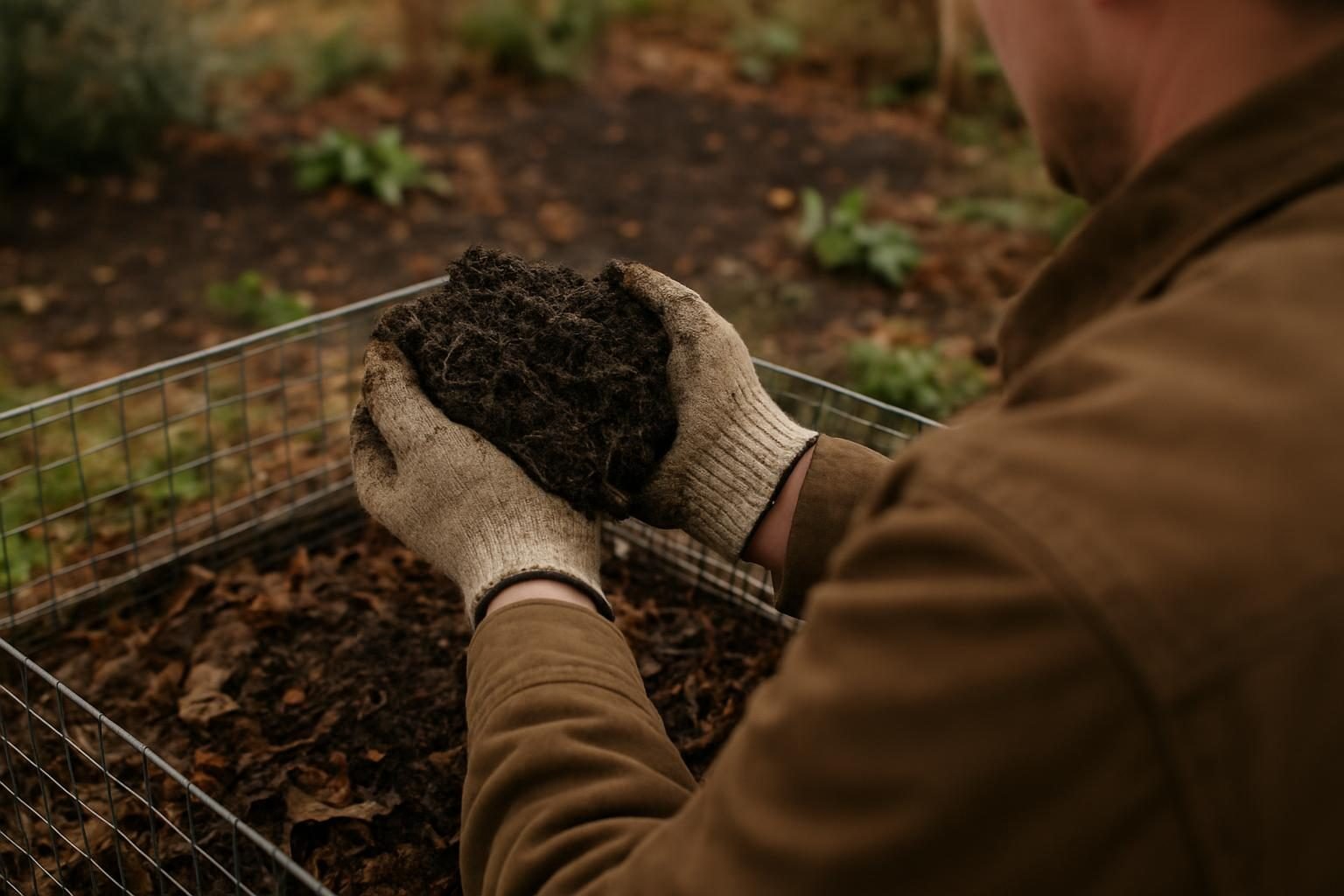
Leaf mold is what you get when leaves decompose mostly through fungal action, cool and slow, rather than in a hot compost pile. It looks like dark, crumbly, forest-floor humus. It is low in nutrients but excellent at holding moisture, loosening heavy soil and improving structure, which makes it a useful ingredient for seed-starting mixes and potting blends once screened, or for amending garden bed soil.
How to make it
- Pick a spot. A shaded corner is ideal, and it can be a simple wire cage, a pallet bin, or just a free-standing pile. Cages of chicken wire or hardware cloth 3-4 feet across work well.
- Shred if you can. Whole leaves still work, but shredded ones finish in a fraction of the time.
- Wet as you pile. Add leaves in layers of 6-8 inches and dampen each layer.
- Leave it alone. Optionally turn the pile once or twice a year to add air and check moisture. Keep it damp in dry spells.
- Harvest. It is ready when it is dark, crumbly and smells earthy.
How long it takes
Timelines vary by species, climate and shredding. As a typical range, shredded leaves kept damp can become usable partly decomposed leaf mold in roughly 6-12 months; whole leaves often take 1-2 years or longer. Oak and beech leaves are tougher and slower; maple, ash and elm break down faster. Warm, humid climates move faster than cold or arid ones. In dry regions, moisture is usually the limiting factor, so cover the pile with a tarp or wood chips to hold water.
Half-finished leaf mold is still useful as mulch. You do not need to wait for perfection.
Method 3: Leaves as the brown in compost
Most compost piles run short on carbon, especially when kitchen scraps, grass clippings or manure supply most of the volume. Leaves are a dependable “brown.” A common starting target is roughly 2-3 parts leaves to 1 part greens by volume, then adjust by feel: too wet, smelly or slimy means add more browns; dry, slow and cool means add greens and water.
| Approach | Effort | Typical time to usable material | Best for | Main caution |
|---|---|---|---|---|
| Mulch on beds | Low | Immediate cover; breaks down over a season | Weed control, moisture, feeding soil life | Thick matted layers, slugs, cold springs |
| Leaf mold | Low, with patience | About 6-24 months | Soil structure, moisture holding, seed mixes | Dry piles stall; low nutrient content |
| Compost brown | Moderate | Weeks to months depending on management | Balancing greens, manure and food scraps | Not enough nitrogen or moisture slows it |
Stockpiling leaves in fall is a smart way to have browns on hand all year, since carbon is scarce in summer when greens are abundant. Keep a covered bin or bagged reserve. If you keep poultry, leaves also make good coop and run bedding that can be composted later; see our upcoming guide to composting chicken manure safely. For help choosing a system, our planned comparison of compost bin types will cover tumblers, piles, bays and worm bins, and the compost troubleshooting guide will help with smells, pests and slow piles.
You can also skip the pile entirely by burying or layering leaves where they will rot, which our upcoming article on composting in place with trench, lasagna and in-bed methods will cover.
Cautions and trade-offs
- Matting. Whole, wet, flat leaves (maple, sycamore, magnolia) mat into a water-shedding sheet. Shred, mix with looser material like straw or chipped brush, or keep layers thin.
- Nitrogen tie-up. Fresh, high-carbon material mixed deep into soil can temporarily pull nitrogen as microbes feed. Surface application is safer than tilling in heavy amounts, and heavy feeders benefit from a nitrogen source or a cover crop.
- Fire risk. In dry western regions, thick dry leaf litter against buildings is a hazard. Keep mulch away from structures and follow local wildfire guidance.
- Pests. Rodents and slugs may use deep mulch. Keep layers moderate near crops and avoid piling against trunks.
- Volume vs. benefit on large acreage. For farms, leaves are practical only where hauling is cheap, such as municipal drop-offs or nearby tree-care operations. Confirm local rules and that the source is free of herbicide residue.
Fitting leaves into the bigger system
Leaves build organic matter slowly, so set expectations: they support a program, they do not replace one. For realistic timelines, see how to increase soil organic matter and how long it takes. Pair leaf mulch with living roots from cover crops, and use a soil test to check pH, organic matter and nutrients before and after (see soil testing for regenerative farmers). Leaves are particularly useful on small plots; our guide to small-scale regenerative farming shows how they fit into intensive systems, and the Soil Health section collects related guides.
Key takeaways
- Shred leaves whenever you can; it is the biggest speed and quality upgrade.
- Keep mulch layers to roughly 2-4 inches and away from stems and trunks.
- Leaf mold is slow (about 6-24 months) but low-effort and excellent for structure and water holding.
- In compost, aim for roughly 2-3 parts leaves to 1 part greens by volume, then adjust by feel.
- Watch for black walnut, herbicide residue, disease and matting.
- Stockpile leaves in fall so you have carbon all year.
Frequently asked questions
Do I need to shred leaves before using them as mulch?
You do not have to, but shredded leaves work better. Whole leaves, especially large flat ones, mat together, shed water and can go sour. If you cannot shred, use a thinner layer and mix with coarser material like straw or wood chips.
Can I use leaves directly on vegetable beds?
Yes. A 2-4 inch layer of shredded leaves on the soil surface is a common practice. Keep it off plant stems, pull it back a bit before spring planting if soil is slow to warm, and avoid black walnut leaves around sensitive crops. For guidance on soil depth and composition in raised beds, see our raised bed soil calculator.
How long does leaf mold take to make?
As a typical range, shredded and kept damp it takes about 6-12 months to become useful, and whole leaves often take 1-2 years or more. Tougher leaves like oak and beech are slower. Dry piles stall, so moisture is key, especially in arid regions.
Are leaves a good brown for compost?
Yes. Leaves are one of the most available carbon sources, usually in the range of 40:1 to 80:1 carbon to nitrogen. Mix them with nitrogen-rich greens such as food scraps, manure or fresh clippings, and keep the pile damp like a wrung-out sponge.
Will leaves make my soil acidic?
Not meaningfully, in most cases. Fresh leaves vary slightly in pH, but decomposed leaf material is close to neutral and soils buffer small changes. If pH is a concern, a soil test will tell you far more than a guess about the leaves.