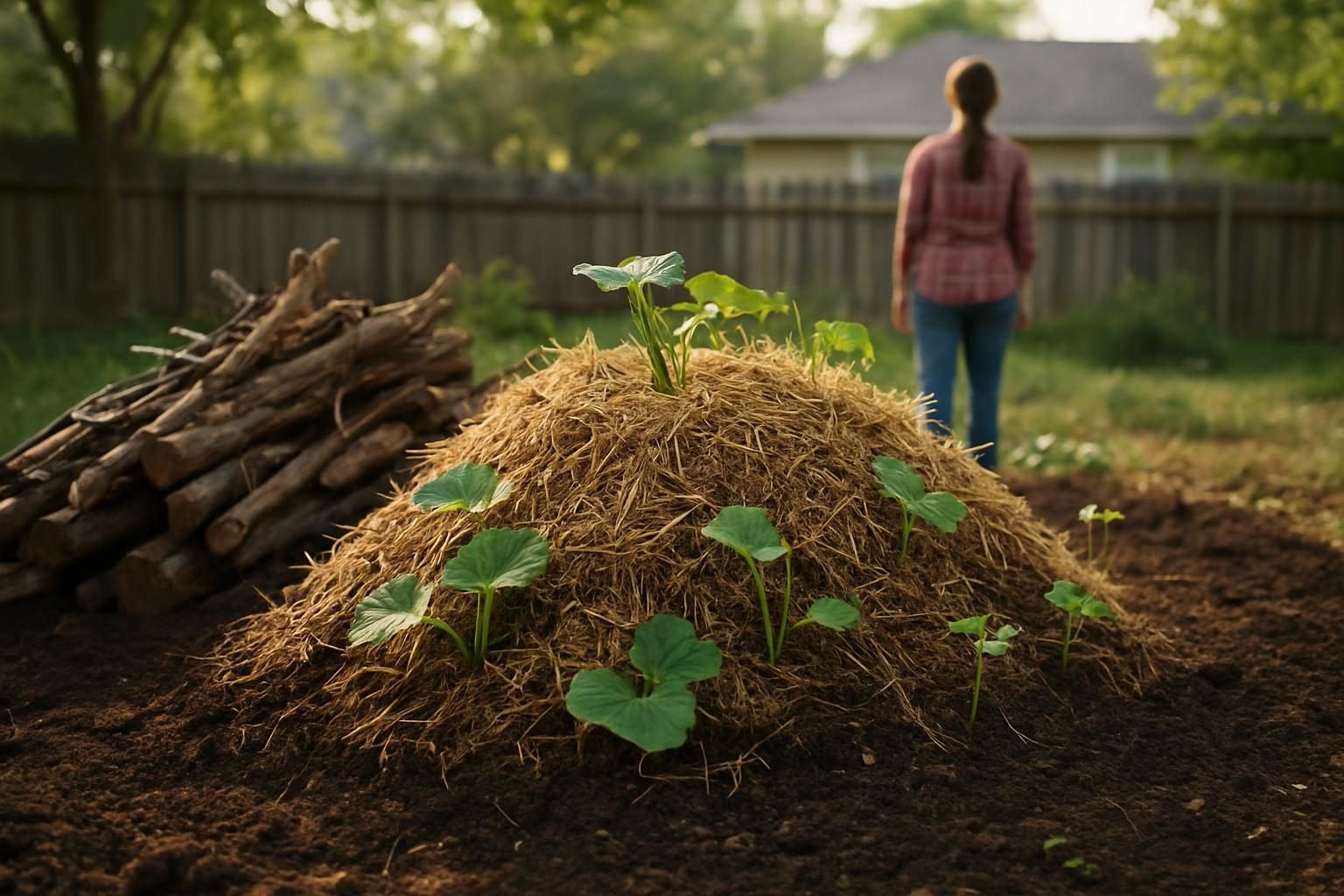
Hugelkultur (pronounced HOO-gul-kool-tur) is the practice of burying logs, branches and other woody material under a mound of soil and compost, then planting in the mound. Done well, it turns yard waste into a long-lived, water-holding bed. Done carelessly, it gives you a lumpy pile that starves your plants of nitrogen for two seasons.
This guide covers which wood to use and avoid, how big to build, how to manage nitrogen drawdown, what to plant in year one, and where hugelkultur genuinely pays off versus where a flat bed will serve you better.
Quick answer: A hugelkultur bed is a mound built over a core of rotting logs and branches, topped with sod, compost and soil. Use hardwood or softwood that is already partly decayed, avoid black walnut, black locust, cedar and treated lumber, and build mounds roughly 3-5 feet wide and 2-4 feet tall. Plan for nitrogen tie-up and settling in the first year, plant heavy feeders sparingly, and expect the best results in dry or low-rainfall climates and the poorest in cold, wet, poorly drained sites.
What hugelkultur is and why it can work
The idea comes from German and Eastern European traditions of mounded beds over woody debris, popularized in permaculture circles. The logic is simple. Wood buried in soil acts like a sponge as fungi break it down. Wood that is partly rotted can hold a lot of water, releasing it slowly to nearby roots. As the wood decomposes it also feeds soil life, and the mound’s height adds planting surface and varied microclimates (a warmer south face, a cooler north face).
It is worth being honest about the evidence. Hugelkultur has a lot of enthusiastic anecdote behind it and relatively little controlled research. Extension services have documented that buried wood can retain moisture and that fresh wood can tie up nitrogen, but the dramatic claims you may see online (watering once a season, decades of fertility with no inputs) are not well supported. Treat it as a useful tool with real trade-offs, not a miracle.
If you are new to the broader design thinking behind mounds, swales and bed placement, our permaculture garden layout guide shows where a hugelkultur mound fits in a whole-site plan.
Wood types to use and avoid
Wood choice is the single biggest decision you will make. The goal is material that is dense enough to hold water, decayed enough not to rob your soil, and free of compounds that harm plants.
| Category | Examples | Notes |
|---|---|---|
| Best | Alder, aspen, cottonwood, willow, birch, oak, maple, apple, cherry (partly rotted) | Softer and mid-density hardwoods break down within a few years and hold moisture well. Old, punky logs are ideal. |
| Acceptable | Pine, fir, spruce (well aged), fresh hardwood branches | Resinous softwoods decompose slowly and can acidify slightly; use aged material and in moderation. Fresh wood increases nitrogen tie-up. |
| Avoid | Black walnut, black locust, cedar, redwood, eucalyptus | Walnut contains juglone, which harms many crops. Locust and cedar are so rot-resistant they barely break down. Redwood and cedar resist decay by design. |
| Never | Pressure-treated lumber, painted or stained wood, plywood, pallets of unknown origin, glued or composite boards | Preservatives, adhesives and finishes can leach into soil where you grow food. |
Two practical rules help. First, if a log is rotten enough that you can crumble it by hand or push a screwdriver in easily, it is prime hugelkultur material. Second, if you are unsure of a tree species, leave it out. Local extension offices can help identify species and flag regional concerns, such as wood from areas under quarantine for pests like emerald ash borer (do not move firewood and logs long distances).
Sizing: how big and how tall
Typical beds run 3-5 feet wide, 2-4 feet tall once finished, and as long as your space allows, often 6-20 feet. Taller mounds mean more wood and more settling, so there is a trade-off between volume and usability.
- Height: Build to 3-4 feet if you can reach the top comfortably or want a raised bed effect. Expect settling of roughly a third or more in the first year or two as wood compacts and decays.
- Width: Keep it narrow enough to reach the center from both sides, usually under 5 feet, so you never need to step on the bed.
- Slope: Steep sides (steeper than about 45 degrees) erode and dry out at the crown. Aim for a gentler, 30-45 degree slope or terrace the sides.
- Orientation: East-west mounds give you a hot south face and a cooler, moister north face. North-south mounds even out sun exposure.
How to build a hugelkultur bed, step by step
- Choose and mark the site. Pick a spot with good sun (6-8 hours for most vegetables) that is not a natural low spot where water pools. Mark the footprint.
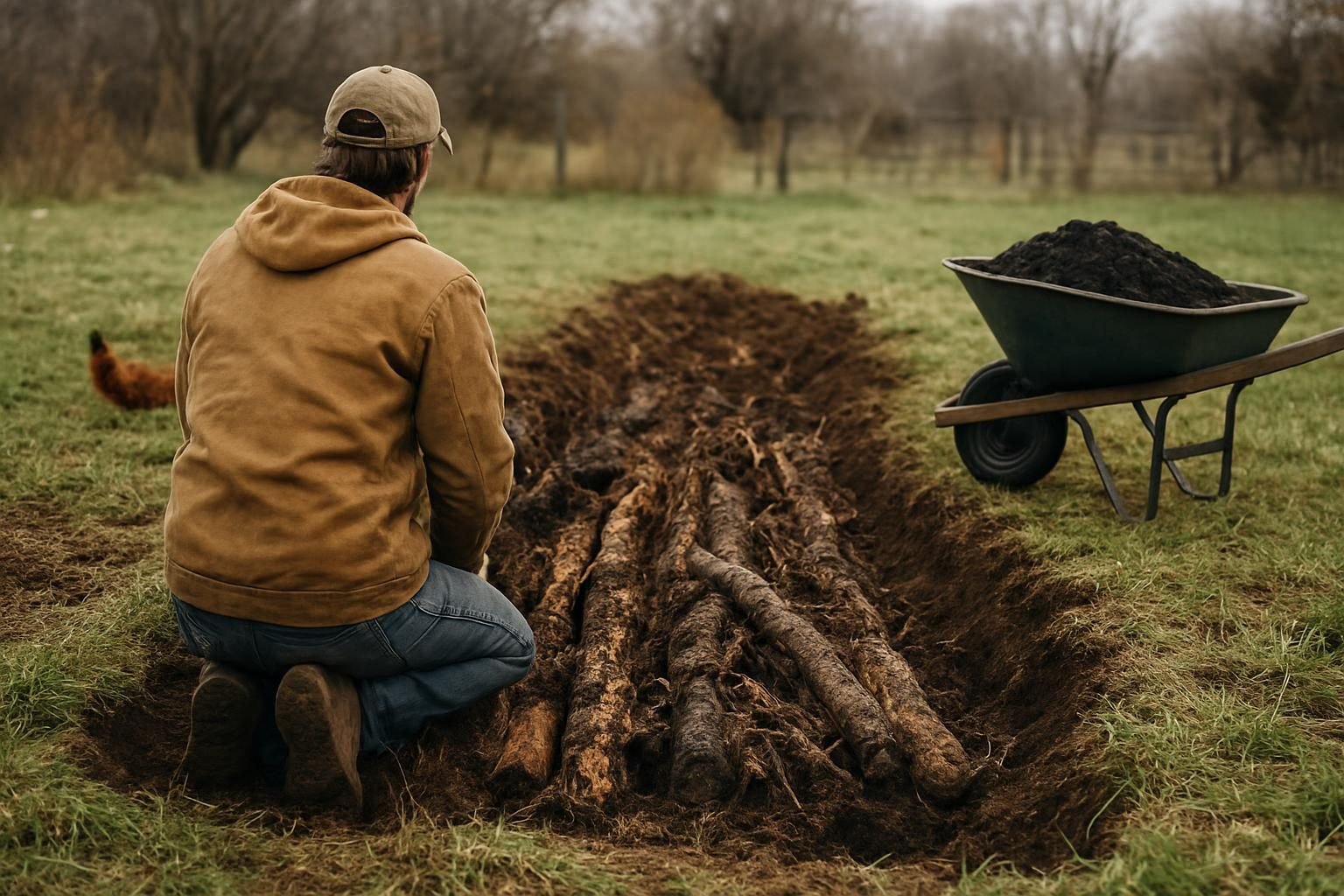
- Dig or strip. Many builders dig a shallow trench 6-12 inches deep and set the removed sod aside. In wet or heavy soils, skip the trench and build on grade so the base does not become a bathtub.
- Lay the largest logs first. Place big, rotted logs at the bottom and center, packed tightly. Fill gaps with smaller branches, twigs and wood chips. Gaps become air pockets that cause uneven settling.
- Add a nitrogen layer. Water everything thoroughly, then cover with grass clippings, manure, or other green material to help feed the microbes that will be eating the carbon.
- Flip the sod. Lay the stripped turf upside down over the wood, grass side in, to close gaps and add organic matter.
- Cap with compost and soil. Finish with 4-8 inches of a mix of topsoil and finished compost. See our guides to compost for raised beds and raised bed soil mix recipes for ratios.
- Mulch and water in. Cover with straw or leaves and soak the mound well before planting.
If you are building on a lawn and want to avoid digging at all, the layering logic overlaps with no-dig gardening, and the soil-biology reasoning is explained in our no-till garden guide.
Nitrogen drawdown: the catch nobody should skip
When microbes and fungi break down carbon-rich wood, they pull nitrogen from the surrounding soil to build their own bodies. This is called nitrogen immobilization, or tie-up. In a hugelkultur mound it is strongest in the first one to two years, especially with fresh wood and small chips, and it is the main reason new beds disappoint.
You can manage it rather than just hope:
- Use aged wood. Partly rotted logs tie up far less nitrogen than green or freshly cut wood.
- Keep wood deep. Roots sit mostly in the soil and compost cap, while the wood stays below. A thicker cap (6-8 inches) buffers the effect.
- Feed the top layer. Add finished compost, composted manure, or a nitrogen-rich amendment such as feather or alfalfa meal at planting, following label rates.
- Plant nitrogen fixers or light feeders first. Legumes and low-demand crops fit the first season better than heavy feeders. A cover crop or a green manure can also build fertility on top of the mound.
- Watch for yellowing. Pale lower leaves and stunted growth signal nitrogen shortage; side-dress with compost or a liquid feed.
Good compost is the cheapest insurance, and our guides to how to make compost and hot composting will help you produce enough to cap several mounds.
First-year planting
Expect settling, uneven moisture and low fertility in year one, so choose crops that tolerate imperfection.
- Good first-year choices: Bush and pole beans, peas, squash and pumpkins (which love a warm mound and rich, loose cap), potatoes, garlic in fall, lettuce and leafy greens on the cooler north side, and herbs such as oregano and thyme on the dry crown.
- Go lighter on: Corn, broccoli, cabbage and other heavy nitrogen feeders until the mound matures, unless you amend generously.
- Start from transplants where you can, since direct seed on a loose, drying slope can wash out or dry before germinating. If you save your own seed, our guides to saving pumpkin seeds and saving tomato seeds pair well with mound planting, and our upcoming seed saving primer for beginners covers where to start.
Water regularly the first season even if you plan to rely on stored moisture later. Wood needs to be wetted through before it can act like a sponge, and a dry core can actually wick moisture away from the soil above it.
Where hugelkultur shines and where it fails
Climate and site matter more than technique.
Where it works well
- Arid and semi-arid West: In dry climates, extra water-holding capacity is valuable, and mounds can reduce irrigation needs once established, though they will not eliminate them. Pair with rainwater harvesting where regulations allow (confirm local rules).
- Sandy or fast-draining soils: Buried wood and compost add organic matter and water retention to soils that otherwise leach quickly.
- Sites with plenty of woody waste: Storm cleanup, orchard prunings and cleared brush become a resource rather than a disposal problem. It fits naturally alongside agroforestry systems that generate steady prunings.
- Shallow or poor soil: Where digging down is impractical, building up solves the depth problem.
Where it struggles
- Cold, wet climates (Pacific Northwest lowlands, upper Midwest, Northeast): Extra moisture is the last thing most beds need. Mounds can stay cold and waterlogged in spring, and voles, slugs and rodents love the cover.
- Heavy clay with poor drainage: A mound built in a soggy spot can turn anaerobic at the base. Fix drainage first; see our guide to improving soil drainage without heavy equipment.
- Humid South: Wood decomposes quickly in heat and moisture, so mounds settle fast and may need rebuilding within a few years. Termites are also a concern near structures; keep mounds well away from buildings.
- Small urban yards: A 3-foot mound eats a lot of space and soil for the planting area it yields. A conventional raised bed is often more efficient in tight spaces.
Longevity, maintenance and honest trade-offs
Most mounds are productive for roughly 5-10 years as wood decomposes, with fertility peaking after the first couple of years and settling continuing the whole time. Plan to top up with compost and mulch annually, and rebuild or refill eventually.
Compared with a standard raised bed, hugelkultur costs more labor up front and gives less predictable early results, in exchange for better moisture holding in the right climate and a use for woody waste. For many growers a flat, no-dig bed filled with a good mix, covered in our small-scale regenerative farming guide and soil-building fundamentals in the soil health guide, will outperform a mound. If you buy fill, compare options in our review of bagged raised bed soils, and see our coming guide to potting mix versus garden soil in raised beds. For more projects at this scale, browse the Small & Urban Farms category.
Key takeaways
- Use partly rotted hardwood or aged softwood; avoid black walnut, black locust, cedar, redwood and any treated or glued wood.
- Build 3-5 feet wide and 2-4 feet tall, and expect a third or more of the height to settle in the first couple of years.
- Nitrogen tie-up is real. Add a nitrogen layer, cap with 4-8 inches of compost and soil, and feed the top.
- Start with beans, squash, potatoes and greens; hold off on heavy feeders until the mound matures.
- Hugelkultur shines in dry climates and sandy soils, and struggles in cold, wet or poorly drained sites.
- Evidence is mostly anecdotal, so start with one small mound and judge it against a conventional bed.
Frequently asked questions
Does hugelkultur really reduce watering?
It can in dry climates once the buried wood is thoroughly wetted and partly decayed, but you will still need to water, especially in year one. Results vary with wood type, mound size, soil and rainfall, and claims of watering rarely or never are not well supported.
Can I use fresh-cut wood?
You can, but it ties up more nitrogen and holds less water than aged wood. If fresh wood is all you have, bury it deep, add generous nitrogen sources, and plant light feeders for the first season or two.
How long does a hugelkultur bed last?
Typically about 5-10 years of useful life, depending on climate and wood. Hot, humid regions break wood down faster, and cool, dry ones slower. As the wood shrinks, top up the mound with compost or rebuild it.
Will hugelkultur attract pests?
It can. Voles, mice and slugs like the cover and the gaps in the wood, and termites can be an issue in warm regions. Keep mounds away from buildings, use tightly packed wood, and consider hardware cloth under the base where voles are a problem.
Is hugelkultur worth it for a small urban garden?
Often not. Mounds take a lot of space and material for a modest planting area. A conventional or no-dig raised bed usually gives better yield per square foot in tight spaces, while hugelkultur suits larger lots with abundant woody waste.