Running short of hay in February is one of the most expensive mistakes a cattle operation can make, and running long ties up money in bales you didn’t need. The good news is that how much hay a cow needs for winter comes down to arithmetic you can do at the kitchen table, once you know a few numbers.
This guide walks through the full calculation: daily intake from body weight, adjustments for hay quality, waste and cold, then the bale count for your whole winter. We’ll also look at how stockpiled forage and bale grazing can shrink the number considerably.
Quick answer: A dry mature cow typically eats about 2.0 to 2.5 percent of her body weight in dry matter per day, so a 1,200-pound cow needs roughly 24 to 30 pounds of dry matter, or about 26 to 33 pounds of hay as fed. Add 10 to 25 percent for waste, more in cold weather or with poor hay, and multiply by the number of feeding days. For a 120-day winter, that works out to roughly 1.5 to 2.5 tons of hay per cow.
Start with body weight and dry matter intake
Cattle eat according to body size, not a fixed number of bales. The standard planning shortcut is dry matter intake (DMI) as a percentage of body weight. Typical ranges, which vary with stage of production and feed quality, look like this:
- Dry, mid-gestation cow: about 2.0 to 2.5 percent of body weight
- Late-gestation cow (last trimester): about 2.2 to 2.7 percent
- Lactating cow: about 2.5 to 3.0 percent or more, depending on milk production
- Growing heifers and stockers: about 2.5 to 3.0 percent
Hay is not 100 percent dry matter. Most dry hay is around 85 to 90 percent dry matter, so divide the DMI by 0.85 to 0.90 to get pounds of hay as fed. Here is the formula:
- Body weight x DMI percentage = pounds of dry matter per day
- Dry matter / 0.88 (a typical hay dry matter fraction) = pounds of hay as fed
Example: A 1,200-pound mid-gestation cow at 2.3 percent DMI needs 27.6 pounds of dry matter. Divided by 0.88, that is about 31 pounds of hay as fed per day, before waste.
Adjust for hay quality
The percentage rule assumes the cow can actually eat that much, and that the hay meets her energy and protein needs. Poor hay breaks both assumptions. Mature, stemmy, low-protein hay moves slowly through the rumen, so cows eat less of it and still fall short on nutrition. Good leafy hay is eaten more readily and covers more of her requirements.
The only way to know what you have is a forage test through your state extension service or a commercial lab. It costs little compared with the feed it protects. Look at crude protein and total digestible nutrients (TDN) or energy values, then compare against the requirements for your cows at their stage of production. A few rules of thumb:
- Late-gestation and lactating cows need higher quality hay than dry cows.
- If hay tests low in protein or energy, you may need to supplement or feed more of it, and cows may still lose condition.
- Very high quality hay can be limit-fed or paired with lower quality hay to stretch supply, since a mid-gestation cow does not need the richest feed on the place.
Quality also changes the bale count indirectly: cows that are underfed on poor hay lose body condition, which costs you in breeding performance come spring.
Account for waste
What the cow needs and what you must buy are different numbers. Waste from trampling, spoilage, bedding and refusal can quietly eat a quarter of your hay. Typical ranges, which depend heavily on feeder type and weather:
| Feeding method | Typical hay waste (estimate) |
|---|---|
| Unrolled on the ground, limited access | 5 to 15 percent |
| Ring feeder with cone or hay saver | 5 to 15 percent |
| Open round bale, no feeder | 20 to 45 percent |
| Hay stored outside uncovered (storage loss only) | 10 to 30 percent or more, climate dependent |
Storage losses are a separate hit on top of feeding waste, and they vary hugely by region. A bale sitting on wet ground in the humid East will lose more than one stored on gravel or under a roof in a dry climate. Plan on 10 to 25 percent combined waste for a reasonably managed operation, and higher if hay sits outside and is fed free-choice without a feeder.
Adjust for cold weather
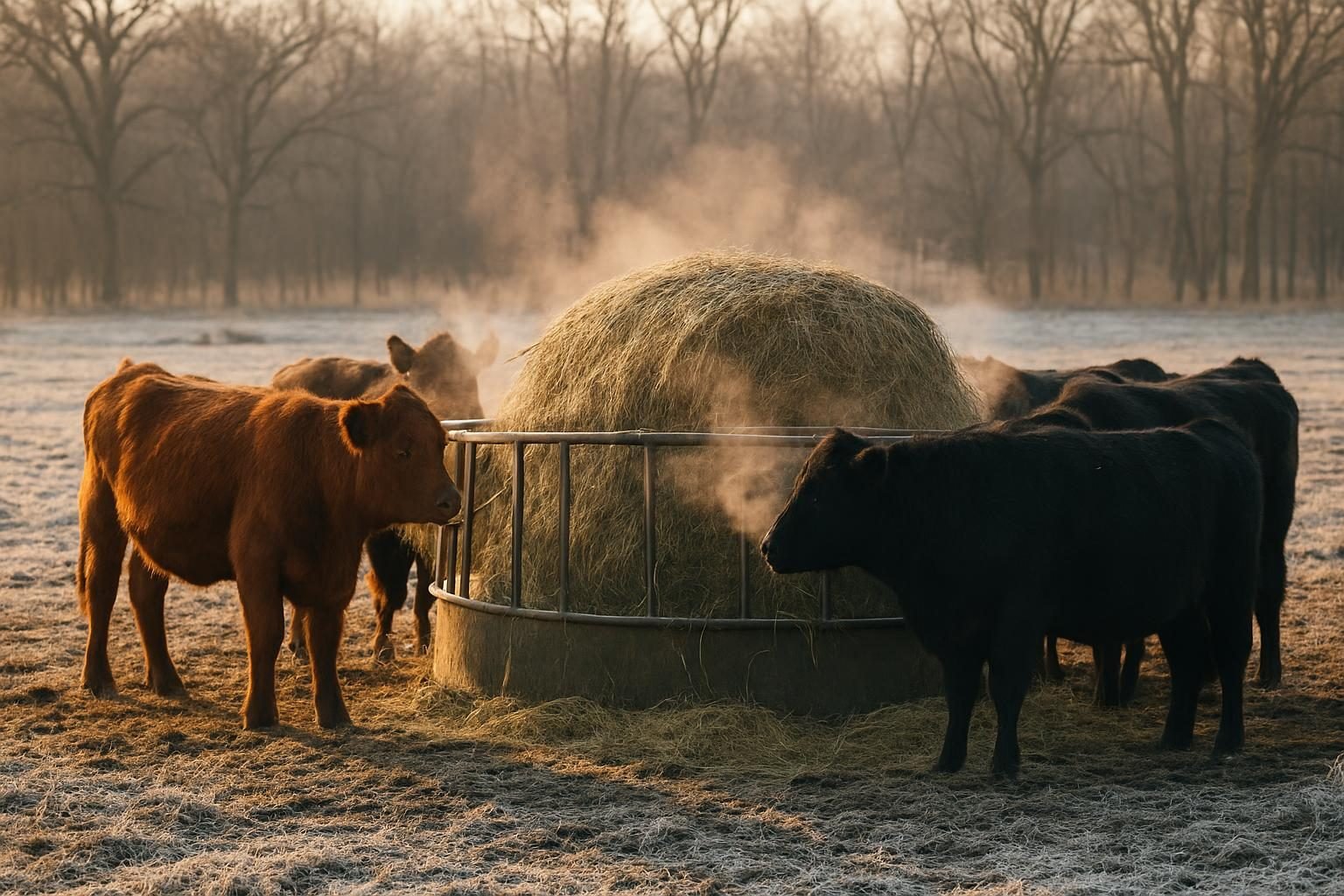
Cattle have a lower critical temperature, below which they burn extra energy to stay warm. For a cow with a dry, full winter coat, that threshold is often cited around 18 degrees Fahrenheit, though it climbs sharply when the coat is wet, muddy or windblown. A common rule of thumb is that energy needs rise by roughly 1 percent for each degree below the critical temperature, though extension recommendations vary, so check your own state’s guidance.
In practice that means:
- In a mild southern winter, you may need little or no cold adjustment.
- In the northern Plains, Upper Midwest and mountain West, plan on 10 to 20 percent more feed for stretches of hard cold, and more for cold rain or wind with no shelter.
- Windbreaks, dry bedding and well-drained lots reduce the penalty. A wet cow in a muddy lot can need far more energy than a dry cow in the same air temperature.
Silvopasture and shelterbelts are one longer-term way to soften the cold load. See our guide to agroforestry and silvopasture for how trees can work into a grazing plan.
Calculate bales for the whole winter
Now put it together. Work through these steps for each group of animals:
- Count feeding days. This is the stretch when pasture cannot supply the herd. In the Deep South it may be 60 days; in the northern states it can run 150 or more. Be honest about it, and consider pulling your own records from past years.
- Find daily hay as fed. Use the body weight method above.
- Add a waste and cold factor. A common combined factor is 1.15 to 1.35.
- Multiply: daily hay x feeding days x waste factor x number of cows.
- Convert to bales using the actual weight of your bales (see below).
Worked example: 20 cows averaging 1,200 pounds, 120 feeding days, 31 pounds of hay per cow per day, with a waste and cold factor of 1.25.
31 lb x 120 days = 3,720 lb per cow. Times 1.25 = 4,650 lb per cow, about 2.3 tons. Times 20 cows = 93,000 lb, about 46.5 tons.
Bale weights vary enormously, so weigh a sample if you can. Typical ranges are roughly 40 to 60 pounds for a small square, 700 to 1,000 pounds for a 4×5 round bale, and 1,000 to 1,500 pounds for a 5×5 or 5×6 round bale, depending on hay type and density. At an average of 1,000 pounds per round bale, the example herd needs about 93 bales. Add a buffer of 10 percent for a late spring or a short hay crop, since a cold, slow April is when most operations get into trouble.
Cut the hay bill with stockpiled forage
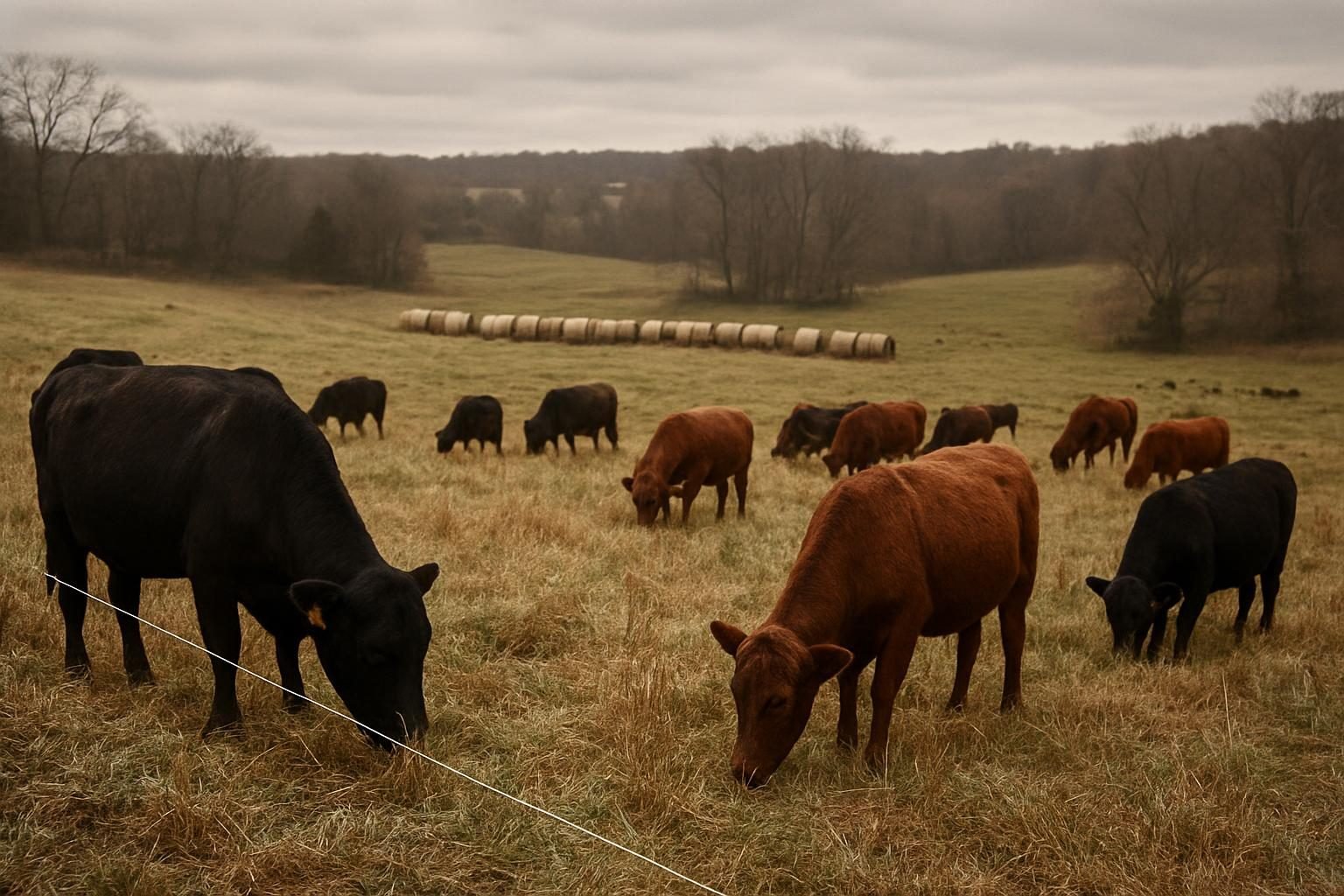
Every day a cow grazes standing forage is a day you don’t haul, grind or feed hay. Stockpiling means letting pasture grow during late summer and early fall, then grazing it in the dormant season. Tall fescue is the classic stockpiling species in much of the East and South, but many cool-season grass mixes and even some warm-season stands can work, depending on region.
Quality and quantity both depend on when you stop grazing, fertility, rainfall and species, so results vary widely. Using strip grazing with temporary fence helps cows clean up what they trample otherwise. Our guide to stockpiling forage for winter grazing covers timing and species in detail, and rotational grazing for beginners shows how to build the paddock system that makes stockpile use efficient. You will need to move fence regularly, so a solid electric fence setup for cattle pays for itself here, and reliable water systems for rotational grazing keep cows drinking when the weather turns.
Reduce waste and build soil with bale grazing
Bale grazing means setting out a winter’s worth of bales in the field in advance and giving cows access to a few at a time with temporary fence. Hay that would otherwise be hauled, stored and fed becomes a one-time placement, and manure and uneaten hay stay where you want fertility. Done well, it can cut feeding labor and move nutrients onto thin pasture.
The trade-offs are real: poorly drained sites turn into mud, bales left out lose some quality, and the first year needs careful placement and site selection to avoid concentrating nutrients near water. Read bale grazing as winter feeding that builds soil before you try it. If you are also thinking about how many animals your land can carry through winter, see how many acres per cow, and for grass-only systems, grass finished beef covers the forage quality side.
The long game ties back to the ground itself. Fewer purchased and hauled bales means more of your feed is grown on-farm, and healthier pasture grows more feed. The soil health guide explains why. For more on the broader topic, browse our grazing and livestock articles.
Key takeaways
- Plan on roughly 2.0 to 3.0 percent of body weight in dry matter per day, depending on the cow’s stage of production.
- Convert dry matter to hay as fed by dividing by about 0.85 to 0.90.
- Add 10 to 25 percent or more for waste, and extra in sustained cold, wet or wind.
- Test your hay. Quality determines both intake and whether cows hold condition.
- Weigh your bales; a bale count is meaningless without a real weight.
- Stockpiled forage and bale grazing can substantially cut the hay you need to buy, store and feed.
Frequently asked questions
How many round bales does one cow need for winter?
For a 1,200-pound cow over 120 days with typical waste, plan on about 4 to 5 round bales of 1,000 pounds each, or roughly 2 to 2.5 tons. Longer winters, colder weather, poor hay or lactating cows push the number up; milder climates, good hay and stockpiled forage bring it down.
How much hay does a cow eat per day?
A mature 1,200-pound cow typically eats about 26 to 33 pounds of hay as fed per day, equal to 2.0 to 2.5 percent of body weight in dry matter. Lactating cows eat more. Add waste on top of that when you plan how much to buy or put up.
Does cold weather really change how much hay a cow eats?
Yes. Below a cow’s lower critical temperature, which is higher when she is wet or windblown, she burns more energy to stay warm and needs more feed. Windbreaks, dry ground and good-quality hay reduce the penalty, so the real increase depends on your shelter and weather.
How can I tell if my hay is good enough?
Send a representative sample to a lab, or ask your county extension office how to submit one. The report shows protein and energy values you can compare against your cows’ needs. Visual cues such as leafiness, color and smell help, but they cannot replace a test.
Does bale grazing reduce how much hay I need?
It mainly reduces waste, labor and fuel, and it moves fertility onto the pasture. It does not change the amount of feed cows need, but you may feed less hay overall if waste drops. Stockpiled forage is the bigger lever for cutting total hay tonnage.