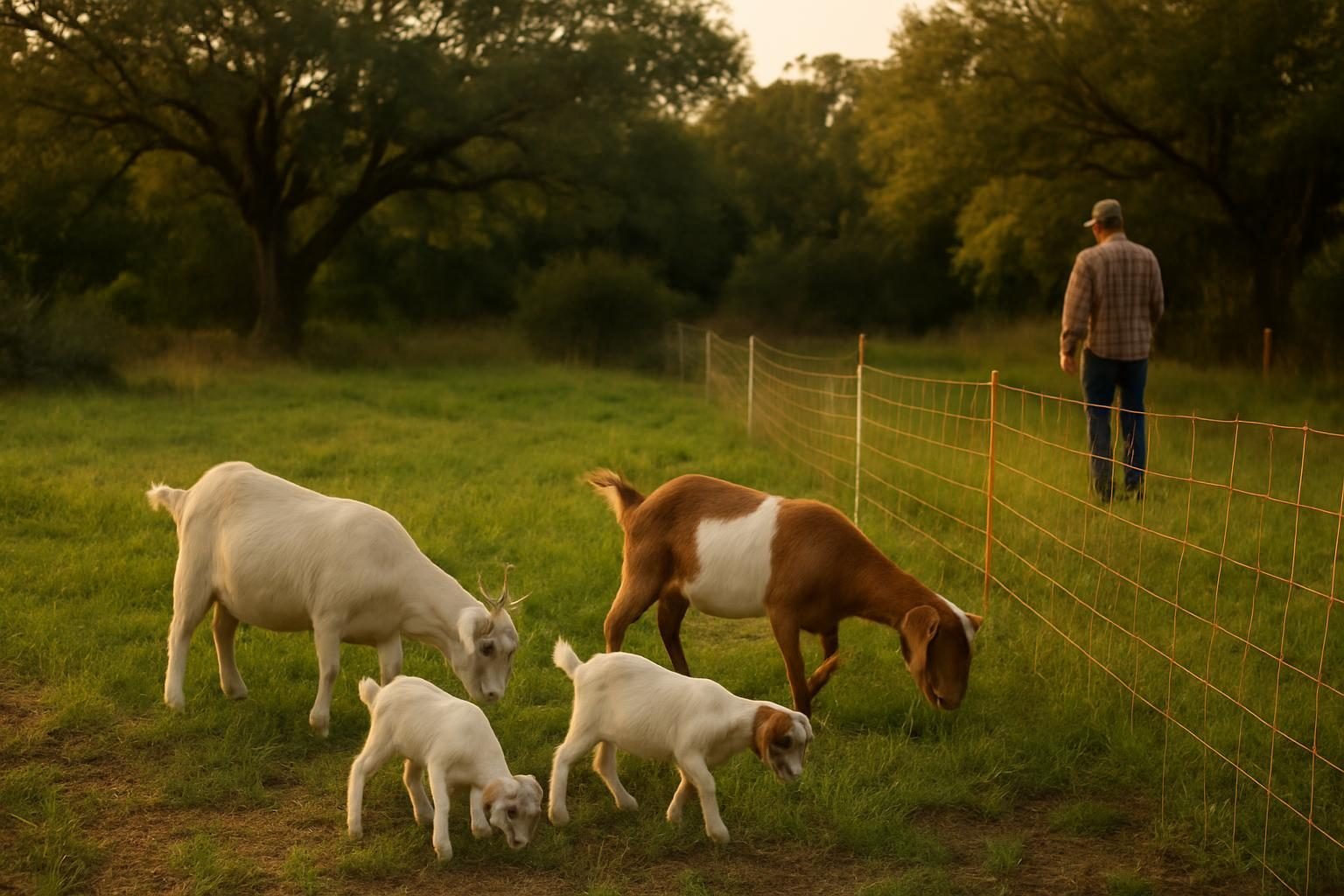
Breeding meat goats well is mostly a planning job, not a luck job. The decisions you make about breed, buck, breeding date and pasture rotation set your kid crop, your parasite load and your margins months before a single kid hits the ground. This guide walks through each step in the order you will actually face them.
Quick answer: For meat production, start with healthy, parasite-resilient does of a proven meat type (Kiko, Spanish, Boer or a Boer cross), pair them with a structurally sound, fertile buck from a low-worm-burden herd, and breed does once they reach roughly 65-70% of adult weight, usually at 8-12 months. Time kidding for when pasture quality peaks and worm pressure is manageable, flush does before breeding, and keep records on every kid so you can cull on performance, not looks.
Why breeding decisions matter more on pasture
On a regenerative farm, goats are doing two jobs: producing meat and managing vegetation. If you are new to the species, our guide to raising goats for brush control and profit covers the land-management side. Breeding is where those two goals meet. A doe that needs constant deworming, hoof trimming and grain to raise twins is a poor fit for a low-input system, no matter how pretty she is.
The goal is a herd that kids easily, raises its young on forage, and stays productive without heavy inputs. That means selecting for function first and appearance second.
Meat goat breed choices
No single breed is right everywhere. Climate, parasite pressure and your market all matter. Here is how the common options compare in general terms.
| Breed | Strengths | Trade-offs | Best fit |
|---|---|---|---|
| Boer | Fast growth, heavy muscling, strong market recognition | Often needs closer parasite and hoof management; can struggle in hot, humid regions without selection | Show and premium live-weight markets, moderate climates |
| Kiko | Hardy, good mothering, generally strong parasite resilience, low-maintenance | Slightly less muscling than Boer; slower finishing | Pasture-based, low-input herds, humid South and East |
| Spanish (brush goat) | Very hardy, thrives on rough browse, good foragers | Smaller frame, lighter carcass | Rough or brushy ground, arid and rangeland settings |
| Savanna | Hardy, good heat tolerance, solid growth | Fewer breeders in some regions | Hot climates, crossbreeding programs |
| Boer x Kiko or Spanish cross | Hybrid vigor, balance of growth and hardiness | Variable kid uniformity if not managed | Commercial producers wanting growth plus resilience |
Many commercial producers end up with a Kiko or Spanish base herd and a Boer or Kiko buck, depending on whether they want more growth or more hardiness. Ask local extension or experienced breeders what thrives in your county, because regional performance varies a lot.
Choosing does
Your does are your herd. Buy fewer, better animals rather than a big group of cheap ones.
- Body condition: Aim for a body condition score of about 2.5-3.5 on a 5-point scale at breeding.
- Udder and teats: Look for a well-attached udder with two functional, reasonably sized teats. Avoid large, pendulous or very small teats that kids struggle to nurse.
- Structure: Strong feet, straight legs, a sound back and room through the pelvis.
- Parasite resilience: Check eyelid color (FAMACHA scoring is a widely used tool) and ask the seller how often the herd is dewormed. Resilient does keep condition under pressure.
- Production history: Prefer does with a record of kidding unassisted, raising twins and returning to breeding on schedule.
Choosing bucks
The buck contributes half the genetics to every kid, so he is your biggest leverage point. Spend accordingly.
- Fertility: Have a veterinarian perform a breeding soundness exam, including testicular size and semen quality, before the season.
- Conformation: Strong legs, a deep body, good muscling and correct jaw alignment.
- Maternal traits: Look at his dam and sisters. A buck from a line of easy-kidding, milky, twin-raising does passes that on.
- Health: Buy from a herd with a known disease status. Ask about caprine arthritis encephalitis (CAE), caseous lymphadenitis (CL) and Johne’s testing, and consider quarantine and testing for new arrivals.
- Ratio: A mature buck can typically cover about 25-40 does; young bucks fewer, often 10-20.
Breeding age, timing and the flushing step
Does generally reach puberty at 5-8 months, but breeding that early stunts growth. A common target is breeding does at about 65-70% of mature body weight, often around 8-12 months, depending on breed and nutrition. Bucklings can be fertile as young as 3-4 months, so separate males from females early to avoid accidental pregnancies.
Goats are seasonal breeders, with cycles triggered by shorter days in late summer and fall. Cycles run about 18-22 days, with heat lasting 12-36 hours. Pregnancy lasts around 145-155 days, roughly five months.
To pick your kidding window, count back from the date you want kids on the ground:
- Decide your target kidding window based on forage growth, weather and market timing.
- Subtract about 150 days to find your breeding start date.
- Begin flushing does 2-3 weeks before breeding, using improved pasture or a modest energy boost to raise ovulation rates.
- Introduce the buck for 35-45 days (about two heat cycles) to keep kidding tight.
- Remove the buck and note the dates.
Spring kidding (March-May in much of the country) lines up with flushes of pasture growth but can coincide with peak worm larvae in warm, wet regions. Fall kidding avoids some of that pressure and suits the South, though winter weather and feed costs are different. Pick the window that fits your climate and your ability to protect kids from cold or heat.
How breeding fits rotational grazing and parasite management
Internal parasites, especially the barber pole worm (Haemonchus contortus), are the biggest health challenge for goats in many regions. Breeding and grazing plans can either amplify or reduce that problem.
Use rest periods to break worm cycles
Worm larvae climb forage and are ingested as goats graze close to the ground. Moving animals on a planned schedule and leaving enough rest lets larvae die off before the herd returns. Our guides to rotational grazing for beginners and adaptive multi-paddock grazing explain how to set paddock size and rest length. In warm, humid regions, rest periods may need to be long, often 60+ days, to be effective, while cooler or drier climates can run shorter.
Protect the most vulnerable animals
Late-pregnant and lactating does and weaned kids are most susceptible to worms. Give them the cleanest, highest-quality paddocks. Many producers graze kids on the first pass through a fresh paddock, then follow with adult animals. Browse and tall forage, which keep goats’ heads up and off the ground, reduce larval intake. Silvopasture can help here, and our agroforestry guide covers how trees and browse fit into a grazing system.
Cull for resilience
Parasite resilience is heritable. If you consistently treat the same does, that tells you something. Cull animals that need repeated deworming, and keep replacement doelings from does that stay in good condition. Use targeted treatment based on FAMACHA scores or fecal egg counts rather than blanket deworming, which speeds up drug resistance. Work with a veterinarian or extension service to build a protocol that fits your region.
Balance the whole farm
Goats work well alongside other species because many parasites are species-specific. Our multi-species grazing guide shows how cattle or sheep can help clean up pasture, and raising sheep for beginners covers a close partner species. Goats are also escape artists, so good fencing matters; see electric fence for cattle for setup principles, adapted with extra wires and tighter spacing for goats.
Pregnancy care
The last six weeks of pregnancy are when about 70% of fetal growth happens, so nutrition matters most then.
- Feed quality: Increase energy and protein in late gestation with good pasture, quality hay, or a modest supplement if forage is poor. Do not overfeed; fat does have kidding trouble.
- Minerals: Provide a loose goat-specific mineral with adequate copper (not sheep mineral, which can be too low in copper for goats). Ask your vet about regional deficiencies like selenium.
- Vaccination: Many producers give CD&T vaccine about 4 weeks before kidding to boost colostrum antibodies. Confirm the protocol with your veterinarian.
- Water and shelter: Reliable water is critical. See water systems for rotational grazing for practical setups.
- Pregnancy check: Ultrasound by a vet or a blood test can confirm pregnancy and sometimes kid counts, helping you group does by feed needs.
Kidding basics
Most does kid without help. Your job is to be prepared and to watch, not to interfere.
Signs of labor
Look for restlessness, pawing, a tight or filling udder, soft ligaments near the tail head, discharge and isolation from the herd. Active labor typically leads to kids within an hour or two of hard pushing.
Kidding checklist
- Prepare a clean, dry, draft-free area, or a clean paddock with shelter if kidding on pasture.
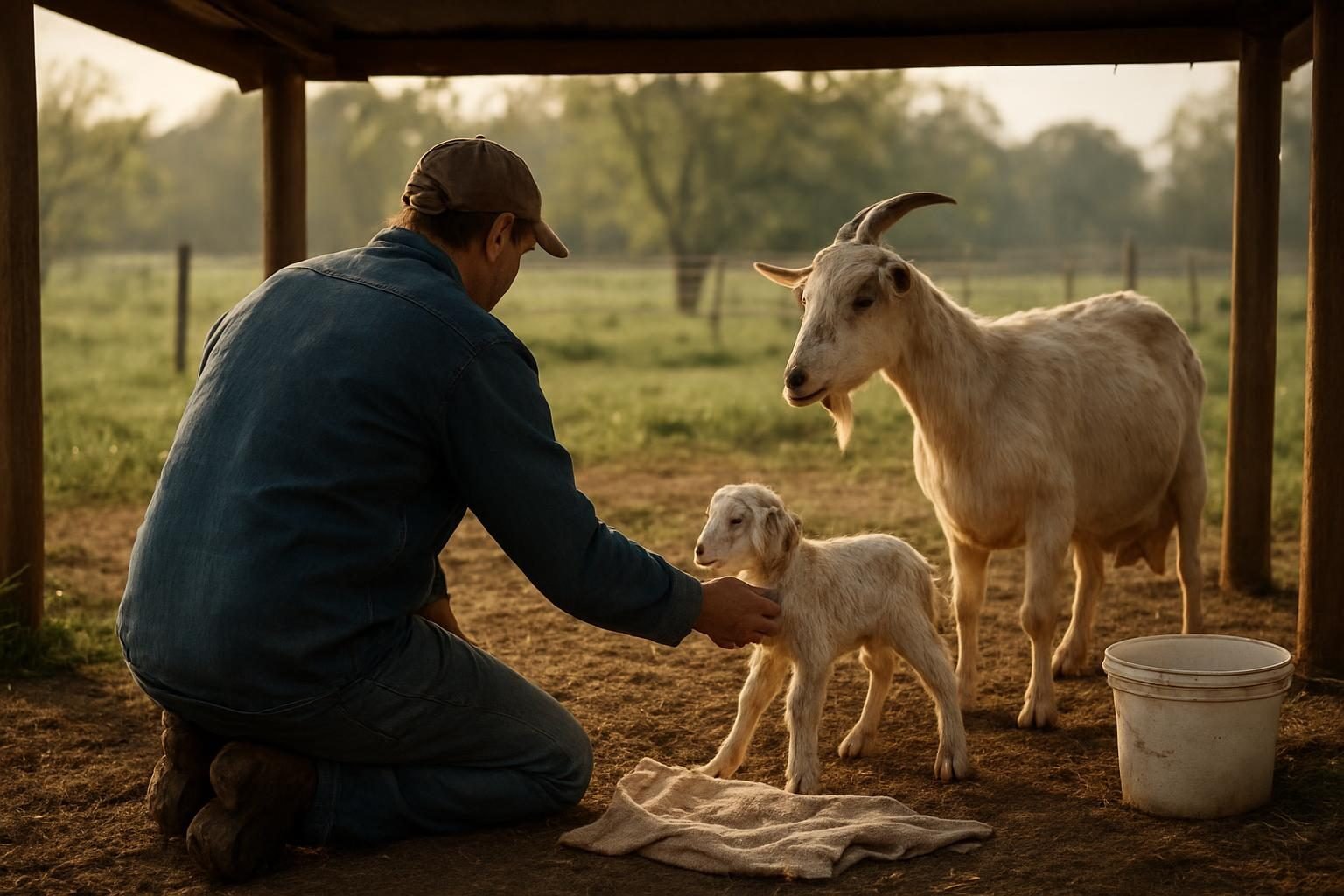
- Have supplies ready: clean towels, iodine for navels, a kit with gloves and lubricant, colostrum or colostrum replacer, and your vet’s number.
- Let the doe work. Normal presentation is two front feet and a nose, or two back feet.
- Dry kids, dip navels in iodine, and make sure each nurses within the first hour or two.
- Confirm the placenta passes, typically within a few hours.
- Watch for weak kids, which need warmth and colostrum fast.
Call your vet if a doe pushes hard for 30-60 minutes without progress, if kids are mispositioned and you are not trained to correct them, or if the doe seems exhausted. Kidding on pasture works well for hardy does and cuts disease buildup in barns, but it requires good weather and watchful eyes.
Record keeping that pays off
Records turn guesses into decisions. Even a simple notebook or spreadsheet works. Track, at minimum:
- Doe and buck ID, breeding dates and expected kidding dates
- Kidding date, litter size, kid sex, birth weights and any assistance needed
- Kid survival, weaning weights (often around 90-120 days) and growth rates
- Doe condition scores, FAMACHA scores and deworming treatments
- Health events, vaccinations and cull reasons
Over a few seasons, you will see which does earn their keep. Combine that with your costs and sales to understand your margins; the regenerative farming business guide is a good place to start, and our stocking rates guide helps you reason about how many animals your land can carry, with adjustments for goats. For the bigger picture, see our complete guide to rotational grazing and the wider grazing and livestock section.
Planning herd size and next steps
Start small. A herd of 10-20 does and one good buck is enough to learn the cycle without being overwhelmed. Plan replacement doelings from your best mothers, keep a buck rotation system to avoid inbreeding, and grow only as fast as your fencing, water and pasture can handle. If your space is tight, pygmy goat care is a different path suited to pets and small homesteads rather than meat production, so match breed to purpose.
Key takeaways
- Choose a breed or cross that suits your climate and parasite pressure; Kiko, Spanish and Boer crosses are common pasture choices.
- Spend the most on the buck, and verify fertility and health before every season.
- Breed does at roughly 65-70% of mature weight, count back about 150 days from your target kidding date, and flush beforehand.
- Use rotation, rest and clean paddocks for vulnerable animals, and cull does that need constant deworming.
- Feed well in the last six weeks of pregnancy, prepare a kidding kit, and call the vet early when labor stalls.
- Keep simple records on every kid and doe, then cull on performance.
Frequently asked questions
What is the best breed for breeding meat goats on pasture?
There is no single best breed. Kiko and Spanish goats tend to be hardy and parasite-resilient, which suits low-input pasture systems, while Boer goats grow faster and have heavier muscling but may need more management in hot, humid areas. Many producers use a Kiko or Spanish doe base with a Boer or Kiko buck. Ask local producers and your extension office what performs in your region.
How old should a doe be before breeding?
Aim for about 65-70% of mature body weight, which is typically 8-12 months of age depending on breed and nutrition. Breeding too young can stunt growth and lead to kidding problems. Weight and condition matter more than age alone.
How long is a goat pregnant?
Goat gestation averages around 145-155 days, or about five months. To pick a breeding date, count back roughly 150 days from when you want kids on the ground, then leave the buck in for about 35-45 days to keep kidding tight.
How many does can one buck breed?
A mature, healthy buck can typically cover about 25-40 does during a defined breeding season, while a young buck should be limited to roughly 10-20. Check his body condition regularly, since bucks can lose a lot of weight during the rut.
How do I reduce worm problems when breeding goats?
Combine breeding for resilience with grazing management. Cull does that need repeated treatment, use FAMACHA scoring or fecal egg counts to deworm only when needed, and move animals through paddocks with enough rest for larvae to die off. Put late-pregnant does and young kids on the cleanest ground, and work with a veterinarian on a protocol for your region.