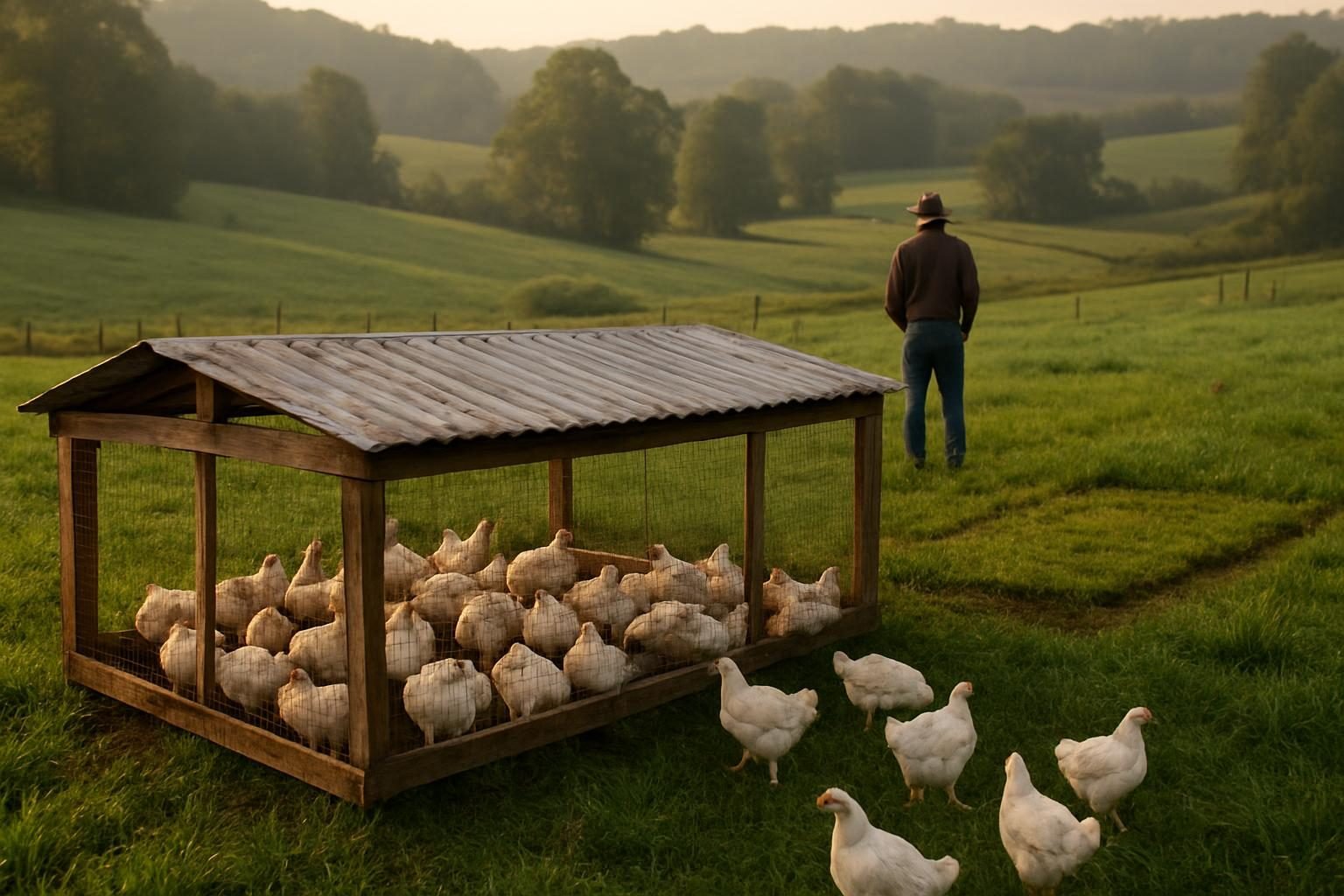
A chicken tractor is a bottomless, movable pen that lets birds scratch, graze and fertilize fresh ground every day or two. Done well, it turns a flock into a mobile soil-building crew; done badly, it leaves a dead rectangle of mud and manure. This guide covers the main designs, how often to move, how many birds fit, how to keep predators out and what the pasture actually gets out of it.
Quick answer: A chicken tractor is a floorless, portable coop-and-run that moves birds onto fresh pasture daily (broilers) or every one to three days (layers). Typical space is about 2 to 4 square feet per broiler and 4 to 10 square feet per laying hen in a small tractor, with a predator-proof frame, shade, shelter and wheels or skids. Moving often is what turns manure into fertility instead of a burn spot.
What a chicken tractor does (and doesn’t do)
The idea is simple: instead of birds living permanently on one patch of dirt, you bring them to the ground that needs them. They eat grass, clover, seeds and insects, scratch at residue and drop nitrogen-rich manure in a thin, even layer. Then you move them before they wreck anything.
It’s worth being honest about limits. A chicken tractor is not a free lunch. Birds still need a balanced ration; forage typically supplements feed rather than replacing it, and the share varies with season, forage quality and bird type. Tractors also won’t fix compacted or depleted ground on their own, but they are a low-cost way to add fertility and break pest cycles as part of a larger system. For the bigger picture, see our guide to pastured poultry, and for how this fits into living ground, the complete guide to soil health.
Salatin-style pens vs small backyard tractors
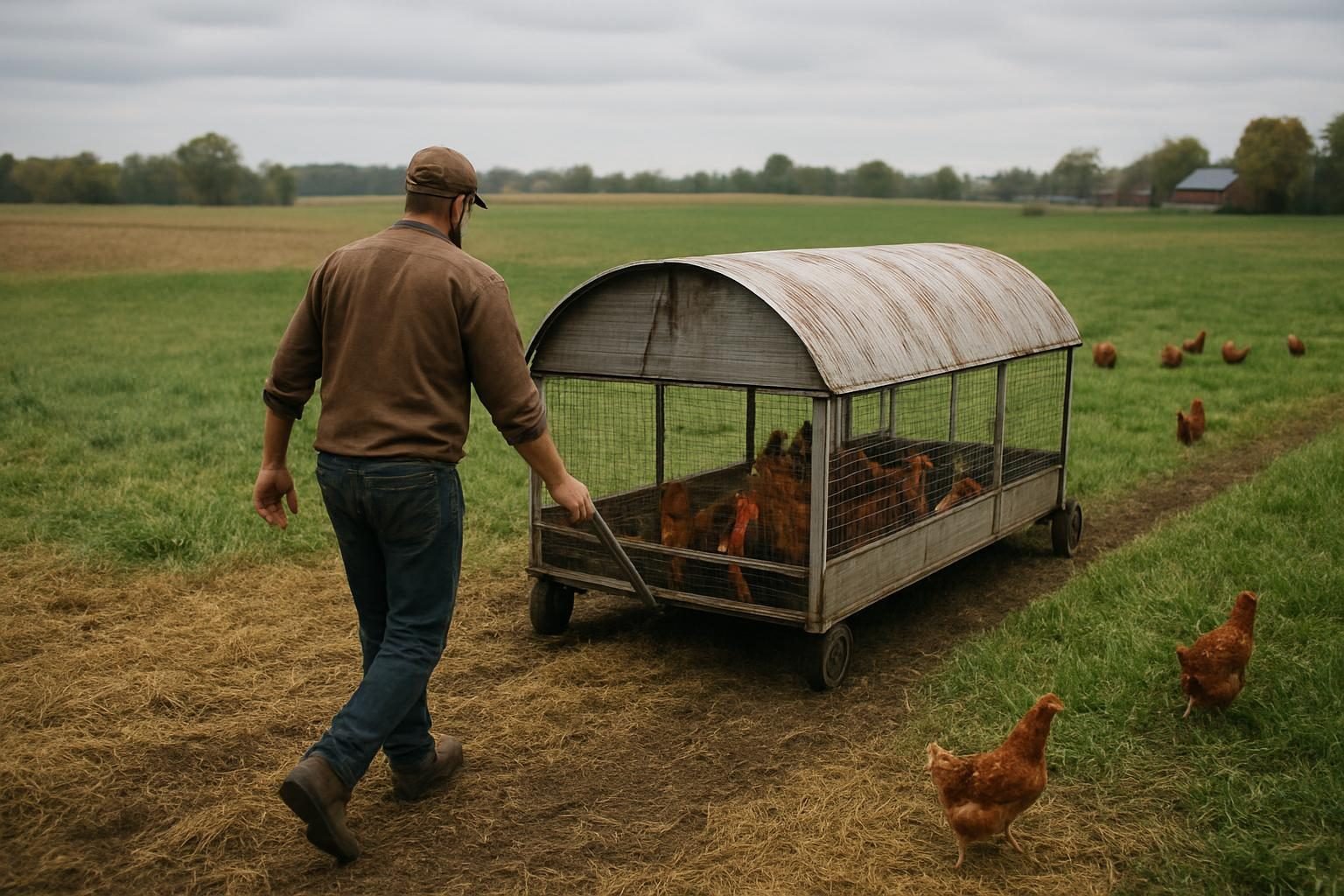
Two broad families dominate. The first is the large, low, shallow pen popularized by Joel Salatin for broilers: roughly 10 by 12 feet, only about 2 feet tall, floorless, with a covered portion for shade and rain and wire or slats elsewhere. Because it’s low, one person can slide it forward by its edge without lifting. The second is the small backyard tractor: an A-frame or arched hoop with a nesting box, usually sized for 3 to 8 hens and moved by handles or a pair of wheels.
| Feature | Salatin-style broiler pen | Small backyard tractor |
|---|---|---|
| Typical size | About 10 x 12 ft, 2 ft tall | About 4 x 6 to 4 x 8 ft, up to 3 ft tall |
| Best for | Meat birds, 6-10 weeks | Laying hens, small flocks |
| Typical stocking | Roughly 2-4 sq ft per broiler | Roughly 4-10 sq ft per hen |
| Move frequency | Daily | Every 1-3 days |
| Moving method | Dragged or slid by hand, or wheeled with a dolly | Handles, wheels or small garden-cart tires |
| Weakness | Low height, hard on your back, little protection in storms unless well roofed | Limited scale, nest and roost space needed |
The low broiler pen shines because broilers don’t need roosts or nests, and they grow fast. Layers are different: they need nest boxes, a roost and enough height to move around, so a hybrid design with a small attached house works better than a squat pen.
How many birds per square foot?
Overcrowding is the most common mistake. A crowded tractor produces dirty birds, disease pressure and mud. The numbers below are typical ranges, not rules, so adjust for your breed, weather and how often you move.
- Broilers: about 2 to 4 square feet each, moved daily. Heavier, faster-growing birds need the upper end near finishing weight.
- Laying hens: about 4 to 10 square feet each in the run, plus roost and nest space in the covered area. More if you move less often.
- Heat or slow moves: in hot weather or when you can only move every few days, give birds more room, not less.
If you’re choosing a breed for the system, our upcoming guide to the best chicken breeds for pasture will compare foragers, layers and dual-purpose birds.
How often to move a chicken tractor
Move often enough that the grass is grazed and scratched, not stripped to soil. For most setups:
- Broilers: once a day, ideally in the morning after feed, so birds start on fresh ground.
- Layers: every one to three days, depending on flock size, rain and the vegetation.
- Watch the ground, not the calendar: if you see bare patches or a sour smell, move sooner. If growth is strong in spring, you can stretch the interval a little.
- Wet weather: move more often or onto firmer ground to prevent mud and foot problems.
- Plan the path: lay out a loop so you don’t return to the same strip before it has recovered, typically several weeks in growing season and longer in slow growth.
This is the same logic as rotational grazing for beginners: short, intense visits followed by long rest.
Keeping predators out
A floorless pen is only as safe as its edges. Raccoons, dogs, foxes, coyotes, weasels and hawks all test tractors, and the threat varies by region. Build for the worst animal in your area.
- Use hardware cloth, not chicken wire, on any area a raccoon or weasel can reach. Chicken wire keeps chickens in; it doesn’t keep determined predators out.
- Skirt or seal the bottom edge. Keep the frame tight to the ground, or add a hardware cloth skirt that lies flat outward so diggers can’t tunnel under easily.
- Latch securely. Raccoons open simple hooks. Use two-step latches or carabiners.
- Cover the top. Solid roofing or netting stops hawks and owls.
- Close birds in at night where the design allows, and move them to a secure spot if you expect heavy pressure.
- Consider electric netting or a hot wire around the area; our guide to electric fence setup covers the basics, and an upcoming piece on cattle fencers will help you choose a charger.
Materials list for a basic tractor
Prices vary widely by region and year, so check local suppliers. A typical build for a small tractor uses:
- Frame: untreated or rot-resistant lumber (2×2 or 2×4), or EMT conduit for a lighter hoop. Avoid pressure-treated lumber where birds will peck or contact it heavily, and check current guidance if you are unsure.
- Wire: 1/2-inch hardware cloth for lower walls and vulnerable spots; welded wire or poultry netting for upper sections if predator pressure is low.
- Roofing: corrugated metal or heavy-duty tarp, covering about half to two-thirds of the pen for shade and rain shelter.
- Hardware: exterior screws, hinges, secure latches, staples or fender washers for wire.
- Mobility: two wheels and a pull handle, skids, or a dolly for big pens.
- Feed and water: a hanging feeder and a nipple or cup waterer that won’t spill when moved.
- Layers only: nest box, roost bars and a ventilated sleeping area.
Weight matters. If you can’t move it easily alone, you won’t move it often enough, and that defeats the point.
What it does for the pasture
The soil benefit comes from timing and distribution. Chicken manure is high in nitrogen, and a pen that moves daily spreads it thinly rather than concentrating it where birds roost. Scratching breaks surface crusts and works residue into the top layer, and birds eat insects, grubs and weed seeds along the way. Many farmers place tractors on pasture after cattle or sheep, where birds scratch through manure pats and reduce fly larvae; this idea of sequencing species appears in our guide to multi-species grazing.
Expect visible greening in the weeks after a visit, but treat that as an observation, not a measurement. To know what’s really happening, track soil with simple tests and visual checks; our guide on what soil health is and how to measure it is a good starting point. Results vary by climate, soil type, how long the birds stay and how much grass is present. In dry regions, shorter stays and more rest matter even more.
Tractors also suit gardens: placing a pen on a spent bed before planting lets birds clear residue and add fertility. For compact setups, see our small-scale regenerative farming guide, and if you’re running larger groups, compare this approach with mob grazing principles. For the broader livestock picture, return to our complete guide to rotational grazing or browse the Grazing & Livestock category.
Common mistakes to avoid
- Stocking too heavily for the pen size or move schedule.
- Moving too rarely, which burns grass and leaves manure piles.
- Weak predator protection, especially the bottom edge and latches.
- Too little shade or ventilation, a real risk in hot, humid regions.
- Building it too heavy to move comfortably.
- Ignoring local rules. Check county or state regulations on poultry numbers, processing and sales before you scale up.
Key takeaways
- A chicken tractor is a floorless, movable pen; its value comes from frequent moves onto fresh ground.
- Salatin-style low pens suit broilers; small tractors with nests and roosts suit layers.
- Typical space is roughly 2 to 4 square feet per broiler and 4 to 10 per hen; give more room if you move less often.
- Move broilers daily and layers every one to three days, and let moved ground rest for weeks.
- Use hardware cloth, secure latches and a covered top to resist predators.
- Measure results with real soil checks rather than assuming improvement.
Frequently asked questions
How big should a chicken tractor be?
Size it to your birds and your back. A 10 by 12 foot low pen holds a batch of broilers, while a 4 by 8 foot tractor suits a handful of hens. If you can’t move it easily by yourself, it’s too big or too heavy.
Can laying hens live in a chicken tractor year-round?
Yes in mild climates, but winter is harder. In cold or snowy regions, many farmers move layers into a winter house or use a heavily insulated, wind-protected tractor. Hens need dry footing, ventilation without drafts, and unfrozen water.
Will a chicken tractor kill my grass?
It can if birds stay too long or the pen is overcrowded. Frequent moves and long rest periods let grass regrow, and in strong growth you’ll often see greener, thicker patches where the pen has been.
What’s the best way to protect birds from raccoons?
Use half-inch hardware cloth on lower walls, a tight or skirted bottom edge, two-step latches and a solid cover over the top. Close birds in at night where possible, and add electric netting if pressure is high.
Do chicken tractors work for meat birds and layers?
Both, with different designs. Broilers do well in low, shallow pens moved daily for a short grow-out. Layers need nests, roosts and more space per bird, and they stay longer, so plan for shelter and security over the long term.