Running short of raised bed soil halfway through filling is a frustrating way to spend a Saturday, and so is staring at a mountain of extra dirt in the driveway. The math is simple once you know the formula, and a little planning around settling and delivery saves real money.
This guide walks through the volume formula, the conversions between cubic feet and cubic yards, worked examples for common bed sizes, and how to decide between bagged and bulk soil.
Quick answer: Multiply length x width x depth (all in feet) to get cubic feet of raised bed soil. Divide by 27 to convert to cubic yards. A 4 x 8 ft bed filled 12 inches deep needs 32 cubic feet, about 1.2 cubic yards. Add roughly 10 to 20 percent for settling, and consider bulk delivery once you need about 1 cubic yard or more.
The raised bed soil volume formula
The formula is the same one you used in middle school: volume equals length times width times depth. The only trap is units. Measure everything in feet, and convert inches to feet by dividing by 12.
- Cubic feet = length (ft) x width (ft) x depth (ft)
- Cubic yards = cubic feet / 27
- Depth in feet = depth in inches / 12 (so 12 in = 1 ft, 10 in = 0.83 ft, 8 in = 0.67 ft)
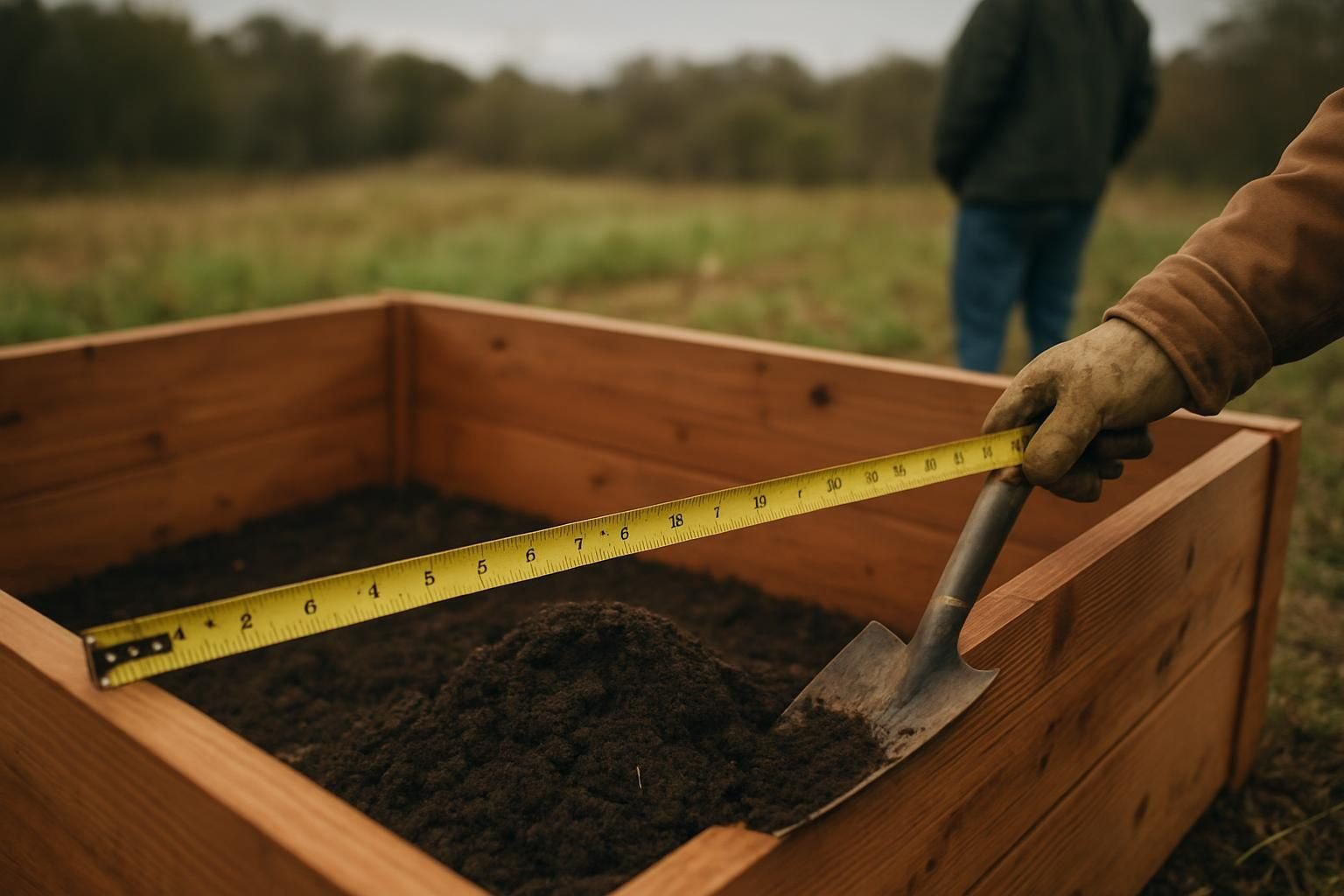
Measure the inside dimensions of the bed, not the outside. If your lumber is 1.5 inches thick, a bed that measures 4 x 8 feet on the outside is closer to 3.75 x 7.75 feet inside. For small beds that gap is trivial; across several beds it can trim a few cubic feet from your order.
Also decide how full you actually want the bed. Most growers fill to within an inch or two of the top so soil and water do not spill over the edge. Use your real fill depth, not the board height.
Cubic feet and cubic yards: the conversions that matter
Bagged soil is sold by the cubic foot. Bulk soil is sold by the cubic yard. One cubic yard is a cube 3 feet on each side, which is 27 cubic feet.
- 1 cubic yard = 27 cubic feet
- 1 cubic foot = about 7.5 gallons
- A common bag size runs around 1 to 2 cubic feet, though sizes vary by brand, so always read the label
- A typical pickup truck bed holds somewhere around 1 to 2 cubic yards of loose soil, depending on the truck and how high you heap it; check weight limits before loading
One caution: bags are sometimes labeled in quarts or liters rather than cubic feet. Convert before you compare prices, or you will think a small bag is a bargain.
Worked examples for common raised bed sizes
These figures use a 12-inch fill depth unless noted. Add settling allowance on top (covered below).
| Bed size | Fill depth | Cubic feet | Cubic yards |
|---|---|---|---|
| 3 x 6 ft | 12 in | 18 | 0.67 |
| 4 x 4 ft | 12 in | 16 | 0.59 |
| 4 x 8 ft | 12 in | 32 | 1.19 |
| 4 x 8 ft | 8 in | 21.3 | 0.79 |
| 4 x 12 ft | 12 in | 48 | 1.78 |
| 3 x 10 ft | 10 in | 25 | 0.93 |
| Four 4 x 8 ft beds | 12 in | 128 | 4.74 |
Example 1: one 4 x 8 bed, 12 inches deep
- Length x width x depth: 8 x 4 x 1 = 32 cubic feet.
- Convert to yards: 32 / 27 = 1.19 cubic yards.
- Add 15 percent for settling: 32 x 1.15 = about 37 cubic feet, or 1.4 cubic yards.
In bags, that is roughly 18 to 19 two-cubic-foot bags. In bulk, order 1.5 yards.
Example 2: a shallow 3 x 6 bed, 8 inches deep
- 6 x 3 x 0.67 = about 12 cubic feet.
- With 15 percent settling: about 14 cubic feet.
This is a bagged-soil job. Seven 2-cubic-foot bags is easy to haul and handle.
Example 3: a market-garden block of six 4 x 25 beds, 10 inches deep
- Each bed: 25 x 4 x 0.83 = about 83 cubic feet.
- Six beds: about 498 cubic feet, or 18.4 cubic yards.
- With 15 percent settling: about 21 cubic yards.
At that scale, bagged soil is not realistic. You are ordering by the truckload, and the real question becomes what is in the load.
Ordering with settling in mind
Fresh raised bed soil, especially anything heavy on compost, bark or other organic material, compacts as it gets watered and as the organic matter breaks down. Expect a drop of an inch or more in the first season. Several things affect how much, including the type and quality of organic materials—which is why understanding compost sources and types matters when building your soil blend.
- Compost-heavy mixes settle more than mineral-heavy ones, because organic matter keeps decomposing.
- Bulky fillers like logs, branches and fall leaves in the bottom of the bed shrink noticeably as they rot.
- Watering in as you fill (a gentle soak after each few inches) knocks out air pockets before planting rather than after.
- Dry, fluffy delivered soil is often measured loose; it packs down once wet and walked on.
A reasonable planning range is to order 10 to 20 percent over your calculated volume. Lean toward 20 percent for compost-rich blends, and 10 percent for mostly mineral soil. You will almost always top off beds in the second spring anyway, and that top-dressing of compost is a feature, not a flaw. It feeds the soil biology that makes the bed productive. If you want to understand why, our guide to the soil microbiome covers how bacteria and fungi turn organic matter into plant food.
Bagged soil or bulk delivery: which is cheaper?
There is no universal crossover point, because prices swing by region, season and supplier. As a rule of thumb, bulk is almost always cheaper per cubic foot than bags, and the gap widens fast as volume grows. Check local prices instead of trusting any figure I could give you.
Compare the two on a per-cubic-foot basis using this approach:
- Get the per-bag price and divide by the bag’s cubic feet.
- Get the bulk price per cubic yard and divide by 27.
- Add the delivery fee to the bulk total. Many suppliers charge a flat fee or by distance, and some set a minimum order.
- Compare the real totals for the volume you actually need.
When bagged soil makes sense
- You need under about half a cubic yard (roughly 13 cubic feet).
- You have no place to dump a pile or no way to move it to the beds.
- You want a specific tested blend and the local bulk options are unknown quality.
When bulk delivery wins
- You need about 1 cubic yard or more.
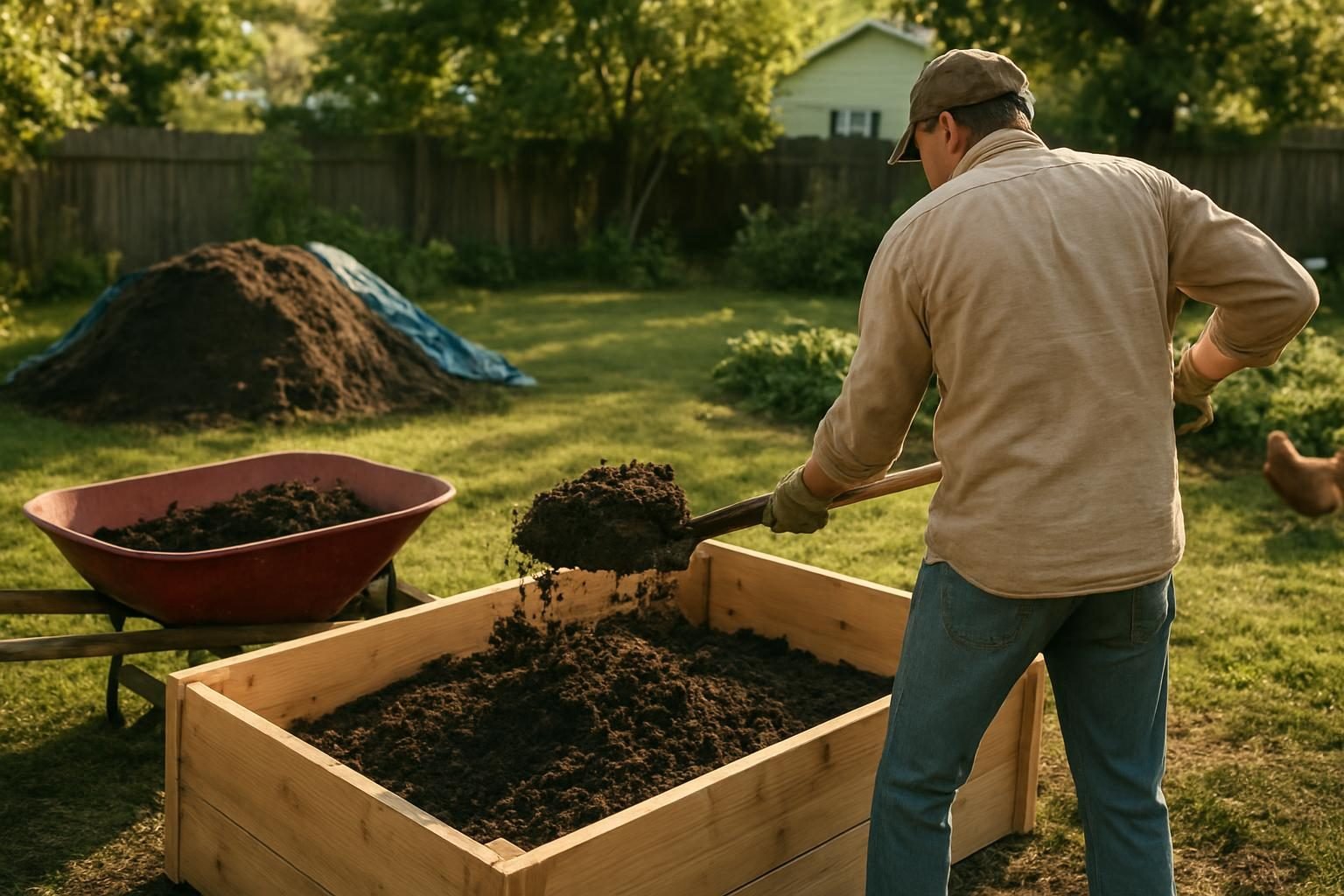
- You can accept a pile on a tarp near the beds and have a wheelbarrow and a couple of strong backs.
- You are filling multiple beds, a market garden or a school or community plot.
Bulk comes with homework. Ask the supplier what is in the blend, how it was composted, and whether they can share a lab report. Be wary of anything sold as “topsoil” without a description, since it may be heavy, weedy native dirt rather than a growing mix. Overly clayey fill can also drain poorly in a bed; our guide on improving soil drainage without heavy equipment explains what to look for and fix.
What to put in the bed once you know the volume
Volume is only half the question. The other half is what fills it. Pure bagged potting mix is light and expensive, and it behaves differently from garden soil in a bed; see our comparison of potting mix vs garden soil in raised beds before you commit. If you are tempted to dig yard soil to cut costs, read whether you can use yard soil in raised beds and how to test and fix it first.
A common starting recipe that many extension services and gardeners use is roughly 60 to 70 percent topsoil or mineral soil and 30 to 40 percent compost, sometimes with a little coarse material for structure. Treat that as a typical range, not a rule, and adjust for your region. In the humid East, drainage and avoiding waterlogging matter most; in the arid West, water retention and avoiding salt buildup in imported compost matter more. A soil test on your finished mix, as described in our soil testing guide, takes the guesswork out.
If you want to cut the cost of fill, the planned guide on filling a raised bed cheaply with layers, logs and leaves covers lower-cost approaches, and the bigger question of amending native soil versus bringing in new is worth settling before you spend. You can also stretch purchased soil by building organic matter over time with fall leaves as mulch and compost, and if you want a deeper look at the bigger picture, our complete guide to building living soil ties it all together.
A quick ordering checklist
- Measure the inside length, width and planned fill depth of each bed.
- Calculate cubic feet per bed, then total them.
- Add 10 to 20 percent for settling.
- Divide by 27 for cubic yards if ordering bulk.
- Compare per-cubic-foot cost, including delivery.
- Ask the supplier for blend details and any test results.
- Plan where the pile will sit and how you will move it.
Key takeaways
- Cubic feet = length x width x depth in feet; divide by 27 for cubic yards.
- A 4 x 8 ft bed at 12 inches deep needs 32 cubic feet, about 1.2 yards, before settling.
- Order 10 to 20 percent extra; compost-rich mixes and organic fillers settle the most.
- Bulk beats bags per cubic foot once you need roughly a cubic yard or more, but add delivery and handling.
- Know what is in the load: ask for the blend and any lab report, and test if you can.
- Plan to top off with compost in year two; it feeds the soil.
Frequently asked questions
How many cubic feet of soil do I need for a 4×8 raised bed?
A 4 x 8 ft bed filled 12 inches deep needs 32 cubic feet, which is about 1.2 cubic yards. Add 10 to 20 percent for settling and you are looking at roughly 35 to 38 cubic feet. If your bed is only 8 inches deep, the number drops to about 21 cubic feet before settling.
How many cubic feet are in a cubic yard?
One cubic yard equals 27 cubic feet, because a yard is 3 feet and 3 x 3 x 3 = 27. That is why you divide cubic feet by 27 to convert, and why a 32-cubic-foot bed is a little over one yard.
How much extra soil should I order for settling?
Plan on 10 to 20 percent over your calculated volume. Use the higher end for compost-heavy mixes or beds with logs and leaves in the bottom, since those break down and shrink. Mostly mineral soil settles less. Topping off with compost the following spring is normal, or consider biochar for sale as an alternative amendment.
Is bulk soil cheaper than bagged soil?
Usually yes per cubic foot, and the savings grow with volume. But delivery fees and minimum orders can erase the advantage on small jobs. Compare real totals for the amount you need, and ask the supplier what is in the blend, since quality varies widely.
Do I measure the inside or outside of the bed?
Measure the inside. Board thickness reduces the usable space, and on larger beds the difference can trim a few cubic feet. Also use your actual fill depth, which is typically an inch or two below the top of the wall, rather than the full board height.