Your energizer is the heart of every electric fence, and cattle fencers that are undersized or poorly grounded are behind most of the escapes and frustration I hear about. Pick the right charger and a single strand of polywire will hold a herd; pick the wrong one and even a fancy multi-wire fence becomes a suggestion. This guide walks through energizer types, how to size joules to your fence, grounding, testing and basic troubleshooting.
Quick answer: Choose a plug-in (AC) energizer if you have reliable power, a battery unit for remote paddocks you can service, and a solar unit where there is no power and decent sun. Size by output joules and fence length: roughly 1 to 3 joules covers small rotational grazing setups, while 5 to 15 joules suits miles of fence or heavy vegetation. Aim for at least 4,000 to 5,000 volts on the fence line, and invest in solid grounding before buying a bigger box.
How an Electric Fence Energizer Works
An energizer sends a short, high-voltage pulse down the fence about once a second. The pulse travels along the wire, passes through the animal when it touches the fence, and returns through the soil to a ground rod connected to the energizer. If any part of that loop is weak, the shock is weak. Cattle are protected by the hair and hide, dry soil and sometimes thick winter coats, so the fence has to deliver a sharp, memorable jolt.
The point of a good shock is training. Cattle learn the fence once, respect it afterward, and then a lightweight temporary wire is enough. That is what makes rotational grazing practical on a budget. If you are still working out your paddock layout and how fencing fits in, our electric fence for cattle setup guide covers the wire, posts and gates; this article focuses on the charger itself.
Energizer Types: Plug-In, Battery and Solar
The right type depends mostly on whether you have power at the fence and how often you can visit it.
| Type | Best for | Strengths | Trade-offs |
|---|---|---|---|
| Plug-in (AC) | Home pastures, barns, permanent perimeters | Most power per dollar, steady output, low maintenance | Needs an outlet; outages kill the fence; lightning exposure |
| Battery (DC) | Remote paddocks, short grazing seasons | Works anywhere, portable | Battery needs recharging or replacing; can fail mid-season if unchecked |
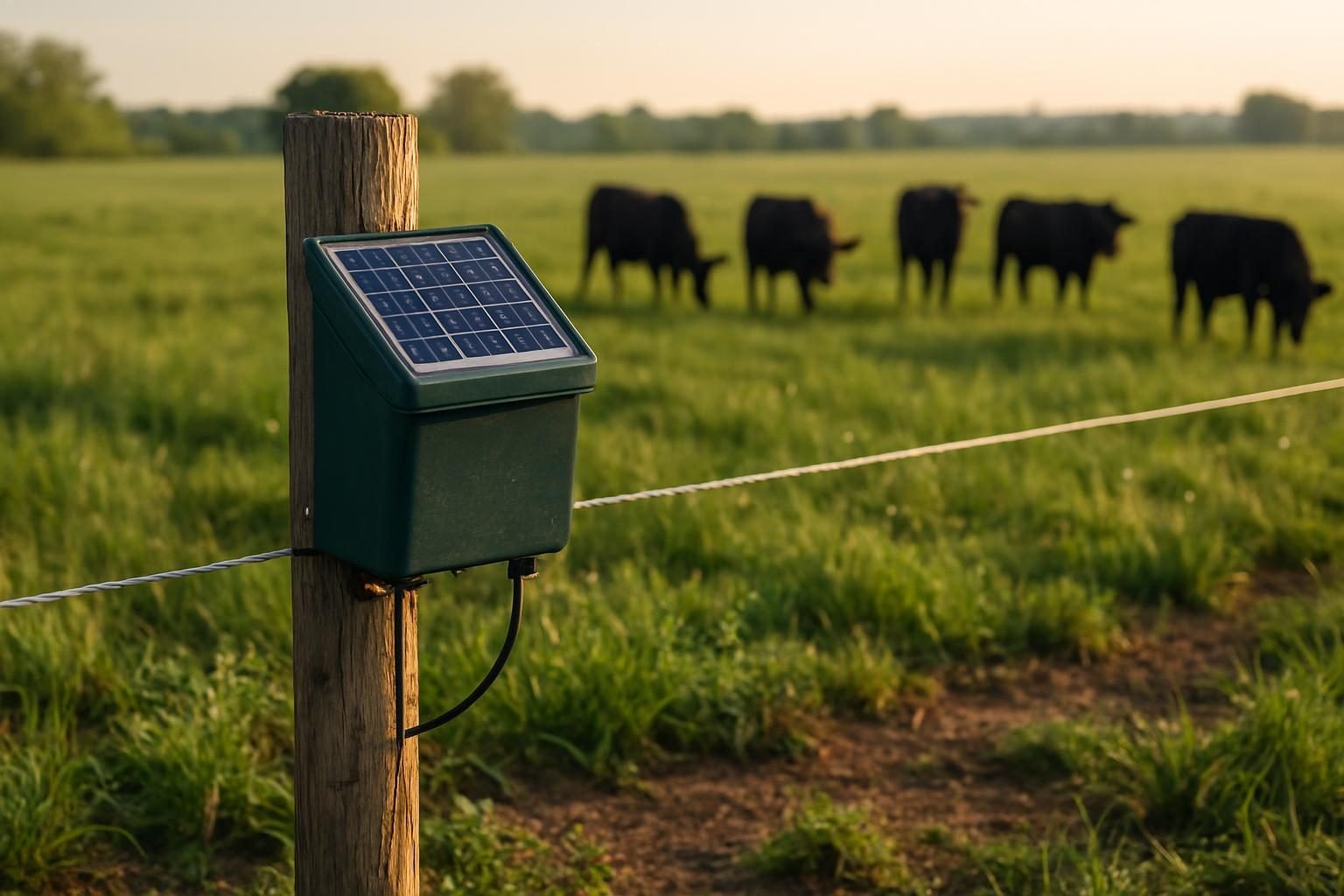
| Solar | Remote pastures, leased ground, rotational grazing | No power bill, self-charging, easy to move | Costs more per joule; weak in long cloudy stretches or heavy shade |
Plug-in energizers
If you can run power to the fence, a plug-in unit is usually the best value. Mount it in a dry, protected spot such as a barn wall, and use a surge protector. Many ranchers run one plug-in energizer at headquarters and feed several paddocks from it with insulated underground cable.
Battery energizers
Battery units are a fine choice for temporary summer paddocks, but they only work if you check the battery. A deep-cycle battery is a better partner than a disposable one for frequent use. Put a reminder on your calendar, because a dead battery usually means cattle in the neighbor’s corn.
Solar energizers
Solar is popular with rotational grazers because paddocks move around. Face the panel south in the Northern Hemisphere, keep it clear of shade and tall weeds, and be realistic about winter. In the humid East and Pacific Northwest, long gray spells can drain a small battery; in the arid West, sun is rarely the problem, but dust on the panel can be. Treat solar output ratings as best-case figures and size up when in doubt.
Matching Joules to Fence Length and Vegetation
Joules measure the energy in each pulse. Voltage matters, but a high-voltage fence with little energy behind it will sag as soon as grass touches the wire. Weeds and wet vegetation act like a slow leak, so more joules gives you more headroom.
These are rough, typical ranges. Manufacturers rate their units differently (some use stored joules, others output joules), so always compare like with like and check the maker’s guidance for your fence length.
| Fence setup | Typical energizer size (output joules) |
|---|---|
| Small temporary paddocks, a few strands of polywire, light vegetation | 0.5 to 2 J |
| Rotational grazing across 10 to 50 acres, mixed vegetation | 2 to 5 J |
| Larger permanent perimeter, a mile or more of wire, moderate weeds | 5 to 10 J |
| Long fence lines, heavy weeds or brush, multiple wires | 10 to 15+ J |
A few judgment calls help:
- Overbuy a little. A bigger energizer costs more, but it does not force more power through a clean fence; it just gives you margin when vegetation grows or conditions are bad.
- Count total wire, not just perimeter. A three-wire perimeter is three times the wire length of a single strand, and each interior paddock adds more.
- Plan for the worst week. Fast spring grass in a wet region will load the fence harder than a dry August.
- Consider your herd. Calves and bulls, and cattle in thick winter coats, may test a fence differently than a gentle cow herd.
If you are still deciding herd size and acreage, our guide to how many acres per cow will help you plan how much fence you actually need.
Grounding: The Part Most People Underbuild
Poor grounding is the number one reason a good energizer seems weak. The shock completes its circuit through the earth, so the energizer needs a strong connection to moist soil.
- Use galvanized ground rods. Typical guidance is about three feet of rod in the ground per joule of output, with a minimum of three rods for most energizers. Check your manufacturer’s manual.
- Space rods about 10 feet apart and connect them with galvanized wire and solid clamps.
- Keep them away from other grounds. Stay clear of the building’s electrical ground, water pipes and telephone lines.
- Drive them into damp soil if you can, such as near a downspout, low spot or shaded north side.
- In dry or sandy ground, add more rods or use a ground-return wire running alongside the fence.
Testing Voltage and Finding Problems
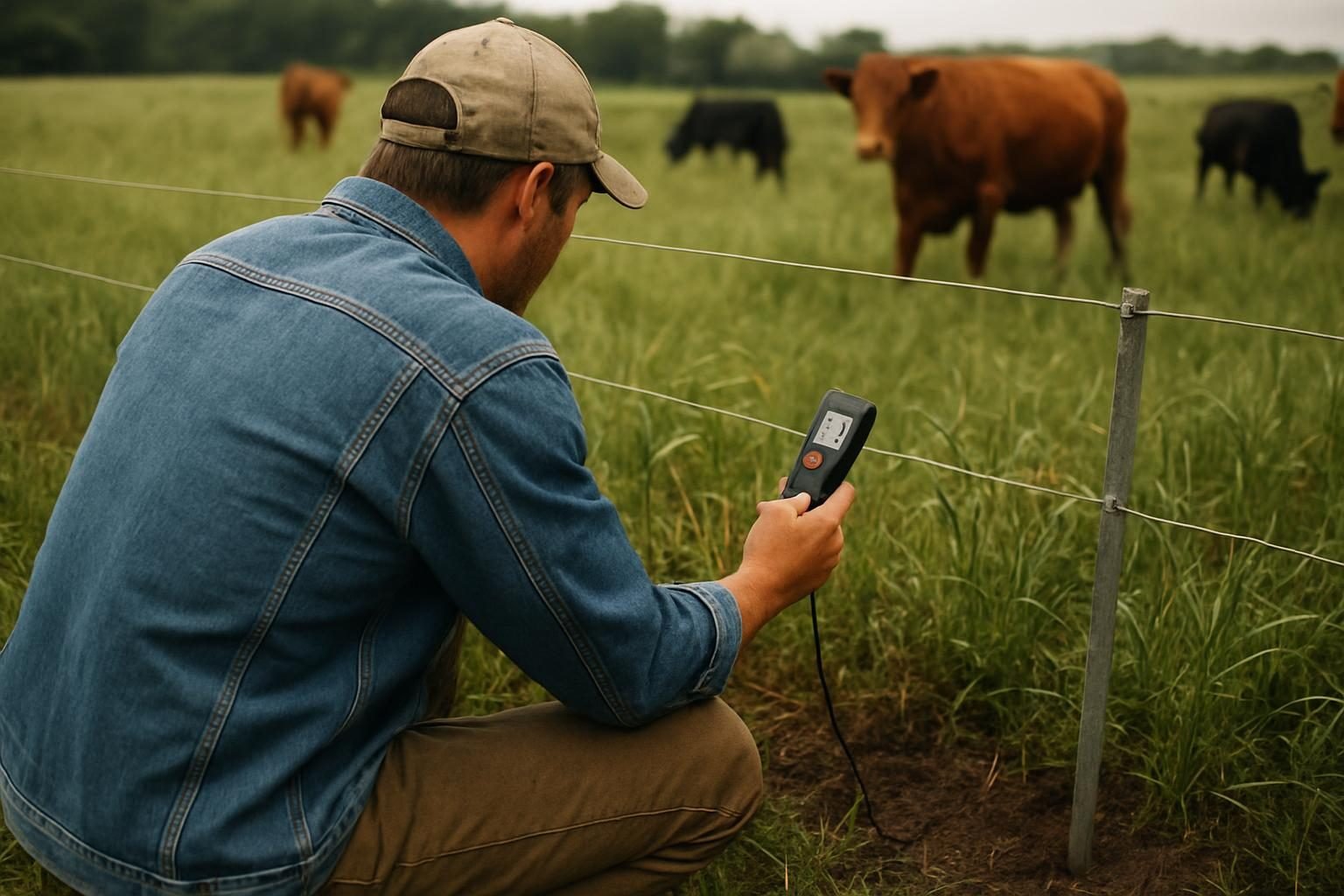
A digital fence tester is one of the best small investments you can make. Test at the energizer first, then at intervals along the fence and at the far end.
- Target: at least 4,000 to 5,000 volts on the line for cattle; many graziers like more, particularly for training and for bulls.
- Test the ground too. Touch the tester probe to the ground rod while the fence is shorted to the earth. If the ground rod reads more than a few hundred volts, you need more or better grounding.
- Disconnect and compare. Test the energizer terminals with the fence disconnected. If voltage is high there and low on the fence, you have a leak. If it is low at the box, the unit or its power supply is the problem.
Voltage dropping gradually along the fence usually means vegetation or a weak wire connection. A sudden drop after a certain point points to a break, short or bad insulator.
Troubleshooting Basics
- No tick from the energizer: check the power source, battery, fuse and plug first.
- Ticking but low voltage: walk the fence looking for vegetation touching wire, broken insulators, wires touching metal posts, or loose splices.
- Good at the start, weak at the end: inspect the line for corroded connections and undersized wire. Use heavy-gauge insulated cable for runs to a distant paddock.
- Weak in dry weather: add ground rods or a ground-return wire.
- Cattle walking through: they may not be trained or the fence may be too low or too slack; reset height to roughly mid-shoulder to chest level for a single wire and retrain them with a hot, visible fence.
- Solar unit dying: clean the panel, check for shade, and test the battery under load; replace it every few seasons.
Setting Up a Charger for Rotational Grazing
For most small and midsize operations, a simple pattern works well: a solid permanent perimeter, a central lane, and temporary polywire or polytape subdividing paddocks. Run one energizer where possible, feed the perimeter from it, and use insulated cable and cutoff switches so you can troubleshoot sections without shutting everything down.
Fence and water go hand in hand, so plan your lanes with your troughs in mind; our guide to water systems for rotational grazing shows how to lay that out. If you push toward very high stock density, our explainer on mob grazing and the broader adaptive multi-paddock grazing approach are good next reads. Running sheep or goats alongside cattle changes your fence needs, since small ruminants need more wires and more voltage; see multi-species grazing for details.
If goats are in your plans, the same fencing principles apply, and we will be covering raising goats for brush control in more depth soon.
Cost, Safety and Practical Notes
- Prices vary widely by brand, region and joule rating. Get quotes from local farm stores, and check whether a reputable used unit makes sense. If equipment cost is a hurdle, see our overview of farm equipment financing.
- Use a lightning diverter and surge protection, especially in storm-prone areas like the South and Plains.
- Buy energizers rated for livestock and follow your local electrical codes. Never build a fence that runs off an unmodified household supply.
- Warn visitors and neighbors with proper signs where required, and keep hot wire away from public rights of way.
Key Takeaways
- Match energizer type to your power situation: plug-in where you have outlets, battery or solar for remote paddocks.
- Size by joules and total wire length, then add margin for weeds and heavy growth.
- Grounding is where most weak fences fail; add rods before upgrading the box.
- Test voltage along the line, at the far end and at the ground rods, and aim for at least 4,000 to 5,000 volts for cattle.
- Keep vegetation off the wire, check connections and inspect solar panels and batteries regularly.
Frequently asked questions
What size energizer do I need for cattle?
For small rotational setups, 1 to 3 joules is often enough. For miles of fence or heavy vegetation, 5 to 15 joules gives better margin. Check the manufacturer’s fence-length guidance and buy a bit larger than you think you need.
How many volts should a cattle fence have?
Aim for at least 4,000 to 5,000 volts at the farthest point of the fence. Many graziers prefer higher voltages for training new cattle or for bulls. A reliable digital tester will tell you where the fence is losing power.
Is a solar energizer strong enough for cattle?
Yes, a properly sized solar unit works well for cattle in most regions, particularly for rotational grazing. Size up from the rated figures, keep the panel clean and unshaded, and plan for long cloudy periods, especially in the humid East and Pacific Northwest.
Why is my electric fence weak even with a new charger?
The usual culprits are poor grounding, vegetation touching the wire, bad splices and failing insulators. Test voltage at the energizer, along the fence and at the ground rods to find where the loss starts.
Can I use one energizer for cattle and other livestock?
Often yes, but sheep and goats need more wires and higher voltage because of wool, hair and size. A larger energizer and a well-built fence let you run mixed groups safely. See our guides to raising sheep for beginners and rotational grazing for more detail, or browse the Grazing & Livestock section.