Soil testing for farmers is the closest thing we have to a dashboard for the ground under our feet. A good test tells you what is limiting your crops or forage, and a good series of tests tells you whether your management is actually changing anything. This guide covers how to sample properly, what each major test type shows, and how to read results over years instead of once.
Quick answer: Start with a standard soil test (pH, organic matter, CEC, nutrients) taken the same way, at the same time of year, every time. Add a Haney test or soil respiration test if you want a read on biological activity and nitrogen release, and consider PLFA or similar biology tests only when you have a specific question. Pair lab work with free field checks (slake test, infiltration, earthworm counts, shovel test) and compare results over three to five years, not season to season.
Why regenerative farmers test differently
Conventional soil testing grew up to answer one question: how much fertilizer should I apply? That is still a useful question, and a standard test answers it well. But if you are building soil through no-till, cover crops and grazing, you also want to know whether biology, structure and organic matter are improving.
No single test captures all of that. Think of testing as a toolbox: chemical tests for fertility, biological tests for activity, and physical field tests for structure and water behavior. The principles of regenerative agriculture all show up somewhere in this toolbox, which is why we use all three categories.
How to sample soil so your results mean something
Most bad soil-test decisions trace back to bad sampling. A lab can only analyze what you send, and a few ounces of soil represent a lot of ground.
- Divide the farm into management zones. Separate fields, pastures or beds by soil type, slope, crop history and management. Never mix a creek bottom with a gravelly knob.
- Pick a consistent depth. Six to eight inches is typical for row crops and gardens; many labs recommend three to four inches for pasture and no-till. Ask your lab, and then stay consistent.
- Take 10 to 20 cores per zone in a zigzag or grid, avoiding fence lines, old manure piles, water tanks and field edges.
- Mix the cores in a clean plastic bucket and fill the lab bag from the blend. Metal buckets and tools can contaminate micronutrient results.
- Record GPS points or mark landmarks so you can resample the same spots later.
- Sample at the same time of year each cycle, ideally when soil is not frozen, waterlogged or just after fertilizer or lime.
For tracking change, consider permanent monitoring points that you revisit every year or two alongside your zone composites. That reduces the noise from natural spatial variability.
What a standard soil test shows
A standard test, offered by land-grant university labs and many commercial labs, is the foundation. Typical reports include:
- pH and buffer pH: the master variable controlling nutrient availability and microbial communities. Most crops and pastures prefer roughly 6.0 to 7.0, though blueberries and some others differ.
- Organic matter (OM): often measured by loss on ignition. Many agricultural soils fall between about 1 and 6 percent, depending on climate and texture. Our guide to increasing soil organic matter explains realistic timelines.
- CEC (cation exchange capacity): the soil’s ability to hold nutrients, driven by clay and organic matter.
- Phosphorus and potassium: extractable levels, with the extraction method varying by region (Bray, Mehlich-3, Olsen). Olsen is common in alkaline western soils.
- Calcium, magnesium, sulfur and micronutrients in many packages.
Two cautions. First, base-saturation philosophies (ideal calcium-to-magnesium ratios) are debated, and university research has often found little yield response to rebalancing when levels are adequate. Treat such recommendations with healthy skepticism and ask for the evidence. Second, labs differ in methods, so you cannot always compare numbers across labs. Pick one lab and stay with it.
Haney test and soil respiration
The Haney test (Soil Health Tool) was developed by USDA-ARS researchers to pair chemical extraction with a biological measure. It uses gentler extractants meant to mimic what plant roots and microbes release, plus a CO2 burst measurement after rewetting dried soil, which approximates microbial respiration. It also reports water-extractable organic carbon and nitrogen, and generates a soil health score.
What it is good for: comparing fields or management systems, spotting where nitrogen may be mineralizing from organic matter, and prompting questions about fertilizer rates. What to keep in mind: the CO2 burst depends on moisture and drying conditions, scores are model outputs rather than universal truths, and interpretation of the score is still an active research topic. Use it as a relative indicator inside your own farm, not as a grade against a national standard.
Simple respiration tests are also available as in-field kits that capture CO2 from soil in a ring. They are rough but cheap, and useful for seeing the same field respond across seasons.
Biology tests: PLFA, DNA and microscopy
If you want to look directly at the soil community, the options are:
- PLFA (phospholipid fatty acid) analysis: measures membrane lipids to estimate living microbial biomass and broad group ratios such as fungi to bacteria. It reflects living biomass fairly well.
- DNA sequencing: identifies which organisms are present, including dormant ones. The information is rich but interpretation guidance for farm decisions is still limited.
- Direct microscopy: counts bacteria, fungi, protozoa and nematodes. Results depend heavily on the operator and sampling, so be cautious about decisions based on a single slide.
These tests cost noticeably more than standard tests, and the honest truth is that benchmark ranges are not well established for most regions and crops. They work best for research-style comparisons, such as a treated versus untreated field, or before and after a big change. If someone sells a product, such as compost tea, and justifies it with a biology test, ask for replicated, independent evidence. For context on fungal partners specifically, see our upcoming piece on mycorrhizal fungi.
Simple in-field tests you can do for free
These cost nothing, take minutes, and often tell you more about structure and water than a lab report.
Shovel test (spade test)
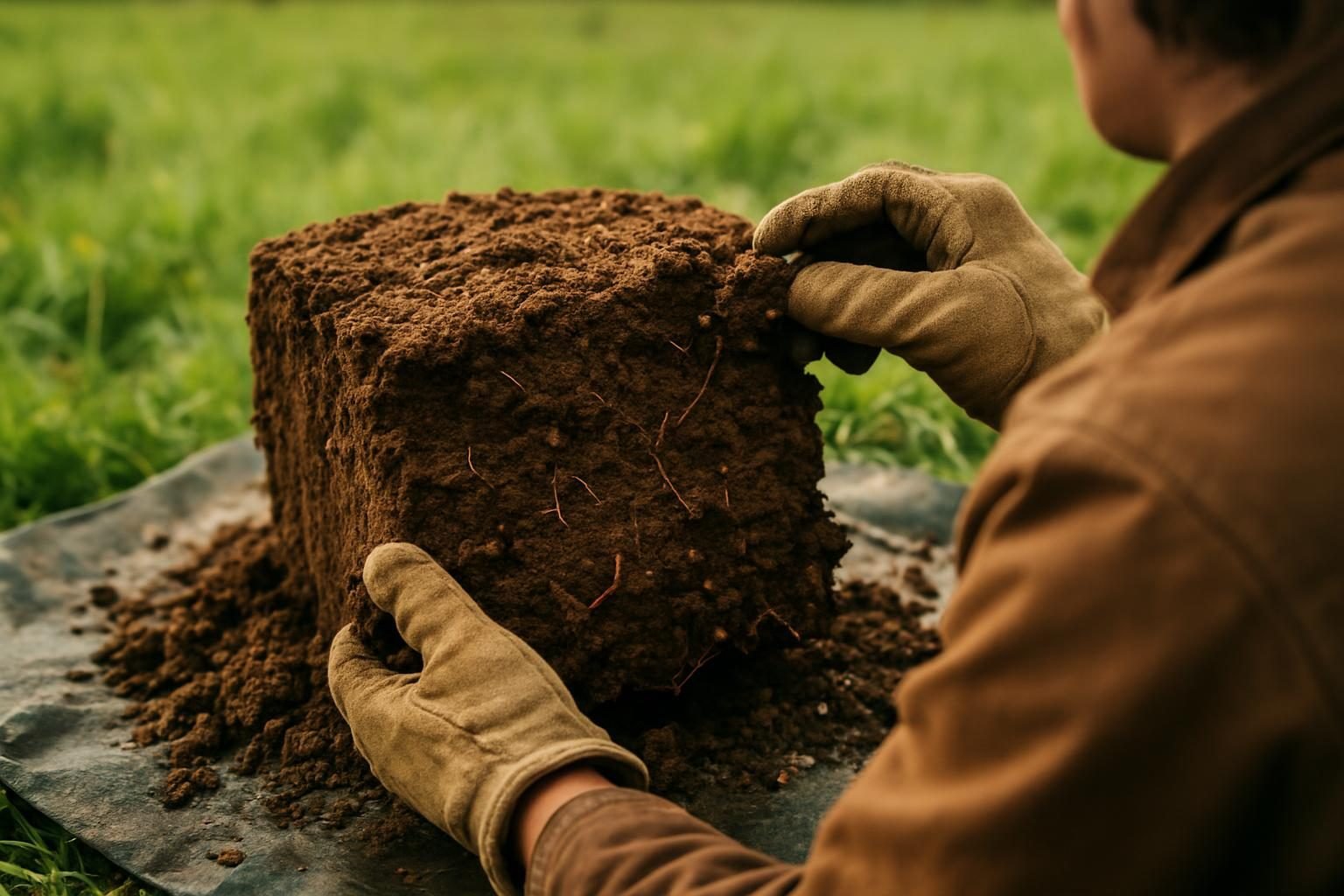
Dig a clean block about 8 inches deep. Look for crumbly aggregates, roots going deep without turning sideways, earthy smell, visible pores and worm channels. Platy layers, gray or blue-gray colors, and roots bending horizontally suggest compaction or poor drainage. If you find them, read about how to fix compacted soil without heavy tillage.
Slake test
Drop a dry, pea-sized aggregate of topsoil in a jar of water and watch. Stable aggregates hold together for minutes or longer; unstable ones collapse into a cloudy mush quickly. Compare fields side by side, using clods of similar size and dryness.
Infiltration test
Push a ring (a 6-inch can with both ends removed works) about 3 inches into the soil, cover the surface with plastic wrap, pour in a measured inch of water, remove the wrap, and time how long it takes to soak in. Repeat the same ring right away for a second reading, since soil is often wetter and slower the second time. Times vary widely by texture and moisture, so compare like soils under similar moisture and track your own trend.
Earthworm count
Dig a 12-by-12-inch, 12-inch-deep hole in spring or fall when soil is moist and warm, sort the soil on a tarp, and count worms. Rough guides often cited by extension services consider around ten or more per square foot a healthy sign for many soils, but dry, sandy or cold soils naturally hold fewer. Count several spots and average.
Other quick checks
Note bare ground percentage, residue cover, plant diversity, ponding after rain, and the smell and color of soil. A simple penetrometer or even a wire flag pushed into the ground can reveal hard layers.
Choosing the right test for your goal
| Question | Best starting tool | Typical frequency |
|---|---|---|
| What fertility or lime do I need? | Standard soil test | Every 1 to 3 years |
| Is my soil biologically active? | Haney test or respiration | Every 1 to 2 years |
| Did a change shift the microbial community? | PLFA or DNA, with a control area | Before and after, then every few years |
| Is my soil compacted or aggregating? | Shovel and slake tests | Every season |
| Is water soaking in? | Infiltration ring | Yearly, same spots |
| Is life returning? | Earthworm count | Yearly, same season |
Reading results over time
Soil is slow and variable, so the trend matters more than any single number. A few rules keep you honest:
- Expect noise. Normal variation between samples can exceed a year’s real change in organic matter. Look for direction over three to five years.
- Keep methods constant. Same lab, same depth, same season, same sampling points.
- Use a control. Leave one conventionally managed or untreated area so weather effects are visible.
- Pair numbers with observation. If infiltration is faster and worms are returning but OM is flat, you are still making progress.
- Adjust management, not just numbers. Results should feed decisions on cover crop selection, grazing rest periods and amendments. A 3-year transition plan works best when testing is built in from year one.
Regional differences matter. Humid eastern soils tend to be acidic and leached, where lime and phosphorus often dominate results. Corn Belt soils carry high organic matter and a strong nitrogen story. Arid western soils may be alkaline, saline or low in organic matter by nature, so a 1.5 percent reading there is not a failure. Southern soils often warm and break down organic matter quickly, making gains harder. Compare against your own baseline and similar local soils, not a national ideal.
If you graze, pair soil data with pasture observations from your rotational grazing records. Many farms also use testing results when applying for regenerative programs and markets, so confirm any documentation requirements with the program directly.
Key takeaways
- Sample consistently: same depth, season, lab and locations.
- A standard test is the foundation; Haney and respiration tests add biological context.
- PLFA and DNA tests are best for specific questions and controlled comparisons.
- Free field tests (shovel, slake, infiltration, worms) reveal structure and water behavior.
- Judge progress over three to five years, against your own baseline, with a control if possible.
- Browse more in our Soil Health section.
Frequently asked questions
How often should I test my soil?
A standard test every one to three years is typical, depending on how actively you are amending. Biological tests like Haney can be done every one to two years, and field checks can be done every season. Always test at the same time of year for comparable results.
What does a Haney test tell me that a standard test does not?
It uses gentler extractants and a CO2 burst measurement to estimate microbial activity and the pool of carbon and nitrogen that may be available to crops. That helps with comparing fields and thinking about nitrogen credit. Its scoring is a model, so use it for relative comparisons on your own farm.
Do I need a PLFA or DNA test?
Most farms do not need one. They are useful if you have a specific question, like comparing a treated and untreated field, and you can afford a proper control. Without established benchmarks for your region, a single result is hard to act on.
How long until I see changes in soil test results?
Field properties like aggregation, infiltration and earthworm activity can improve within a year or two. Organic matter typically changes slowly, often a few tenths of a percent over several years at best, and varies with climate and soil type. Biological indicators can move sooner but fluctuate with weather.
Can I rely on home soil test kits?
Home kits are fine for rough pH or a quick look, but their nutrient readings are less accurate than a certified lab. For fertility decisions and long-term tracking, use a lab. Use home and field tests as supplements, not substitutes.