Choosing among composter types is mostly a question of how much material you have, how much effort you want to spend, and what pests live near you. This guide compares open piles, enclosed bins, tumblers, multi-bay systems and worm bins so you can match a system to your garden and household.
No design is best everywhere. A backyard gardener with a small lot and a market farmer with a truckload of manure need very different tools, and the fanciest option is rarely the one that gets used.
Quick answer: For most households with a yard, a simple enclosed bin or a two-to-three bay system gives the best balance of cost, capacity and low effort. Open piles are cheapest and handle the most volume. Tumblers are tidy and fast for small batches but hold little. Worm bins are the right choice for kitchen scraps in apartments or small spaces. Match the system to the volume of material you actually produce.
How compost systems actually differ
Every system does the same job: it gives microbes the food (carbon and nitrogen), water and air they need to turn waste into stable organic matter. The differences come down to how well a design holds heat, how easily you can add air, how much it holds, and how it keeps animals out.
Hot composting, where the pile reaches roughly 130 to 160°F, is faster and kills many weed seeds and pathogens, but it needs enough mass (commonly cited as about a cubic yard) to hold heat. Cold or slow composting works at any size but takes months to a year or more. Most small bins and tumblers sit somewhere in between, and that is fine for most gardens.
If you want the biology behind this, our guide to the soil microbiome explains why finished compost is worth the wait, and the broader soil health guide shows where compost fits in a whole-system approach.
Composter types compared at a glance
The ranges below are typical, not guarantees. Your climate, feedstock mix and management will shift them.
| System | Typical cost | Speed to finished | Capacity | Effort | Pest resistance |
|---|---|---|---|---|---|
| Open pile | Free to low | 3 to 12 months (faster if turned) | Very high | Low to moderate | Low |
| Enclosed bin | Low to moderate | 4 to 12 months | Small to medium | Low | Moderate to good |
| Tumbler | Moderate to high | 1 to 3 months per batch | Small | Low to moderate | Good |
| Multi-bay system | Low (DIY) to moderate | 2 to 6 months per bay | Medium to very high | Moderate | Moderate |
| Worm bin | Low to moderate | 2 to 4 months | Small | Low, with attention | Good if managed |
Open piles
A pile on the ground is the oldest and cheapest method. It scales from a backyard heap to a farm windrow, and it handles bulky material like leaves, straw, bedding and garden waste better than anything else.
Pros and cons
- Pros: near-zero cost, unlimited capacity, easy to reach temperature if you build a big enough pile, simple to turn with a fork or loader.
- Cons: looks untidy, attracts rodents, raccoons and dogs if you add food scraps, dries out or soaks in weather without a cover.
Piles suit rural properties and farms where space is plentiful. Keep meat, dairy and oily foods out, and bury kitchen scraps in the center. Our guide to fall leaves as mulch and compost carbon shows why a leaf stockpile makes a perfect companion to any pile.
Enclosed bins
A fixed bin, typically plastic or wood with a lid, keeps things tidier and helps retain moisture. It is the default choice for suburban yards.
Most hold well under a cubic yard, so they often compost slowly unless you actively mix them. Many have a bottom door for pulling finished compost. Make sure the lid fits tightly and the base is on soil or has hardware cloth underneath to discourage burrowing animals.
The main trade-off is turning. It is hard to aerate a full bin, so build in carbon layers (shredded leaves, straw, cardboard) as you go to keep air moving through the material.
Tumblers
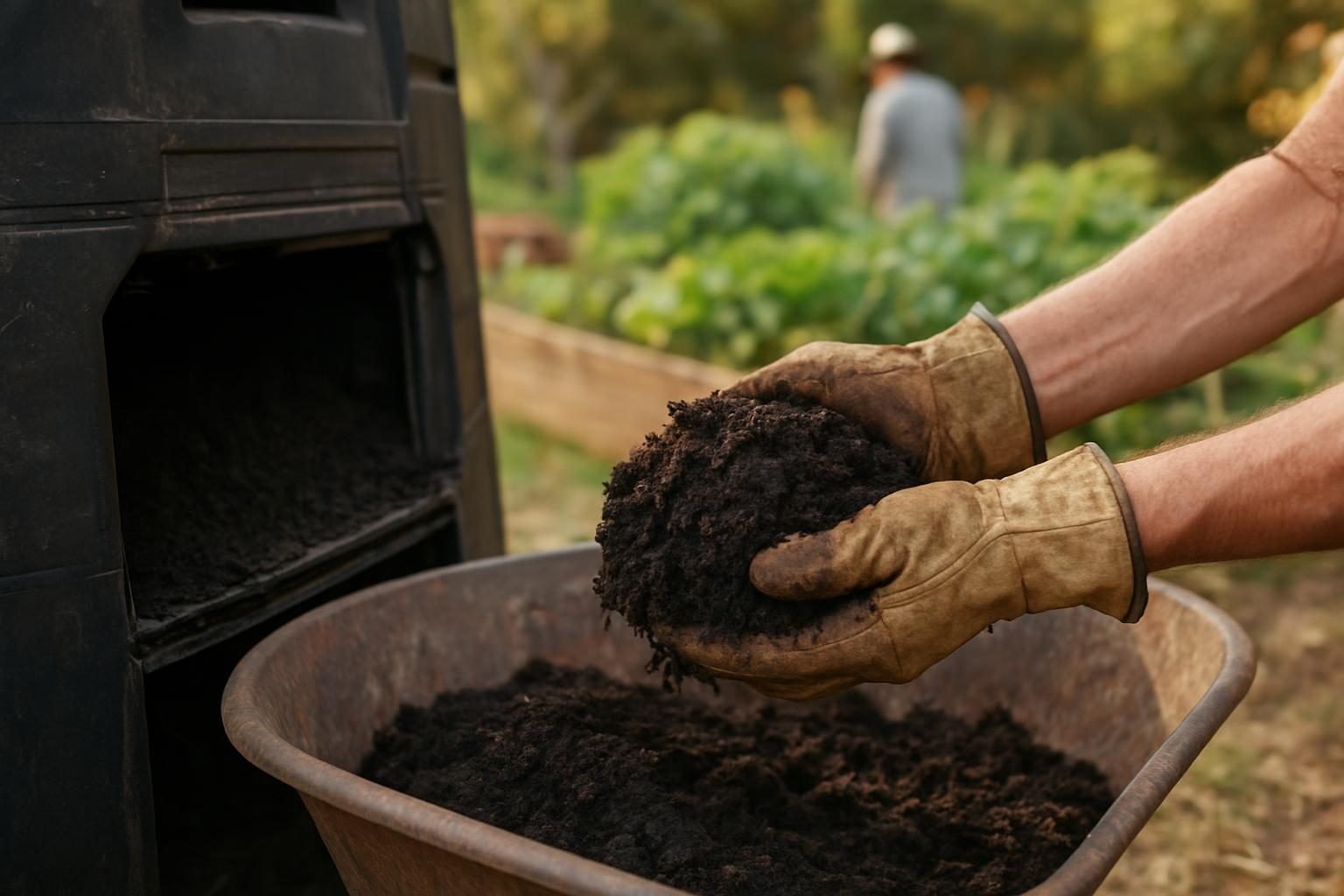
Tumblers are sealed drums on a frame that you rotate to mix. They are clean, elevated and animal-resistant, and a well-balanced batch can finish in a couple of months in warm weather.
What to know before buying
- Batch size is small. Most hold the equivalent of a few wheelbarrow loads, so a busy garden outgrows one fast.
- Dual-chamber models let you fill one side while the other cures, which solves the biggest practical problem.
- Heavy when full. Turning a wet, full drum is real work, and cheap units can crack or bind.
- Cold weather slows them down unless the drum is dark and in the sun.
Tumblers are best for gardeners with limited space, strong pest pressure, or HOA rules. They are a poor fit if you generate large volumes of yard waste.
Multi-bay systems
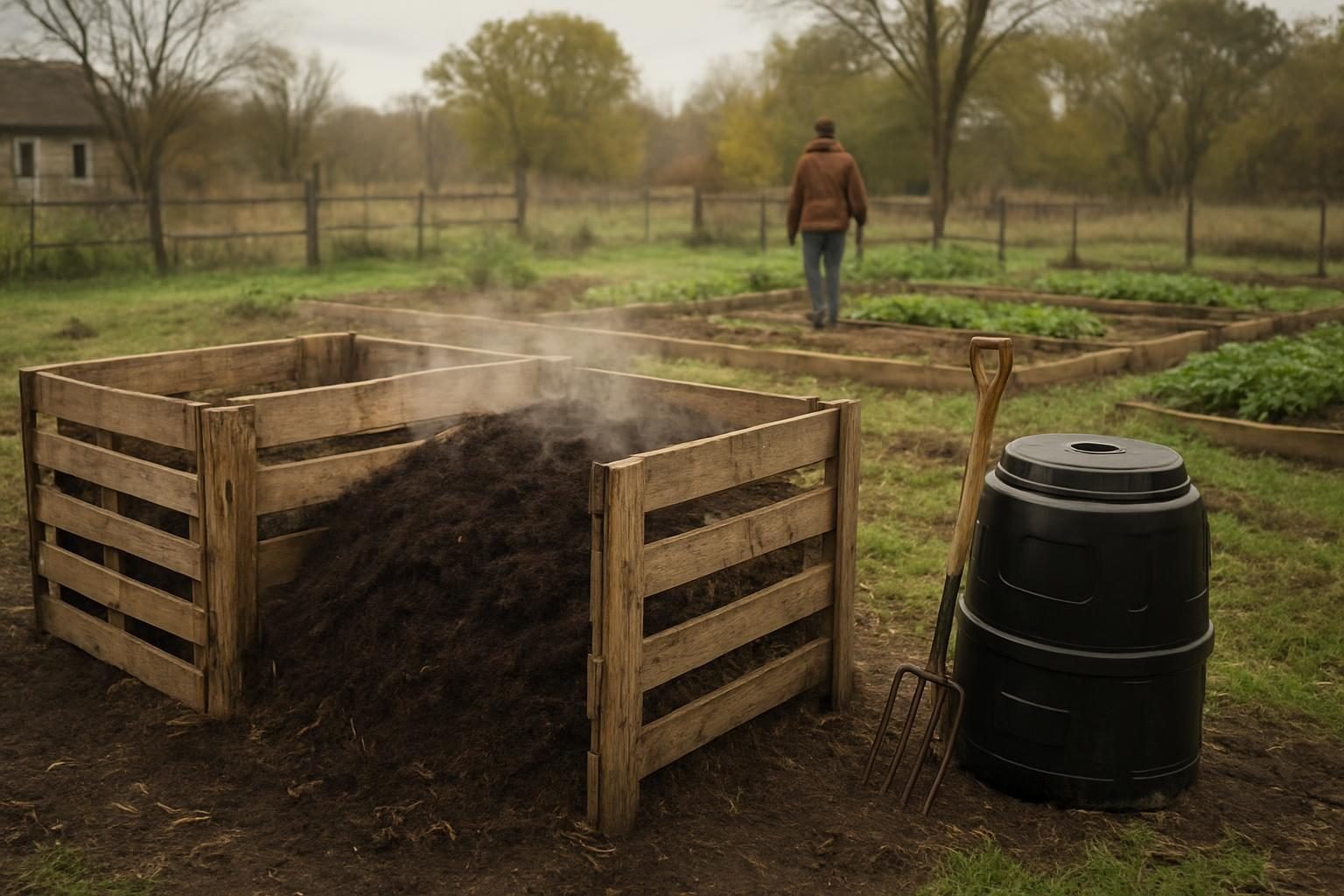
A multi-bay system is two or three adjacent bins, often built from pallets, wire or lumber. You build a pile in the first bay, turn it into the second to keep it going, and let the third cure or hold new material.
This is the workhorse for serious gardeners, market growers and small farms. It handles large volume, makes turning easy, and lets you manage material in stages so you always have finished compost coming.
- Build three bays roughly 3 by 3 by 3 feet each (or larger if you have the material), with removable fronts or slatted sides for airflow.
- Fill bay one with a mix of browns and greens until it is full, then let it heat up.
- Turn it into bay two after a few weeks, adding water if it is dry.
- Start a fresh pile in bay one while bay two works.
- Move to bay three to cure, then screen and use.
The cost is mostly your time, and pallet bays can be nearly free. Mind the pest question: slatted sides let in air but also let in rodents unless you line them with hardware cloth.
Worm bins
Vermicomposting uses red wigglers (Eisenia fetida) to process food scraps into worm castings. It works indoors, in garages, and on balconies, which makes it the best option for apartment dwellers and anyone with limited outdoor space.
- Best for: kitchen scraps, small households, year-round indoor use.
- Limits: small capacity, no yard waste, worms need temperatures roughly in the 55 to 80°F range and can die in heat or hard freezes.
- Common problems: overfeeding, too much moisture or acidity, and fruit flies. Bury scraps and keep a dry bedding layer on top.
Worm castings are a rich amendment, and worm bin output pairs well with the ideas in our piece on compost tea and biological amendments, including an honest look at what does and does not work.
Chooser: match the system to your situation
| Your situation | Best fit | Why |
|---|---|---|
| Apartment or condo, kitchen scraps only | Worm bin | Compact, indoor-friendly, no yard needed |
| Small city lot, 1 to 2 people | Enclosed bin or dual-chamber tumbler | Tidy, pest-resistant, modest volume |
| Suburban yard with a vegetable garden, family of 3 to 5 | Enclosed bin plus a small pile or two bays | Handles scraps and seasonal yard waste |
| Large garden, market garden, or under 5 acres | Three-bay system | High volume, easy turning, steady supply |
| Farm, livestock bedding or manure | Open pile or windrow | Scales to large volume with a loader |
| Heavy raccoon, bear or rodent pressure | Tumbler or secured enclosed bin | Sealed design limits access |
If you keep poultry, check our upcoming guide to composting chicken manure before adding it, since it needs more careful handling than kitchen waste. Gardeners who want to skip bins altogether can read about composting in place.
Getting good results in any system
The container matters less than the recipe. A few habits make almost any design work:
- Balance browns and greens. Aim for roughly two to three parts carbon-rich browns (leaves, straw, cardboard) to one part nitrogen-rich greens (food scraps, fresh grass, manure) by volume.
- Keep it damp, not soggy. The material should feel like a wrung-out sponge.
- Chop big pieces. Smaller particles break down faster.
- Add air. Turn, fork, or layer coarse material to keep oxygen moving.
- Be patient. Finished compost is dark, crumbly and smells earthy, not sour.
When something goes wrong, from smells to pests to a pile that will not heat, our forthcoming guide to composting troubleshooting will walk through fixes. Once you have a finished product, you can use it to build soil organic matter or fill beds, as covered in our guide to soil for garden beds.
Regional notes
In the humid East and South, piles stay moist and break down fast, but they can turn soggy and smelly in summer rain, so a cover or well-drained base helps. In the arid West, evaporation is the enemy, so shade, a lid and regular watering matter more. In cold northern climates, large piles and insulated bays keep working through winter, while small tumblers and worm bins may need to be moved indoors or into a garage.
Key takeaways
- Match the system to your volume of material first, then to your space and pest pressure.
- Open piles are cheapest and scale best; tumblers and worm bins are tidier but small.
- A three-bay system is the most practical choice for serious gardeners and small farms.
- Worm bins are the answer for apartments and kitchen-scrap-only households.
- Technique (carbon-nitrogen balance, moisture, air) beats equipment in the end.
For more on building living soil from the ground up, visit our Soil Health category.
Frequently asked questions
What is the fastest type of composter?
A well-managed hot pile or a tumbler loaded with a balanced mix is usually fastest, often finishing in one to three months in warm weather. Speed depends more on particle size, moisture, aeration and temperature than on the container itself.
Are tumblers better than open piles?
Not necessarily. Tumblers are cleaner, more pest-resistant and easy to mix, but they hold small batches. Open piles handle far more material at lower cost. Choose a tumbler for small yards and pest problems, and a pile or bays for larger volume.
How do I keep rodents and raccoons out of my compost?
Avoid meat, dairy and greasy food, bury scraps in the center, use a tight lid, and put hardware cloth under and around the bin. Sealed tumblers and secured enclosed bins are the most resistant. A hot, active pile is also less appealing to pests.
Can I compost in an apartment?
Yes. A worm bin works indoors or on a balcony and processes kitchen scraps into castings. Keep it between roughly 55 and 80°F, avoid overfeeding, and bury scraps under dry bedding to limit odor and fruit flies. Some cities also offer municipal or community drop-off programs; check local options.
How many bays do I really need?
Three is ideal because it gives you one bay filling, one cooking and one curing. Two bays still work well, and even a single bin does the job if you do not need a continuous supply. Scale to how much waste you produce and how often you want finished compost.