Hot composting is the fast way to turn manure, crop residues, leaves and kitchen scraps into dark, crumbly compost, often in four to ten weeks instead of a year or more. It works because you feed a thermophilic microbial population exactly what it needs, then let it cook. Done well, it also kills most weed seeds and pathogens, which matters if you grow food for sale.
Quick answer: To make hot compost, build a pile at least 3 x 3 x 3 feet (1 cubic yard) with roughly 25-30 parts carbon (browns) to 1 part nitrogen (greens) by weight, keep it as damp as a wrung-out sponge, and turn it when the core temperature starts to fall. Aim for 130-150°F, hold 131°F or higher for several days per turn, and expect finished compost in about 4-10 weeks, followed by a curing period.
Why hot composting is worth the effort
Cold, passive piles work, but slowly and unpredictably. A hot pile gives you control: you decide when compost is ready, you can sanitize inputs like manure and diseased crop residue, and you can produce a consistent amendment for beds and transplants. For market gardeners and urban growers short on space, speed is the whole point.
Compost is also one of the most practical tools in regenerative systems. It adds stable organic matter and living biology, and it recycles nutrients you already have on the farm. If you are still building the big picture, start with our guide to what regenerative agriculture is and how to start, then come back here for the nuts and bolts.
The carbon to nitrogen ratio
Microbes need carbon for energy and nitrogen to build proteins. A workable starting range is a carbon to nitrogen (C:N) ratio of about 25-30:1 for the whole pile. Too much carbon and the pile stalls and stays cool. Too much nitrogen and it heats fast, then turns slimy and smells of ammonia.
You do not need a lab. Think in terms of volume as a rough guide: about two to three parts browns to one part greens by volume, then adjust by smell and temperature. Wet, dense greens like fresh manure and grass clippings carry more nitrogen per bucket than their volume suggests, so you may need more browns than expected.
| Material | Type | Typical C:N (approximate) |
|---|---|---|
| Dry leaves | Brown | 40-80:1 |
| Straw | Brown | 60-100:1 |
| Wood chips, sawdust | Brown | 150-500:1 (use sparingly) |
| Cardboard, paper | Brown | 150-400:1 |
| Kitchen scraps | Green | 15-25:1 |
| Fresh grass clippings | Green | 15-25:1 |
| Cow, horse, sheep manure with bedding | Green/mixed | 20-40:1 |
| Poultry manure | Green | 5-15:1 |
These are typical ranges; real values vary with moisture, age and diet. Treat them as a starting point and let the pile tell you what it needs.
Pile size and shape
Heat comes from mass. A pile smaller than about 3 x 3 x 3 feet loses heat faster than microbes can make it. A pile much larger than about 5-6 feet tall can compact and go anaerobic in the center.
- Minimum: 3 x 3 x 3 feet (about 1 cubic yard).
- Good working size: 4-5 feet wide and tall, as long as you need.
- Windrows: For larger volumes, long rows 5-6 feet wide and 3-5 feet tall let you work with a loader or tractor.
Build the pile all at once if you can, in layers or mixed together. Chop or shred coarse materials. Smaller particles mean more surface area and faster decomposition, but do not grind everything to mush or you will lose airflow.
Moisture and air
Aim for 50-60 percent moisture, which feels like a wrung-out sponge: a squeezed handful releases a drop or two of water, not a stream. Too dry and activity stops. Too wet and air is pushed out of the pores, producing the sour, rotten-egg smell of anaerobic decay.
Water dry materials as you build, not after. Straw and leaves often need soaking. In the arid West, plan to cover piles and re-wet them when turning. In the humid East and Southeast, cover piles during heavy rain so they do not become waterlogged, and build on a slightly raised, well-drained base.
Temperature targets and turning
A long-stem compost thermometer is the best fifty dollars or so you can spend on this process. Probe the center of the pile.
- Below 100°F: The pile has not started or has stalled.
- 131-150°F: The sweet spot for fast decomposition and sanitation.
- Above 160°F: Too hot. Beneficial microbes begin to die off and you risk losing nitrogen. Turn and add moisture or browns to cool it.
For food safety, standard guidance for sanitizing manure-based compost is to hold at or above 131°F for at least three days in an in-vessel or aerated static system, or 15 days with at least five turns in windrows. Rules differ for farms covered by food safety programs and organic standards, so confirm requirements with your certifier and the USDA or your state extension service.
A simple hot composting step list
- Gather your materials: roughly two to three parts browns to one part greens by volume.
- Moisten browns as you build, to a wrung-out sponge feel.
- Build the pile at least 3 x 3 x 3 feet, mixing or layering thinly.
- Insert a thermometer to the center and check daily.
- Expect heat to climb within 24-72 hours.
- Turn when the core drops below about 130°F after peaking, moving outside material to the inside.
- Repeat turns every 3-7 days at first, then less often as heat fades.
- When the pile no longer reheats after turning, let it cure for 2-4 weeks.
Troubleshooting your hot pile
| Symptom | Likely cause | Fix |
|---|---|---|
| Pile never heats | Too small, too dry, or too much carbon | Add greens or manure, water it, rebuild larger |
| Ammonia smell | Too much nitrogen | Mix in browns and turn |
| Rotten-egg or sour smell | Anaerobic, too wet or compacted | Turn, add dry browns, improve drainage |
| Heats then quickly cools | Ran out of food or oxygen | Turn, add moisture and fresh greens |
| Dry, white or gray patches | Too dry | Water as you turn |
| Flies, rodents | Exposed food scraps | Bury scraps in the center, cover with browns |
Curing and using finished compost
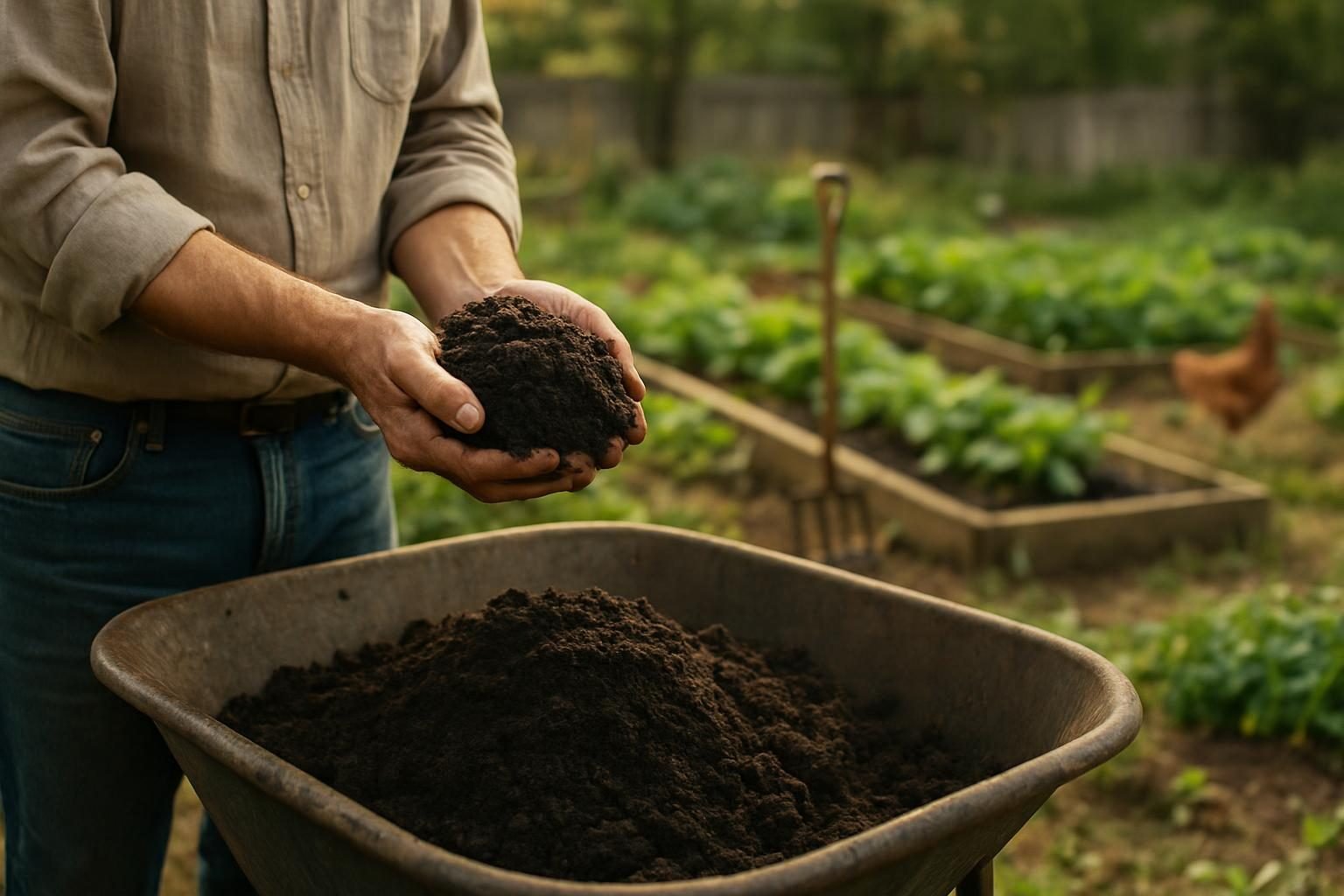
Finished compost is dark, crumbly and smells like forest soil, with no recognizable feedstock. Hot piles often finish the active phase in a few weeks but still need curing, which is a cooler, slower stage where stabilization finishes. Using immature compost can tie up nitrogen or harm seedlings.
A quick check is to bag a handful of damp compost for a day: a sour or ammonia smell means it needs more time. You can also sow a few radish or lettuce seeds in a pot of the compost to see whether they germinate cleanly. For a fuller read on what your compost is contributing, a soil test with biology and organic matter measures helps you track results over seasons. Compost is one lever among several for building soil organic matter, and gains take years, not weeks.
If you grow without tillage, finished compost is the classic top-dressing for beds. See our guide to no-dig gardening for how to layer it.
Scaling up for a market garden
A few buckets of scraps will not feed a half-acre of vegetables. Rough planning numbers vary widely by crop, soil and rate, so consult your extension service, but many growers apply compost in layers of roughly a quarter to one inch per season on intensive beds. Even a modest rate across thousands of square feet requires cubic yards of finished product, and finished compost shrinks to about half the original volume. For growers planning to start a CSA farm, these volumes are a key consideration in scaling production.
- Source feedstocks reliably: Local stables, dairies, breweries, coffee roasters, arborists and municipal leaf programs often give material away. Vet it for herbicide residues, especially persistent aminopyralid and clopyralid in hay and manure.
- Work in windrows: A tractor with a loader, or a dedicated compost turner, makes turning realistic at scale.
- Use a three-stage system: One pile building, one actively cooking, one curing, so you always have finished compost coming.
- Keep records: Log temperatures, turning dates and inputs. This also supports food safety plans and certification audits.
- Weigh the economics: Compare your labor, fuel and equipment time against buying compost. See our step-by-step plan to start a market garden for how to budget inputs, and think about which crops justify the investment using our guide to the most profitable crops for small farms.
If you keep animals, your composting system and your livestock plan are linked. Poultry bedding and manure make excellent high-nitrogen feedstock; see our guide to pastured poultry, and watch for our upcoming piece on regenerative backyard chickens. For small-scale kitchen waste, vermicomposting is a good complement when you do not have enough volume to heat a pile. Urban growers should also see our overview of urban farming, and check local rules on composting in city limits.
The Johnson-Su bioreactor: a different approach
The Johnson-Su bioreactor is a passive, aerated bin system developed by researchers David Johnson and Hui-Chun Su. Instead of turning, you build a pile in a wire-mesh cylinder, usually with a perforated pipe for airflow, keep it moist, and leave it for about a year. It stays cooler than a hot pile and aims to encourage fungal-dominated biology.
It is low labor but slow, and its benefits for crop performance are still being studied. Treat claims with caution and evaluate it on your own farm. It suits growers who want a biology-rich amendment or inoculant and can wait, while hot composting suits those who need volume and speed.
Key takeaways
- Build at least 3 x 3 x 3 feet, with roughly 25-30:1 carbon to nitrogen.
- Keep moisture like a wrung-out sponge and let air in.
- Target 130-150°F, turn when the core falls, and cure before use.
- Verify food safety and organic requirements with your certifier, extension service or the USDA.
- Watch for herbicide residues in hay and manure before you build.
- Scale with windrows and a three-stage system; compare costs to buying compost.
For more guides on growing on a small footprint, browse our Small and Urban Farms section. If you are planning season extension to pair with a steady compost supply, keep an eye out for our guide to the hoop house.
Frequently asked questions
How long does hot composting take?
Typically four to ten weeks of active composting with regular turning, plus two to four weeks of curing. Smaller piles, cold weather or poor ratios stretch that timeline.
How often should I turn a hot compost pile?
Turn when the core temperature peaks and begins to fall below about 130°F, usually every three to seven days early on, then less often. If the pile smells bad or heats unevenly, turn sooner and adjust moisture.
Can I hot compost meat, dairy and bones?
It is possible in a well-managed, hot, enclosed system, but these items attract rodents and flies and can create odors. Most small growers skip them. Check local ordinances and, for commercial farms, food safety guidance.
Does hot composting kill weed seeds and diseases?
Sustained temperatures above about 131°F kill most weed seeds and many pathogens, but only if every part of the pile reaches that heat, which is why turning outside material into the center matters. Some persistent herbicides and a few plant diseases are not eliminated by composting.
What is the difference between hot composting and a Johnson-Su bioreactor?
Hot composting is active and fast, with turning and high temperatures. A Johnson-Su bioreactor is passive and slow, relying on airflow and moisture over roughly a year, and runs cooler. The two serve different goals and can be used together.